Chapter 14
Aircraft Fuel Systems
Aircraft and engine manufacturers designate approved fuels for each aircraft and engine. Consult manufacturer data and use only those fuel specified therein.
The existence of more than one fuel makes it imperative that fuel be positively identified and never introduced into a fuel system that is not designed for it. The use of dyes in fuel helps aviators monitor fuel type. 100LL AVGAS is the AVGAS most readily available and used in the United States. It is dyed blue. Some 100 octane or 100/130 fuel may still be available, but it is dyed green.
80/87 AVGAS is no longer available. It was dyed red. Many supplemental type certificates have been issued to engine and engine/airframe combinations that permit the use of automobile gasoline in engines originally designed for red AVGAS. A relatively new AVGAS fuel, 82UL (unleaded), has been introduced for use by this group of relatively low compression engines. It is dyed purple.
115/145 AVGAS is a fuel designed for large, high performance reciprocating engines from the World War II era. It is available only by special order from refineries and is also dyed purple in color.
The color of fuel may be referred to in older maintenance manuals. All grades of jet fuel are colorless or straw colored. This distinguishes them from AVGAS of any kind that contains dye of some color. Should AVGAS fuel not be of a recognizable color, the cause should be investigated. Some color change may not affect the fuel. Other times, a color change may be a signal that fuels have been mixed or contaminated in some way. Do not release an aircraft for flight with unknown fuel onboard.
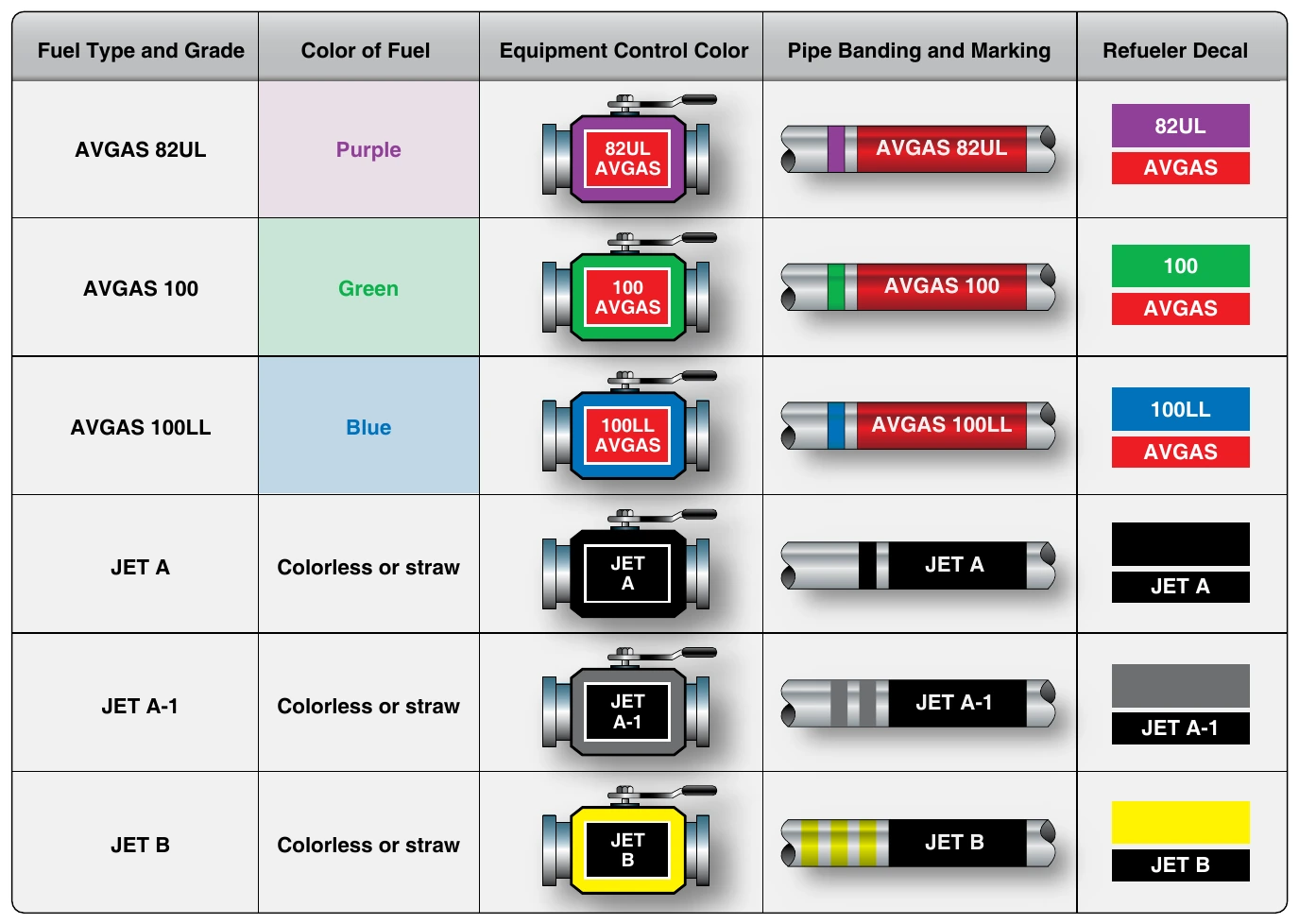
Identifying fuel and ensuring the correct fuel is delivered into storage tanks, fuel trucks, and aircraft fuel tanks is a process aided by labeling. Decals and markings using the same colors as the AVGAS colors are used. Delivery trucks and hoses are marked as are aircraft tank fuel caps and fill areas. Jet fuel fill hose nozzles are sized too large to fit into an AVGAS tank fill opening. Figure 14-8 shows examples of color-coded fuel labeling.
Purity
The use of filters in the various stages of transfer and storage of AVGAS removes most foreign sediment from the fuel. Once in the aircraft fuel tanks, debris should settle into the fuel tank drain sumps to be removed before flight. Filters and strainers in the aircraft fuel system can successfully capture any remaining sediment.
The purity of aviation gasoline is compromised most often by water. Water also settles into the sumps given enough time. However, water is not removed by the aircraft’s filters and strainers as easily as solid particles. It can enter the fuel even when the aircraft is parked on the ramp with the fuel caps in place. Air in the tank vapor space above the liquid fuel contains water vapor. Temperature fluctuations cause the water vapor to condense on the inner surface of the tanks and settle into the liquid fuel. Eventually, this settles to the sump, but some can remain in the fuel when the aircraft is to be flown.
Proper procedure for minimizing water entering aircraft fuel is to fill the aircraft fuel tanks immediately after each flight. This minimizes the size of the vapor space above the liquid fuel and the amount of air and associated water vapor present in the tank. When excessive water is drawn into the fuel system, it passes through carburetor jets where it can interrupt the smooth operation of the engine(s).
If water is entrained or dissolved in the fuel, it cannot be removed by draining the sump(s) and filter bowls before flight. However, there may be enough water for icing to be a concern. As the aircraft climbs and fuel is drawn out of the tanks, the fuel supply cools. Entrained and dissolved water in the fuel is forced out of solution and becomes free water. If cool enough, ice crystals form rather than liquid water. These can clog filters and disrupt fuel flow to the engines. Both AVGAS and jet fuel have this type of water impurity issue leading to icing that must be monitored and treated.
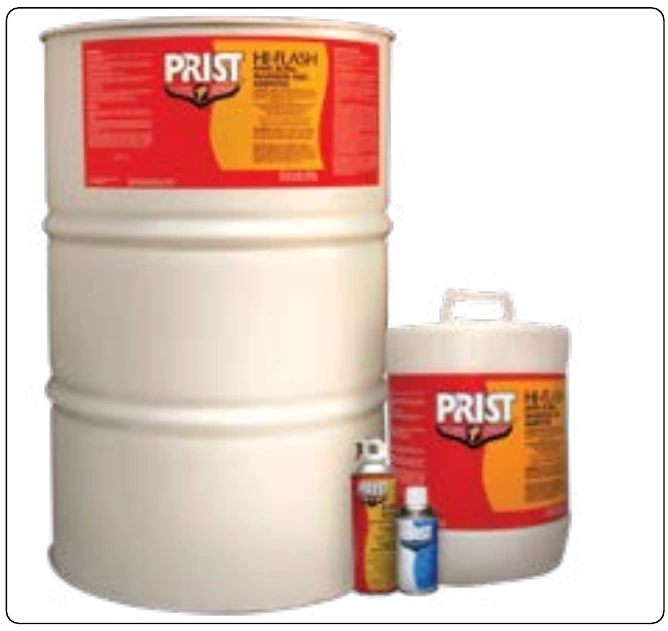
Fuel anti-ice additives can be added to the bulk fuel and also directly into the aircraft fuel tank, usually during refueling. These are basically diethylene glycol solutions that work as antifreeze. They dissolve in free water as it comes out of the fuel and lower its freezing point. [Figure 14-9]
Turbine Engine Fuels
Aircraft with turbine engines use a type of fuel different from that of reciprocating aircraft engines. Commonly known as jet fuel, turbine engine fuel is designed for use in turbine engines and should never be mixed with aviation gasoline or introduced into the fuel system of a reciprocating aircraft engine fuel system.
The characteristics of turbine engine fuels are significantly different from those of AVGAS. Turbine engine fuels are hydrocarbon compounds of higher viscosity with much lower volatility and higher boiling points than gasoline. In the distillation process from crude oil, the kerosene cut from which jet fuel is made condenses at a higher temperature than the naphtha or gasoline cuts. The hydrocarbon molecules of turbine engine fuels are composed of more carbon than are in AVGAS. [Figure 14-10]
Turbine engine fuels sustain a continuous flame inside the engine. They typically have a higher sulfur content than gasoline, and various inhibitors are commonly added to them. Used to control corrosion, oxidation, ice, and microbial and bacterial growth, these additives often are already in the fuel when it arrives at the airport for use.
Turbine Fuel Volatility
The choice of turbine engine fuel reflects consideration of conflicting factors. While it is desirable to use a fuel that is low in volatility to resist vapor lock and evaporation while in the aircraft’s fuel tanks, turbine engine aircraft operate in cold environments. Turbine engines must start readily and be able to restart while in flight. Fuel with high volatility makes this easier.