
Chapter 17
Fire Protection Systems
Smoke Detectors
A smoke detection system monitors the lavatories and cargo baggage compartments for the presence of smoke, which is indicative of a fire condition. Smoke detection instruments that collect air for sampling are mounted in the compartments in strategic locations. A smoke detection system is used where the type of fire anticipated is expected to generate a substantial amount of smoke before temperature changes are sufficient to actuate a heat detection system. Two common types used are light refraction and ionization.
Light Refraction Type
The light refraction type of smoke detector contains a photoelectric cell that detects light refracted by smoke particles. Smoke particles refract the light to the photoelectric cell and, when it senses enough change in the amount of light, it creates an electrical current that sets off a warning light. This type of smoke detector is referred to as a photoelectrical device.
Ionization Type
Some aircraft use an ionization type smoke detector. The system generates an alarm signal (both horn and indicator) by detecting a change in ion density due to smoke in the cabin. The system is connected to the 28-volt DC electrical power supplied from the aircraft. Alarm output and sensor sensitive checks are performed simply with the test switch on the control panel.
Flame Detectors
Optical sensors, often referred to as flame detectors, are designed to alarm when they detect the presence of prominent, specific radiation emissions from hydrocarbon flames. The two types of optical sensors available are infrared (IR) and ultraviolet (UV), based on the specific emission wavelengths that they are designed to detect. IR-based optical flame detectors are used primarily on light turboprop aircraft and helicopter engines. These sensors have proven to be very dependable and economical for these applications.
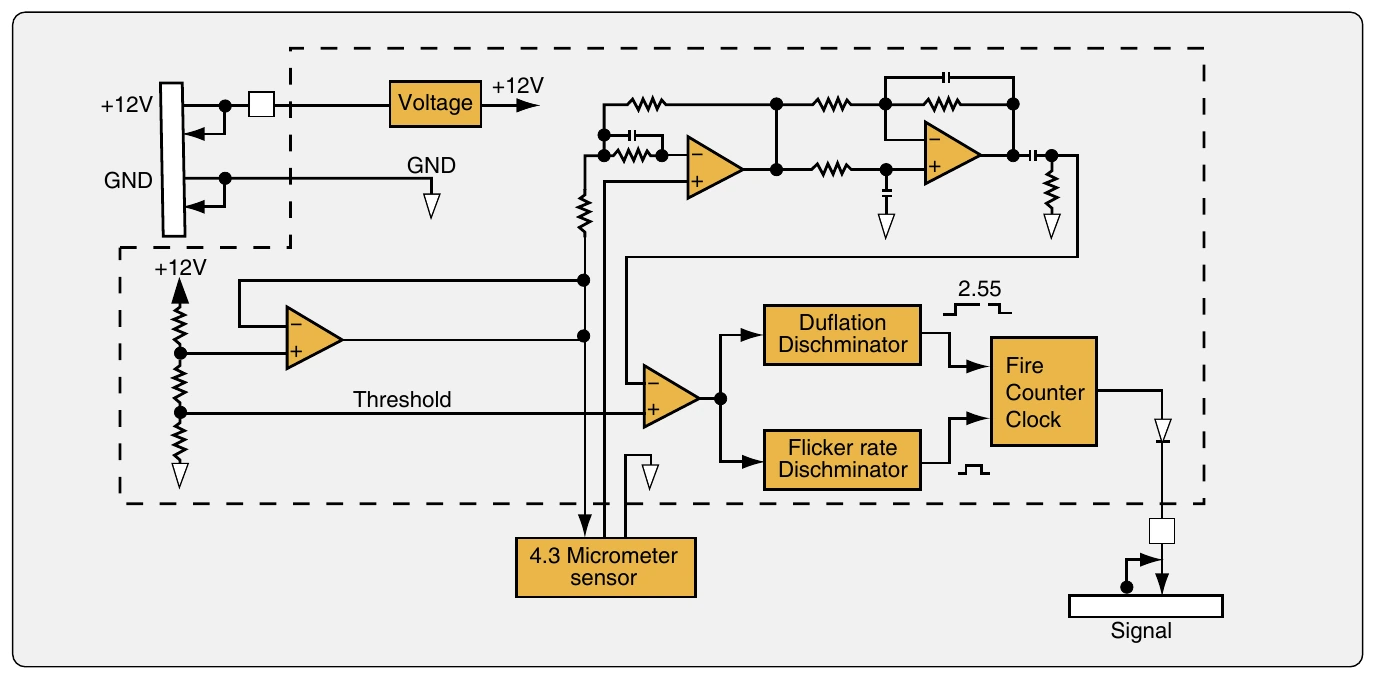
When radiation emitted by the fire crosses the airspace between the fire and the detector, it impinges on the detector front face and window. The window allows a broad spectrum of radiation to pass into the detector where it strikes the sensing device filter. The filter allows only radiation in a tight waveband centered on 4.3 micrometers in the IR band to pass on to the radiation-sensitive surface of the sensing device. The radiation striking the sensing device minutely raises its temperature causing small thermoelectric voltages to be generated. These voltages are fed to an amplifier whose output is connected to various analytical electronic processing circuits. The processing electronics are tailored exactly to the time signature of all known hydrocarbon flame sources and ignores false alarm sources, such as incandescent lights and sunlight. Alarm sensitivity level is accurately controlled by a digital circuit. [Figure 17-9]
Carbon Monoxide Detectors
Carbon monoxide is a colorless, odorless gas that is a byproduct of incomplete combustion. Its presence in the breathing air of human beings can be deadly. To ensure crew and passenger safety, carbon monoxide detectors are used in aircraft cabins and flight decks. They are most often found on reciprocating engine aircraft with exhaust shroud heaters and on aircraft equipped with a combustion heater. Turbine bleed air, when used for heating the cabin, is tapped off of the engine upstream of the combustion chamber. Therefore, no threat of carbon monoxide presence is posed.
Carbon monoxide gas is found in varying degrees in all smoke and fumes of burning carbonaceous substances. Exceedingly small amounts of the gas are dangerous if inhaled. A concentration of as little as 2 parts in 10,000 may produce headache, mental dullness, and physical lethargy within a few hours. Prolonged exposure or higher concentrations may cause death.
There are several types of carbon monoxide detectors. Electronic detectors are common. Some are panel mounted and others are portable. Chemical color-change types are also common. These are mostly portable. Some are simple buttons, cards, or badges that have a chemical applied to the surface. Normally, the color of the chemical is tan. In the presence of carbon monoxide, the chemical darkens to grey or even black. The transition time required to change color is inversely related to the concentration of CO present. At 50 parts per million, the indication is apparent within 15 to 30 minutes. A concentration of 100 parts per million changes the color of the chemical in as little as 2–5 minutes. As concentration increases or duration of exposure is prolonged, the color evolves from grey to dark grey to black. If contaminated, installing a new indicating element allows a carbon monoxide portable test unit to be returned to service.
Extinguishing Agents & Portable Fire Extinguishers
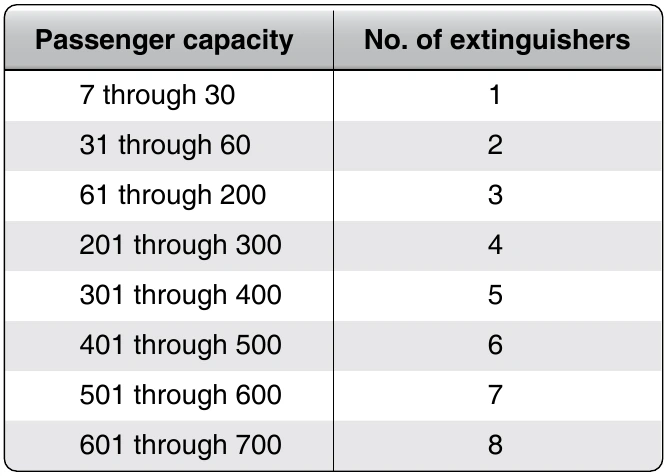
There must be at least one hand held, portable fire extinguisher for use in the pilot compartment that is located within easy access of the pilot while seated. There must be at least one hand held fire extinguisher located conveniently in the passenger compartment of each airplane accommodating more than 6 and less than 30 passengers. Each extinguisher for use in a personnel compartment must be designed to minimize the hazard of toxic gas concentrations. The number of portable, hand held fire extinguishers for transport aircraft is shown in Figure 17-10.
Halogenated Hydrocarbons
For over 45 years, halogenated hydrocarbons (Halons) have been practically the only fire extinguishing agents used in civil transport aircraft. However, Halon is an ozone depleting and global warming chemical, and its production has been banned by international agreement. Although Halon usage has been banned in some parts of the world, aviation has been granted an exemption because of its unique operational and fire safety requirements. Halon has been the fire extinguishing agent of choice in civil aviation because it is extremely effective on a per unit weight basis over a wide range of aircraft environmental conditions. It is a clean agent (no residue), electrically nonconducting, and has relatively low toxicity.
Two types of Halons are employed in aviation: Halon 1301(CBrF3) a total flooding agent, and Halon 1211 (CBrClF2) a streaming agent. Class A, B, or C fires are appropriately controlled with Halons. However, do not use Halons on a class D fire. Halon agents may react vigorously with the burning metal.