
Chapter 17
Fire Protection Systems
The thermal discharge indicator is connected to the fire container relief fitting and ejects a red disc to show when container contents have dumped overboard due to excessive heat. The agent discharges through the opening left when the disc blows out. This gives the flight and maintenance crews an indication that the fire extinguisher container needs to be replaced before next flight.
Yellow Disc Discharge Indicator
If the flight crew activates the fire extinguisher system, a yellow disc is ejected from the skin of the aircraft fuselage. This is an indication for the maintenance crew that the fire extinguishing system was activated by the flight crew, and the fire extinguishing container needs to be replaced before next flight.
Fire Switch
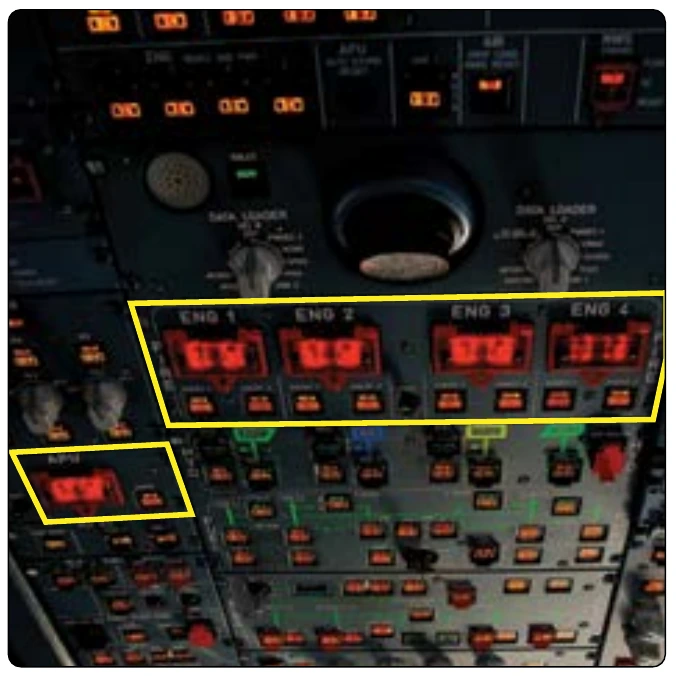
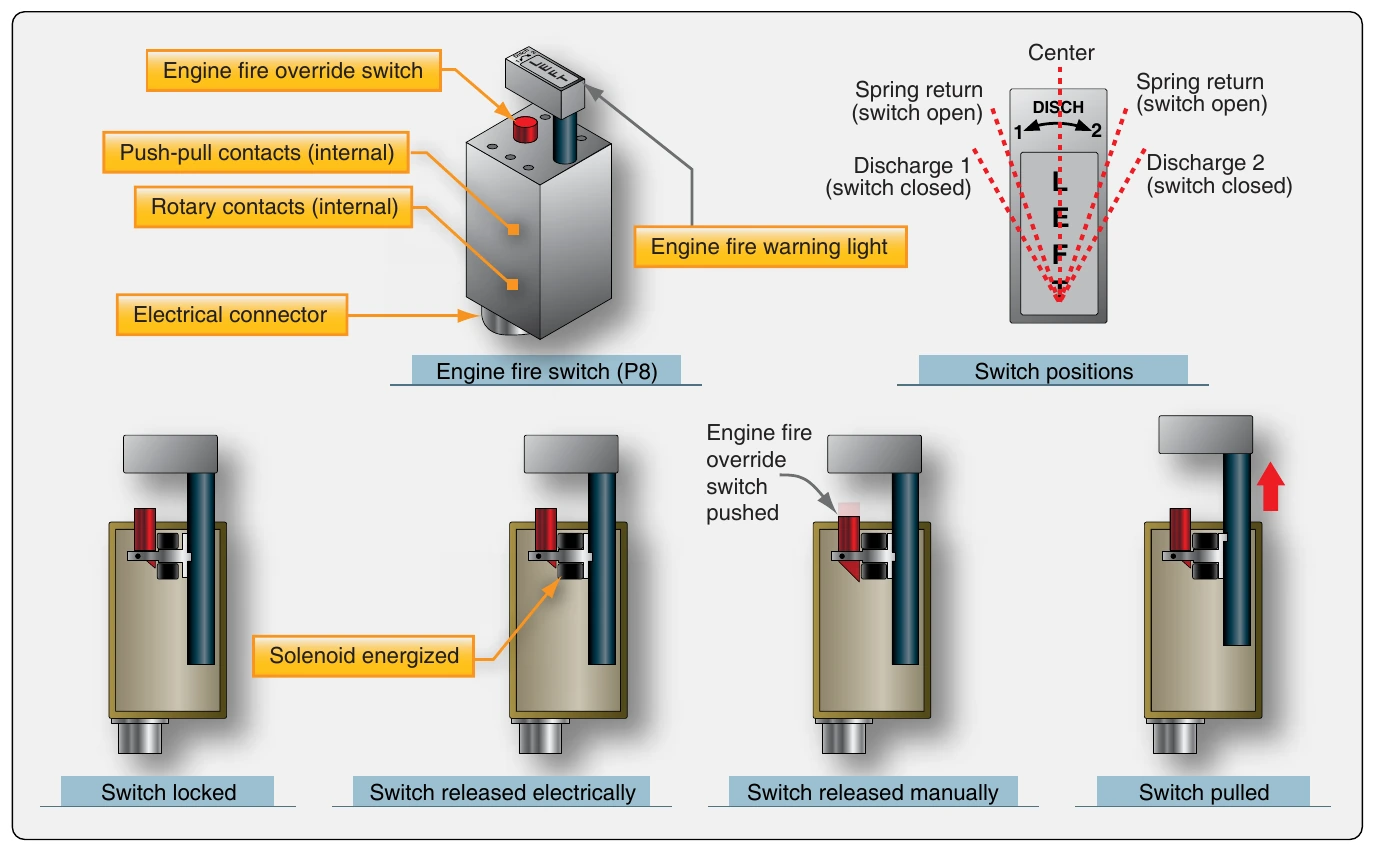
The engine and APU fire switches are typically installed on the center overhead panel or center console in the flight deck. [Figure 17-16] When an engine fire switch is activated, the following happens: the engine stops because the fuel control shuts off, the engine is isolated from the aircraft systems, and the fire extinguishing system is activated. Some aircraft use fire switches that need to be pulled and turned to activate the system, while others use a push-type switch with a guard. To prevent accidental activation of the fire switch, a lock is installed that releases the fire switch only when a fire has been detected. This lock can be manually released by the flight crew if the fire detection system malfunctions. [Figure 17-17]
Cargo Fire Detection
Transport aircraft need to have the following provisions for each cargo or baggage compartment:
- The detection system must provide a visual indication to the flight crew within 1 minute after the start of a fire.
- The system must be capable of detecting a fire at a temperature significantly below that at which the structural integrity of the airplane is substantially decreased.
- There must be means to allow the crew to check, in flight, the functioning of each fire detector circuit.
Cargo Compartment Classification
Class A
A Class A cargo or baggage compartment is one in which the presence of a fire would be easily discovered by a crewmember while at his or her station and each part of the compartment is easily accessible in flight.
Class B
A Class B cargo, or baggage compartment, is one in which there is sufficient access in flight to enable a crewmember to effectively reach any part of the compartment with the contents of a hand fire extinguisher. When the access provisions are being used, no hazardous quantity of smoke, flames, or extinguishing agent enters any compartment occupied by the crew or passengers. There is a separate approved smoke detector or fire detector system to give warning at the pilot or flight engineer station.
Class C
A Class C cargo, or baggage compartment, is one not meeting the requirements for either a Class A or B compartment but in which:
- There is a separate approved smoke detector or fire detector system to give warning at the pilot or flight engineer station.
- There is an approved built-in fire extinguishing or suppression system controllable from the flight deck.
- There are means to exclude hazardous quantities of smoke, flames, or extinguishing agent from any compartment occupied by the crew or passengers.
- There are means to control ventilation and drafts within the compartment so that the extinguishing agent used can control any fire that may start within the compartment.