
Chapter 4
Aircraft Metal Structural Repair
Pens
Fiber-tipped pens are the preferred method of marking lines and hole locations directly on aluminum, because the graphite in a No. 2 pencil can cause corrosion when used on aluminum. Make the layout on the protective membrane if it is still on the material, or mark directly on the material with a fiber-tipped pen, such as a fine-point Sharpie®, or cover the material with masking tape and then mark on the tape.
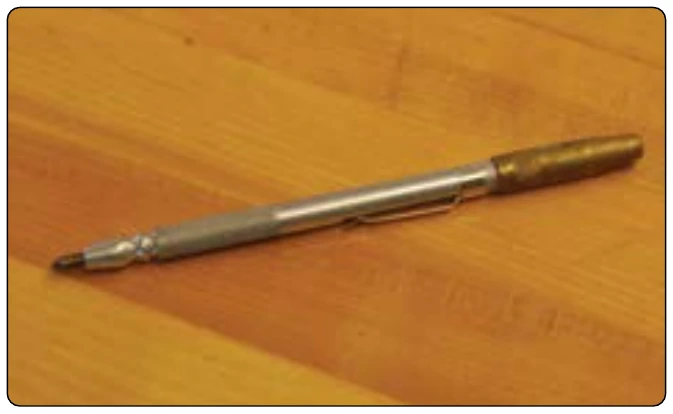
Scribes
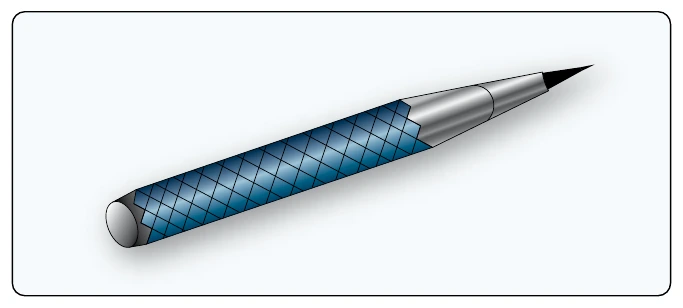
A scribe is a pointed instrument used to mark or score metal to show where it is to be cut. A scribe should only be used when marks will be removed by drilling or cutting because it makes scratches that weaken the material and could cause corrosion. [Figure 4-7]
Punches
Punches are usually made of carbon steel that has been hardened and tempered. Generally classified as solid or hollow, punches are designed according to their intended use. A solid punch is a steel rod with various shapes at the end for different uses. For example, it is used to drive bolts out of holes, loosen frozen or tight pins and keys, knock out rivets, pierce holes in a material, etc. The hollow punch is sharp edged and used most often for cutting out blanks. Solid punches vary in both size and point design, while hollow punches vary in size.
Prick Punch
A prick punch is primarily used during layout to place reference marks on metal because it produces a small indentation. [Figure 4-8] After layout is finished, the indentation is enlarged with a center punch to allow for drilling. The prick punch can also be used to transfer dimensions from a paper pattern directly onto the metal. Take the following precautions when using a prick punch:
- Never strike a prick punch a heavy blow with a hammer because it could bend the punch or cause excessive damage to the item being worked.
- Do not use a prick punch to remove objects from holes because the point of the punch spreads the object and causes it to bind even more.
Center Punch
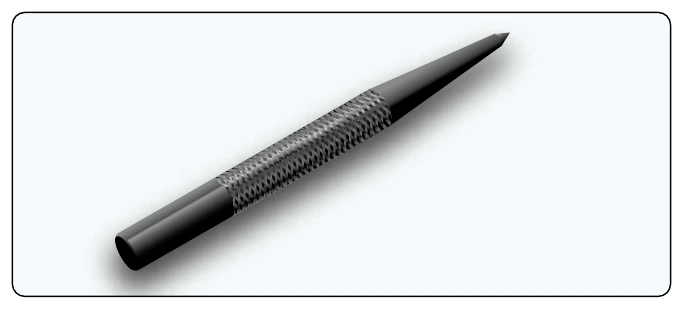
A center punch is used to make indentations in metal as an aid in drilling. [Figure 4-9] These indentations help the drill, which has a tendency to wander on a flat surface, stay on the mark as it goes through the metal. The traditional center punch is used with a hammer, has a heavier body than the prick punch, and has a point ground to an angle of about 60°. Take the following precautions when using a center punch:
- Never strike the center punch with enough force to dimple the item around the indentation or cause the metal to protrude through the other side of the sheet.
- Do not use a center punch to remove objects from holes because the point of the punch spreads the object and causes it to bind even more.
Automatic Center Punch
The automatic center punch performs the same function as an ordinary center punch, but uses a spring tension mechanism to create a force hard enough to make an indentation without the need for a hammer. The mechanism automatically strikes a blow of the required force when placed where needed and pressed. This punch has an adjustable cap for regulating the stroke; the point can be removed for replacement or sharpening. Never strike an automatic center punch with a hammer. [Figure 4-10]