
Chapter 4
Aircraft Metal Structural Repair
Friction-lock blind rivets are less expensive than mechanical-lock blind rivets and are sometimes used for nonstructural applications. Inspection of friction-lock blind rivets is visual. A more detailed discussion on how to inspect riveted joints can be found later in this chapter. Removal of friction-lock blind rivets consists of punching out the friction-lock stem and then treating it like any other rivet.
Mechanical-Lock Blind Rivets
The self-plugging, mechanical-lock blind rivet was developed to prevent the problem of losing the center stem due to vibration. This rivet has a device on the puller or rivet head that locks the center stem into place when installed. Bulbed, self-plugging, mechanically-locked blind rivets form a large, blind head that provides higher strength in thin sheets when installed. They may be used in applications where the blind head is formed against a dimpled sheet.
Manufacturers such as Cherry® Aerospace (CherryMAX®, CherryLOCK®, Cherry SST®) and Alcoa Fastening Systems (Huck-Clinch®, HuckMax®, Unimatic®) make many variations of this of blind rivet. While similar in design, the tooling for these rivets is often not interchangeable.
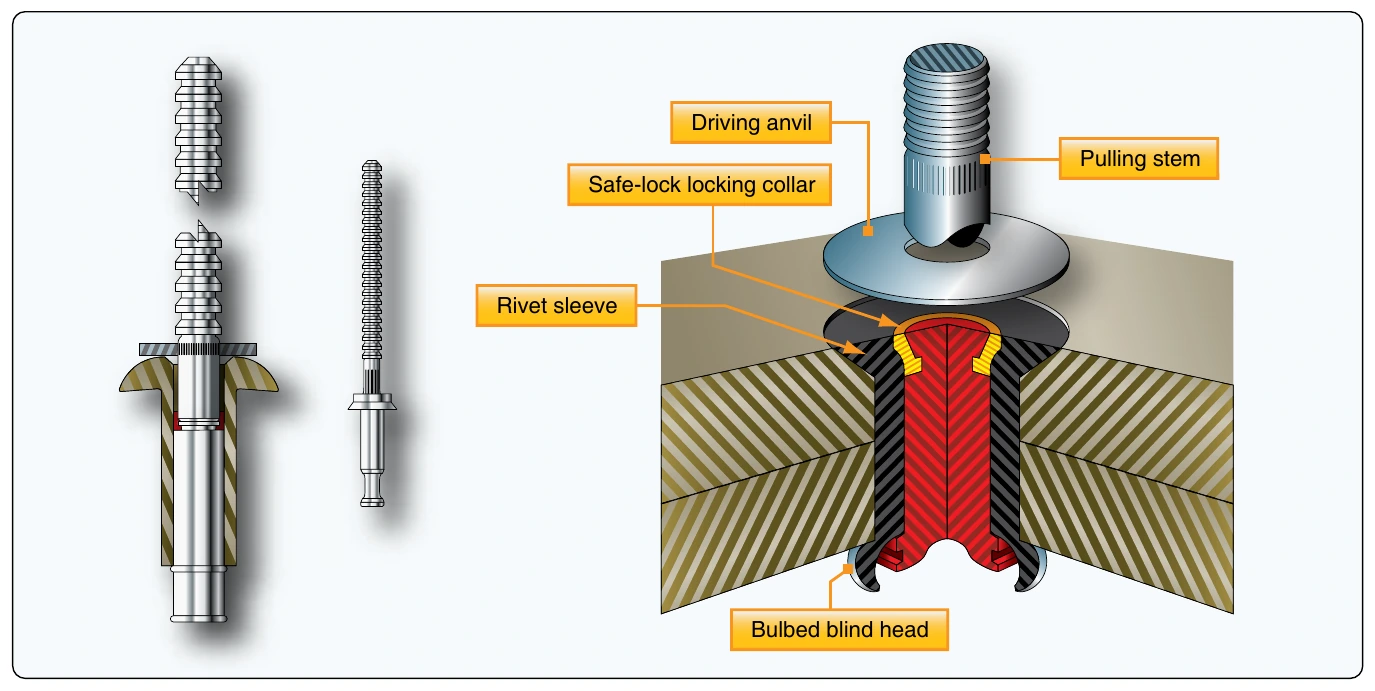
The CherryMAX® Bulbed blind rivet is one of the earlier types of mechanical-lock blind rivets developed. Their main advantage is the ability to replace a solid shank rivet size for size. The CherryMAX® Bulbed blind rivet consists of four parts:
- A fully serrated stem with break notch, shear ring, and integral grip adjustment cone.
- A driving anvil to ensure a visible mechanical lock with each fastener installation.
- A separate, visible, and inspectable locking collar that mechanically locks the stem to the rivet sleeve.
- A rivet sleeve with recess in the head to receive the locking collar.
It is called a bulbed fastener due to its large blind side bearing surface, developed during the installation process. These rivets are used in thin sheet applications and for use in materials that may be damaged by other types of blind rivets. This rivet features a safe-lock locking collar for more reliable joint integrity. The rough end of the retained stem in the center on the manufactured head must never be filed smooth because it weakens the strength of the lockring, and the center stem could fall out.
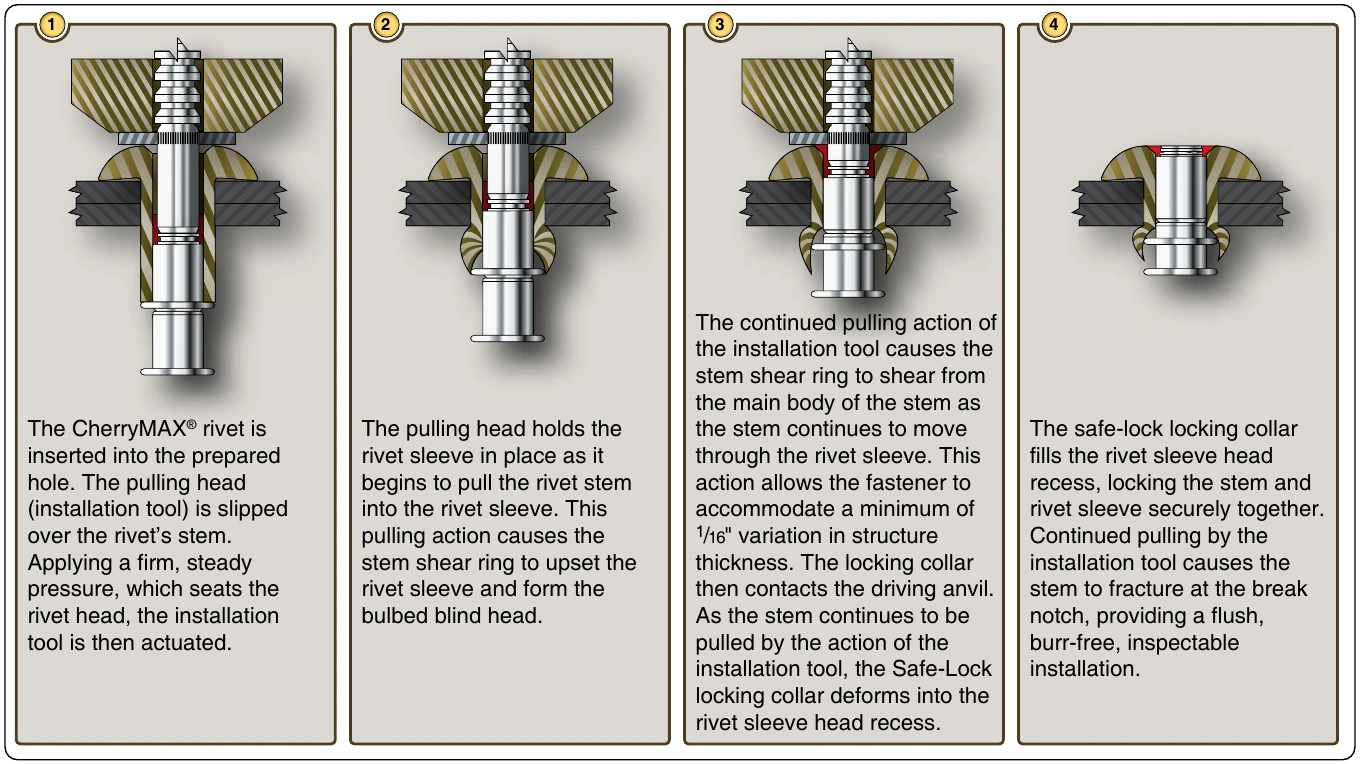
CherryMAX® bulbed rivets are available in three head styles: universal, 100° countersunk, and 100° reduced shear head styles. Their lengths are measured in increments of 1⁄16 inch. It is important to select a rivet with a length related to the grip length of the metal being joined. This blind rivet can be installed using either the Cherry® G750A or the newly released Cherry® G800 hand riveters, or either the pneumatic-hydraulic G704B or G747 CherryMAX® power tools. For installation, please refer to Figure 4-102.
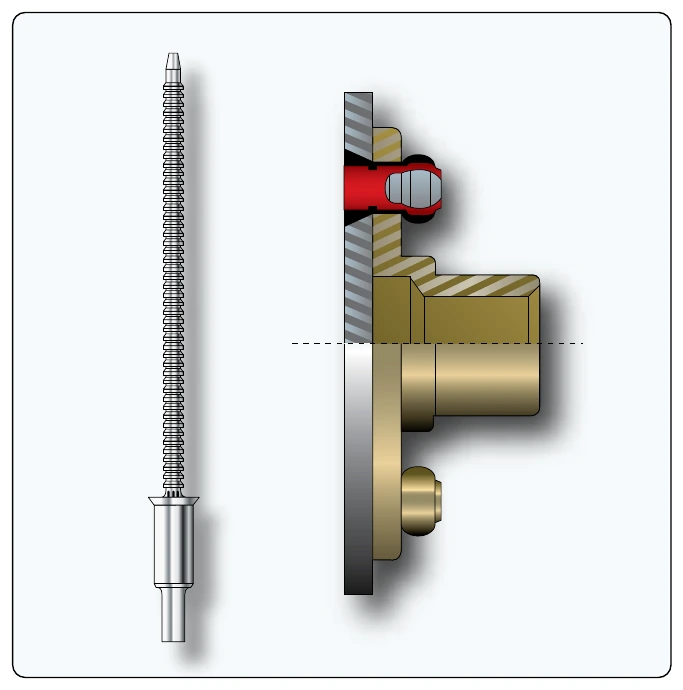
The CherryMAX® mechanical-lock blind rivet is popular with general aviation repair shops because it features the one tool concept to install three standard rivet diameters and their oversize counterparts. [Figure 4-103] CherryMAX® rivets are available in four nominal diameters: 1⁄8, 5⁄32, 3⁄16, and 1⁄4-inch and three oversized diameters and four head styles: universal, 100° flush head, 120° flush head, and NAS1097 flush head. This rivet consists of a blind header, hollow rivet shell, locking (foil) collar, driving anvil, and pulling stem complete with wrapped locking collar. The rivet sleeve and the driving washer blind bulbed header takes up the extended shank and forms the bucktail.
The stem and rivet sleeve work as an assembly to provide radial expansion and a large bearing footprint on the blind side of the fastened surface. The lock collar ensures that the stem and sleeve remain assembled during joint loading and unloading. Rivet sleeves are made from 5056 aluminum, Monel® and INCO 600. The stems are made from alloy steel, CRES, and INCO® X-750. CherryMAX® rivets have an ultimate shear strength ranging from 50 KSI to 75 KSI.
Removal of Mechanically-Locked Blind Rivets
Mechanically-locked blind rivets are a challenge to remove because they are made from strong, hard metals. Lack of access poses yet another problem for the aviation technician. Designed for and used in difficult to reach locations means there is often no access to the blind side of the rivet or any way to provide support for the sheet metal surrounding the rivet’s location when the aviation technician attempts removal.
The stem is mechanically locked by a small lock ring that needs to be removed first. Use a small center drill to provide a guide for a larger drill on top of the rivet stem and drill away the upper portion of the stem to destroy the lock. Try to remove the lock ring or use a prick punch or center punch to drive the stem down a little and remove the lock ring. After the lock ring is removed, the stem can be driven out with a drive punch. After the stem is removed, the rivet can be drilled out in the same way as a solid rivet. If possible, support the back side of the rivet with a backup block to prevent damage to the aircraft skin.
Pin Fastening Systems (High-Shear Fasteners)
A pin fastening system, or high-shear pin rivet, is a two-piece fastener that consists of a threaded pin and a collar. The metal collar is swaged onto the grooved end, effecting a firm tight fit. They are essentially threadless bolts.
High-shear rivets are installed with standard bucking bars and pneumatic riveting hammers. They require the use of a special gun set that incorporates collar swaging and trimming and a discharge port through which excess collar material is discharged. A separate size set is required for each shank diameter.