
Chapter 4
Aircraft Metal Structural Repair
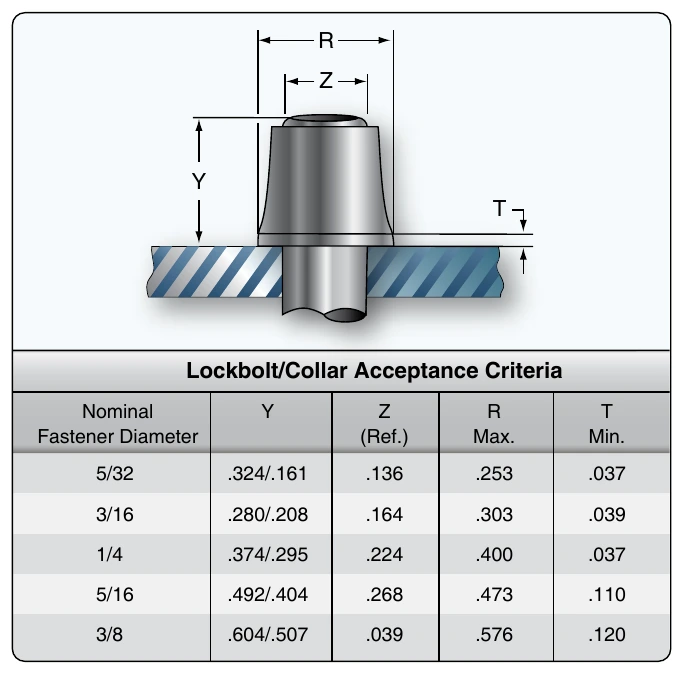
After installation, a lockbolt needs to be inspected to determine if installation is satisfactory. [Figure 4-108] Inspect the lockbolt as follows:
- The head must be firmly seated.
- The collar must be tight against the material and have the proper shape and size.
- Pin protrusion must be within limits.
Lockbolt Removal
The best way to remove a lockbolt is to remove the collar and
Q3,.------------ Q4 i.-----------
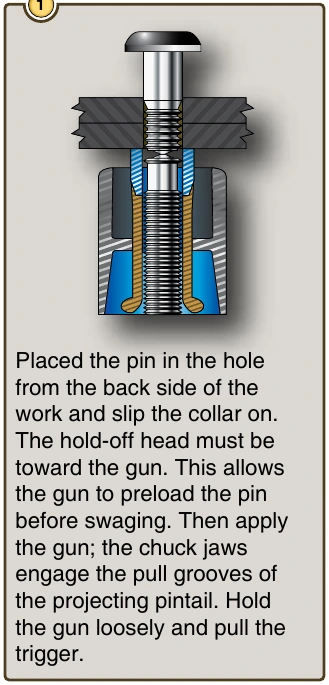
Further pull swages the collar into the locking grooves to form a permanent lock. Continued force breaks the pin and ejects the tail. Anvil returns and disengages from the swaged collar.
drive out the pin. The collar can be removed with a special collar cutter attached to a drill motor that mills off the collar without damaging the skin. If this is not possible, a collar splitter or small chisel can be used. Use a backup block on the opposite side to prevent elongation of the hole.
The Eddie-Bolt® 2 Pin Fastening System
The Eddie-Bolt® 2 looks similar to the Hi-Lok®, but has five flutes, equally spaced along a portion of the pin thread area. A companion threaded collar deforms into the flutes at a predetermined torque and locks the collar in place. The collar can be unscrewed using special tooling. This fastening system can be used in either clearance or interference-fit holes.
Blind Bolts
Bolts are threaded fasteners that support loads through pre-drilled holes. Hex, close-tolerance, and internal wrenching bolts are used in aircraft structural applications. Blind bolts have a higher strength than blind rivets and are used for joints that require high strength. Sometimes, these bolts can be direct replacements for the Hi-Lok® and lockbolt. Many of the new generation blind bolts are made from titanium and rated at 90 KSI shear strength, which is twice as much as most blind rivets.
Determining the correct length of the fastener is critical to correct installation. The grip length of a bolt is the distance from the underhead bearing surface to the first thread. The grip is the total thickness of material joined by the bolt. Ideally, the grip length should be a few thousands of an inch less than the actual grip to avoid bottoming the nut. Special grip gauges are inserted in the hole to determine the length of the blind bolt to be used. Every blind bolt system has its own grip gauge and is not interchangeable with other blind bolt or rivet systems.
Blind bolts are difficult to remove due to the hardness of the core bolt. A special removal kit is available from the manufacturer for removing each type of blind bolt. These kits make it easier to remove the blind bolt without damaging the hole and parent structure. Blind bolts are available in a pull-type and a drive-type.
Pull-Type Blind Bolt
Several companies manufacture the pull-type of blind bolt fastening systems. They may differ in some design aspects, but in general they have a similar function. The pull-type uses the drive nut concept and is composed of a nut, sleeve, and a draw bolt. Frequently used blind bolt systems include but are not limited to the Cherry Maxibolt® Blind Bolt system and the HuckBolt® fasteners which includes the Ti-Matic® Blind Bolt and the Unimatic® Advanced Bolt (UAB) blind bolt systems.
Cherry Maxibolt® Blind Bolt System
The Cherry Maxibolt® blind bolt, available in alloy steel and A-286 CRES materials, comes in four different nominal and oversized head styles. [Figure 4-109] One tool and pulling head installs all three diameters. The blind bolts create a larger blind side footprint and they provide excellent performance in thin sheet and nonmetallic applications. The flush breaking stem eliminates shaving while the extended grip range accommodates different application thicknesses. Cherry Maxibolts® are primarily used in structures where higher loads are required. The steel version is 112 KSI shear. The A286 version is 95 KSI shear. The Cherry® G83, G84, or G704 installation tools are required for installation.