
Chapter 4
Aircraft Metal Structural Repair
The Huck Blind Bolt is a high strength vibration-resistant fastener. [Figure 4-110] These bolts have been used successfully in many critical areas, such as engine inlets and leading edge applications. All fasteners are installed with a combination of available hand, pneumatic, pneudraulic, or hydraulic pull-type tools (no threads) for ease of installation.
Huck Blind Bolts can be installed on blind side angle surfaces up to 5° without loss of performance. The stem is mechanically locked to provide vibration-resistant FOD-free installations. The locking collar is forced into a conical pocket between stem and sleeve, creating high tensile capability. The lock collar fills the sleeve lock pocket to prevent leakage or corrosion pockets (crevice corrosion).
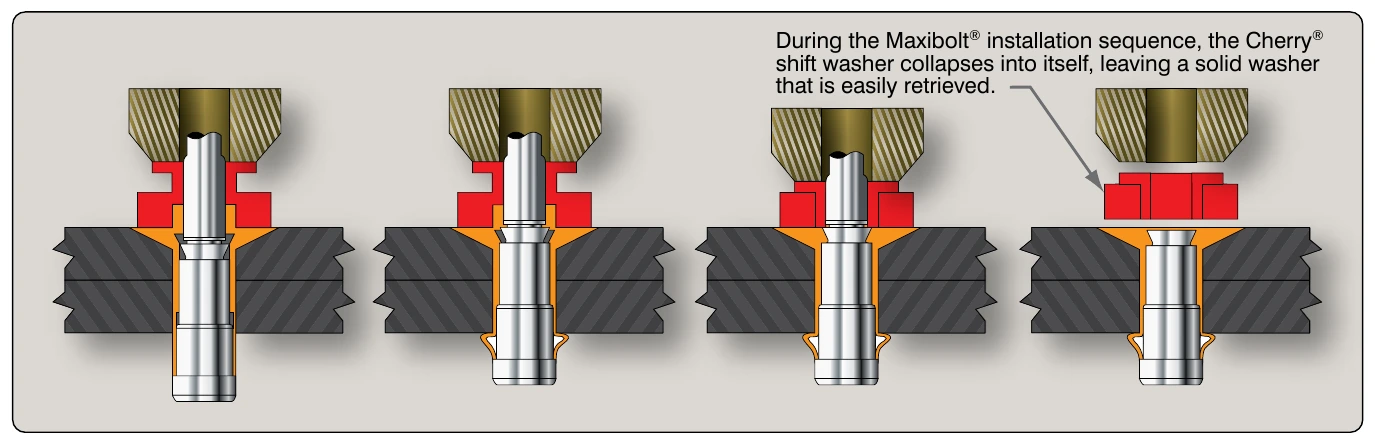
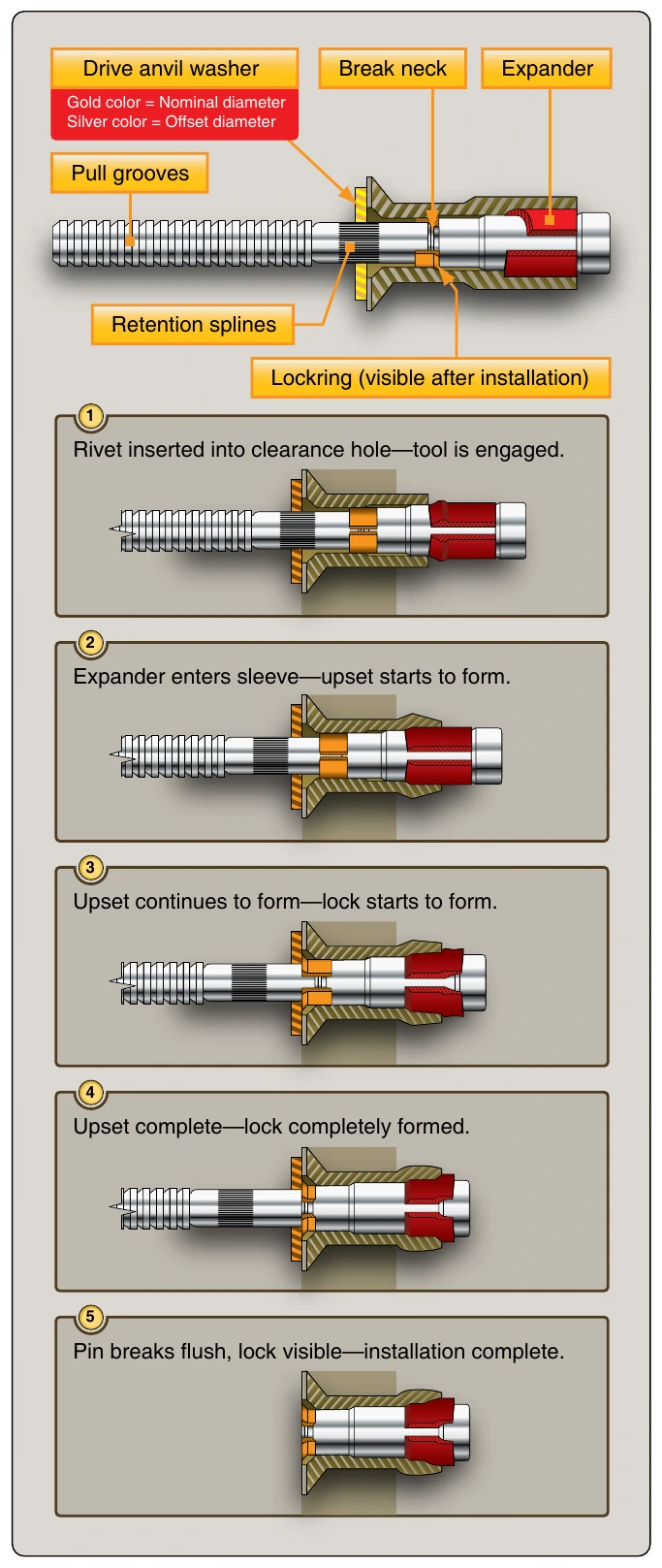
Flush head blind bolts are designed to install with a flush stem break that often requires no trimming for aerodynamic surfaces. The Huck Blind Bolt is available in high-strength A286 CRES at 95KSI shear strength in 5⁄32-inch through 3⁄8-inch diameters in 100° flush tension and protruding head. Also available are shear flush heads in 3⁄16-inch diameter. A286 CRES Huck Blind Bolts are also available in 1⁄64-inch oversize diameters for repair applications.
Drive Nut-Type of Blind Bolt
Jo-bolts, Visu-lok®, Composi-Lok®, OSI Bolt®, and Radial- Lok® fasteners use the drive nut concept and are composed of a nut, sleeve, and a draw bolt. [Figure 4-111] These types of blind bolts are used for high strength applications in metals and composites when there is no access to the blind side. Available in steel and titanium alloys, they are installed with special tooling. Both powered and hand tooling are available. During installation, the nut is held stationary while the core bolt is rotated by the installation tooling. The rotation of the core bolt draws the sleeve into the installed position and continues to retain the sleeve for the life of the fastener. The bolt has left hand threads and driving flats on the threaded end. A break-off relief allows the driving portion of the bolt to break off when the sleeve is properly seated. These types of bolts are available in many different head styles, including protruding head, 100° flush head, 130° flush head, and hex head.
Use the grip gauge available for the type of fastener and select the bolt grip after careful determination of the material thickness. The grip of the bolt is critical for correct installation. [Figure 4-112]
Installation procedure:
- Install the fastener into the hole, and place the installation tooling over the screw (stem) and nut.
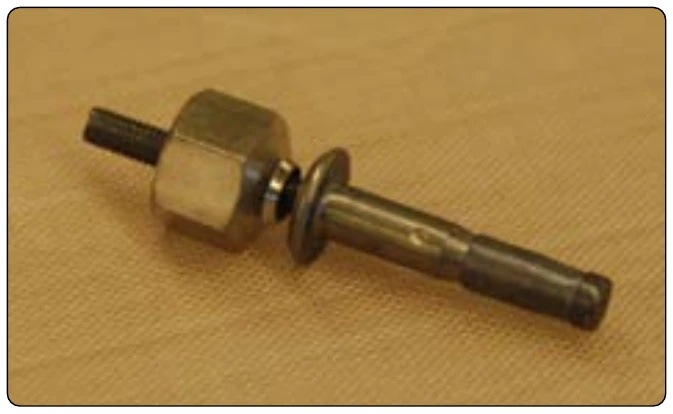
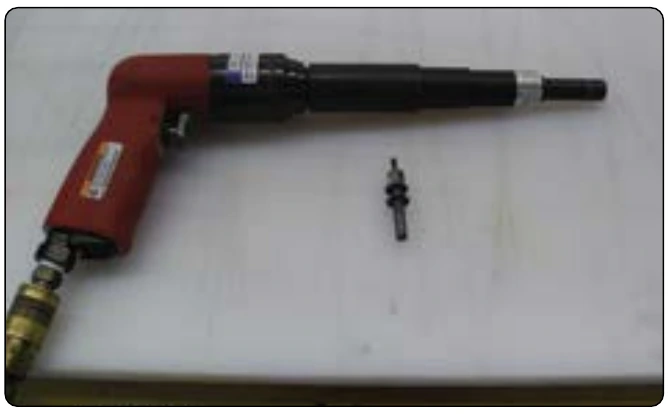
- Apply torque to the screw with the installation tool while keeping the drive nut stationary. The screw continues to advance through the nut body causing the sleeve to be drawn up over the tapered nose of the nut. When the sleeve forms tightly against the blind side of the structure, the screw fractures in the break groove. The stem of Jo-bolts, Visu-lok®, and Composi-Lok® II fasteners does not break off flush with the head. A screw break-off shaver tool must be used if a flush installation is required. The stem of the newer Composi-Lok3® and OSI Bolt® break off flush.
Tapered Shank Bolt
Tapered shank bolts, such as the Taper-Lok®, are lightweight, high strength shear or tension bolts. This bolt has a tapered shank designed to provide an interference fit upon installation. Tapered shank bolts can be identified by a round head (rather than a screwdriver slot or wrench flats) and a threaded shank. The Taper-Lok® is comprised of a tapered, conical-shank fastener, installed into a precision tapered hole. The use of tapered shank bolts is limited to special applications such as high stress areas of fuel tanks. It is important that a tapered bolt not be substituted for any other type of fastener in repairs. It is equally as important not to substitute any other type of fastener for a tapered bolt.
Tapered shank bolts look similar to Hi-Lok® bolts after installation, but the tapered shank bolts do not have the hex recess at the threaded end of the bolt. Tapered shank bolts are installed in precision-reamed holes, with a controlled interference fit. The interference fit compresses the material around the hole that results in excellent load transfer, fatigue resistance, and sealing. The collar used with the tapered shank bolts has a captive washer, and no extra washers are required. New tapered shank bolt installation or rework of tapered shank bolt holes needs to be accomplished by trained personnel. Properly installed, these bolts become tightly wedged and do not turn while torque is applied to the nut.
Sleeve Bolts
Sleeve bolts are used for similar purposes as tapered shank bolts, but are easier to install. Sleeve bolts, such as the two piece SLEEVbolt®, consist of a tapered shank bolt in an expandable sleeve. The sleeve is internally tapered and externally straight. The sleeve bolt is installed in a standard tolerance straight hole. During installation, the bolt is forced into the sleeve. This action expands the sleeve which fills the hole. It is easier to drill a straight tolerance hole than it is to drill the tapered hole required for a tapered shank bolt.
Rivet Nut
The rivet nut is a blind installed, internally-threaded rivet invented in 1936 by the Goodrich Rubber Company for the purpose of attaching a rubber aircraft wing deicer extrusion to the leading edge of the wing. The original rivet nut is the Rivnut® currently manufactured by Bollhoff Rivnut Inc. The Rivnut® became widely used in the military and aerospace markets because of its many design and assembly advantages.