
Chapter 4
Aircraft Metal Structural Repair
Open End Bend (Less Than 90°)
Figure 4-147 shows an example for a 45° bend.
Observe that the brake reference line is still located one radius from the bend tangent line.
Closed End Bend (More Than 90°)
Figure 4-148 shows an example of a 135° bend.
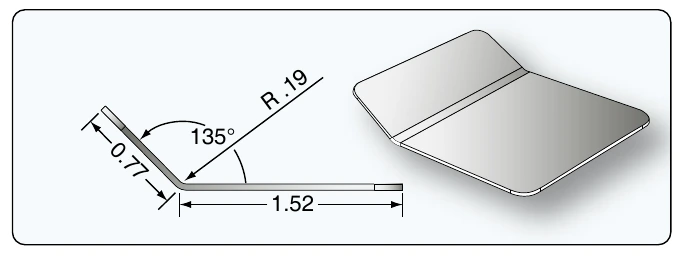
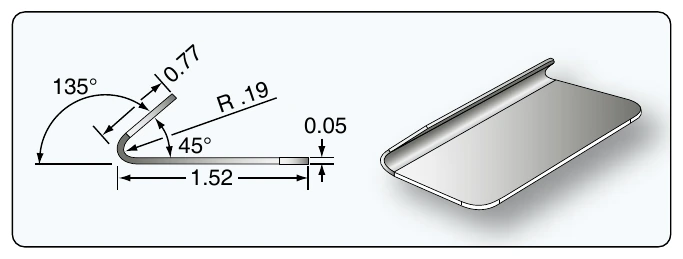
It is obvious from both examples that a closed bend has a smaller TDW than an open-end bend and the material length needs to be adjusted accordingly.
Hand Forming
All hand forming revolves around the processes of stretching and shrinking metal. As discussed earlier, stretching means to lengthen or increase a particular area of metal while shrinking means to reduce an area. Several methods of stretching and shrinking may be used, depending on the size, shape, and contour of the part being formed.
For example, if a formed or extruded angle is to be curved, either stretch one leg or shrink the other, whichever makes the part fit. In bumping, the material is stretched in the bulge to make it balloon, and in joggling, the material is stretched between the joggles. Material in the edge of lightening holes is often stretched to form a beveled reinforcing ridge around them. The following paragraphs discuss some of these techniques.
Straight Line Bends
The cornice brake and bar folder are ordinarily used to make straight bends. Whenever such machines are not available, comparatively short sections can be bent by hand with the aid of wooden or metal bending blocks.
After a blank has been laid out and cut to size, clamp it along the bend line between two wooden forming blocks held in a vise. The wooden forming blocks should have one edge rounded as needed for the desired radius of bend. It should also be curved slightly beyond 90° to allow for spring-back.
Bend the metal that protrudes beyond the bending block to the desired angle by tapping lightly with a rubber, plastic, or rawhide mallet. Start tapping at one end and work back and forth along the edge to make a gradual and even bend. Continue this process until the protruding metal is bent to the desired angle against the forming block. Allow for spring-back by driving the material slightly farther than the actual bend. If a large amount of metal extends beyond the forming blocks, maintain hand pressure against the protruding sheet to prevent it from bouncing. Remove any irregularities by holding a straight block of hardwood edgewise against the bend and striking it with heavy blows of a mallet or hammer. If the amount of metal protruding beyond the bending blocks is small, make the entire bend by using the hardwood block and hammer.