
Chapter 4
Aircraft Metal Structural Repair
Both formed and extruded types of angles can be curved (not bent sharply) by stretching or shrinking either of the flanges. Curving by stretching one flange is usually preferred since the process requires only a V-block and a mallet and is easily accomplished.
Stretching with V-Block Method
In the stretching method, place the flange to be stretched in the groove of the V-block. [Figure 4-149] (If the flange is to be shrunk, place the flange across the V-block.) Using a round, soft-faced mallet, strike the flange directly over the V portion with light, even blows while gradually forcing it downward into the V.
Begin at one end of the flange and form the curve gradually distributing the hammer blows at equal spaces on the flange. Hold the strip firmly to keep it from bouncing when hammered. An overly heavy blow buckles the metal, so keep moving the flange across the V-block, but always lightly strike the spot directly above the V.
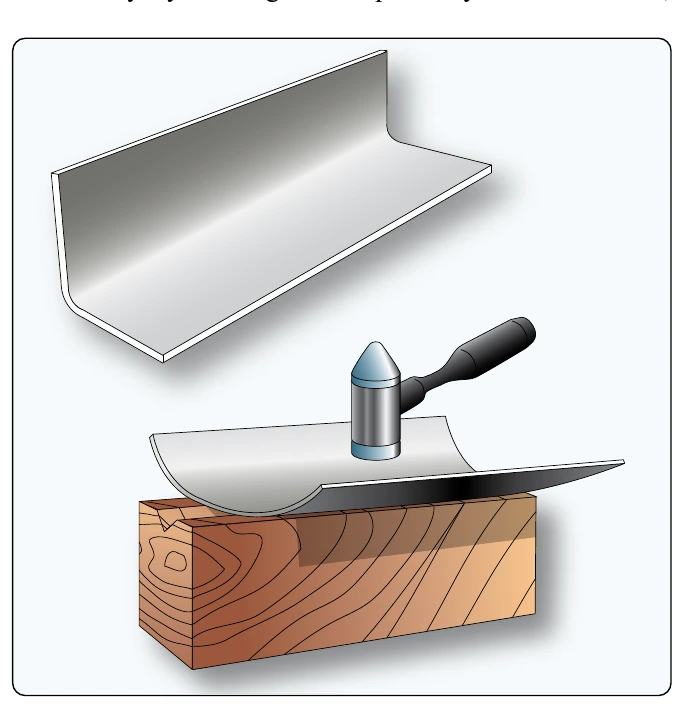
Lay out a full-sized, accurate pattern on a sheet of paper or plywood and periodically check the accuracy of the curve. Comparing the angle with the pattern determines exactly how the curve is progressing and just where it needs to be increased or decreased. It is better to get the curve to conform roughly to the desired shape before attempting to finish any one portion, because the finishing or smoothing of the angle may cause some other portion of the angle to change shape. If any part of the angle strip is curved too much, reduce the curve by reversing the angle strip on the V-block, placing the bottom flange up, and striking it with light blows of the mallet.
Try to form the curve with a minimum amount of hammering, for excessive hammering work hardens the metal. Work-hardening can be recognized by a lack of bending response or by springiness in the metal. It can be recognized very readily by an experienced worker. In some cases, the part may have to be annealed during the curving operation. If so, be sure to heat treat the part again before installing it on the aircraft.
Shrinking With V-Block & Shrinking Block Methods
Curving an extruded or formed angle strip by shrinking may be accomplished by either the previously discussed V-block method or the shrinking block method. While the V-block is more satisfactory because it is faster, easier, and affects the metal less, good results can be obtained by the shrinking block method.
In the V-block method, place one flange of the angle strip flat on the V-block with the other flange extending upward. Using the process outlined in the stretching paragraphs, begin at one end of the angle strip and work back and forth making light blows. Strike the edge of the flange at a slight angle to keep the vertical flange from bending outward.
Occasionally, check the curve for accuracy with the pattern. If a sharp curve is made, the angle (cross-section of the formed angle) closes slightly. To avoid such closing of the angle, clamp the angle strip to a hardwood board with the hammered flange facing upward using small C-clamps. The jaws of the C-clamps should be covered with masking tape. If the angle has already closed, bring the flange back to the correct angle with a few blows of a mallet or with the aid of a small hardwood block. If any portion of the angle strip is curved too much, reduce it by reversing the angle on the V-block and hammering with a suitable mallet, as explained in the previous paragraph on stretching. After obtaining the proper curve, smooth the entire angle by planishing with a soft-faced mallet.
If the curve in a formed angle is to be quite sharp or if the flanges of the angle are rather broad, the shrinking block method is generally used. In this process, crimp the flange that is to form the inside of the curve.
When making a crimp, hold the crimping pliers so that the jaws are about 1⁄8-inch apart. By rotating the wrist back and forth, bring the upper jaw of the pliers into contact with the flange, first on one side and then on the other side of the lower jaw. Complete the crimp by working a raised portion into the flange, gradually increasing the twisting motion of the pliers. Do not make the crimp too large because it will be difficult to work out. The size of the crimp depends upon the thickness and softness of the material, but usually about 1⁄4-inch is sufficient. Place several crimps spaced evenly along the desired curve with enough space left between each crimp so that jaws of the shrinking block can easily be attached.
After completing the crimping, place the crimped flange in the shrinking block so that one crimp at a time is located between the jaws. [Figure 4-150] Flatten each crimp with light blows of a soft-faced mallet, starting at the apex (the closed end) of the crimp and gradually working toward the edge of the flange. Check the curve of the angle with the pattern periodically during the forming process and again after all the crimps have been worked out. If it is necessary to increase the curve, add more crimps and repeat the process. Space the additional crimps between the original ones so that the metal does not become unduly work hardened at any one point. If the curve needs to be increased or decreased slightly at any point, use the V-block.
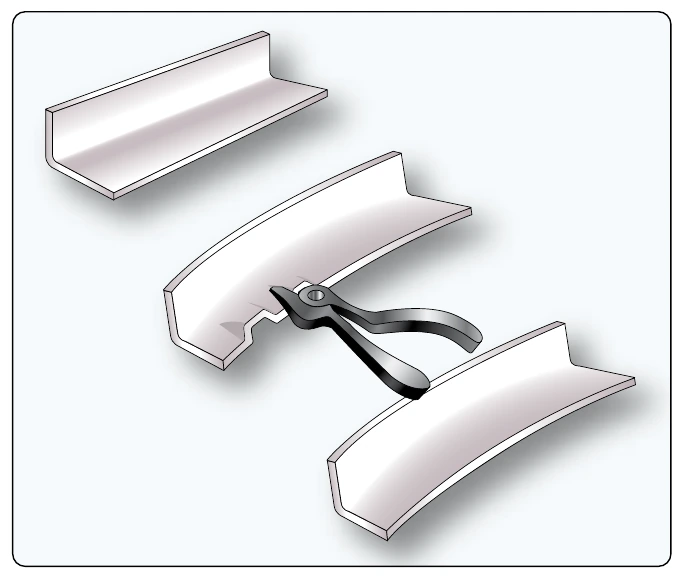
After obtaining the desired curve, planish the angle strip over a stake or a wooden form.
Flanged Angles
The forming process for the following two flanged angles is slightly more complicated than the previously discussed angles because the bend is shorter (not gradually curved) and necessitates shrinking or stretching in a small or concentrated area. If the flange is to point toward the inside of the bend, the material must be shrunk. If it is to point toward the outside, it must be stretched.
Shrinking
In forming a flanged angle by shrinking, use wooden forming blocks similar to those shown in Figure 4-151 and proceed as follows: