
Chapter 4
Aircraft Metal Structural Repair
Working Stainless Steel
Corrosion-resistant-steel (CRES) sheet is used on some parts of the aircraft when high strength is required. CRES causes magnesium, aluminum, or cadmium to corrode when it touches these metals. To isolate CRES from magnesium and aluminum, apply a finish that gives protection between their mating surfaces. It is important to use a bend radius that is larger than the recommended minimum bend radius to prevent cracking of the material in the bend area.
When working with stainless steel, make sure that the metal does not become unduly scratched or marred. Also, take special precautions when shearing, punching, or drilling this metal. It takes about twice as much pressure to shear or punch stainless steel as it does mild steel. Keep the shear or punch and die adjusted very closely. Too much clearance permits the metal to be drawn over the edge of the die and causes it to become work hardened, resulting in excessive strain on the machine. When drilling stainless steel, use an HSS drill bit ground to an included angle of 135°. Keep the drill speed about one-half that required for drilling mild steel, but never exceed 750 rpm. Keep a uniform pressure on the drill so the feed is constant at all times. Drill the material on a backing plate, such as cast iron, which is hard enough to permit the drill bit to cut completely through the stock without pushing the metal away from the drill point. Spot the drill bit before turning on the power and also make sure that pressure is exerted when the power is turned on.
Working Inconel® Alloys 625 & 718
Inconel® refers to a family of nickel-chromium-iron super alloys typically used in high-temperature applications. Corrosion resistance and the ability to stay strong in high temperatures led to the frequent use of these Inconel® alloys in aircraft powerplant structures. Inconel® alloys 625 and 718 can be cold formed by standard procedures used for steel and stainless steel.
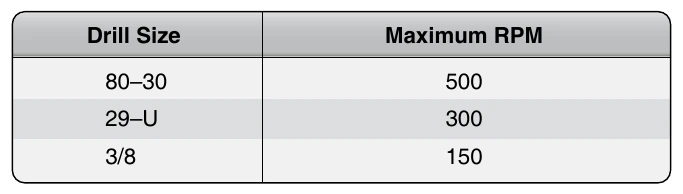
Normal drilling into Inconel® alloys can break drill bits sooner and cause damage to the edge of the hole when the drill bit goes through the metal. If a hand drill is used to drill Inconel® alloys 625 and 718, select a 135° cobalt drill bit. When hand drilling, push hard on the drill, but stay at a constant chip rate. For example, with a No. 30 hole, push the drill with approximately 50 pounds of force. Use the maximum drill rpm as illustrated in Figure 4-166. A cutting fluid is not necessary when hand drilling.
The following drilling procedures are recommended:
- Drill pilot holes in loose repair parts with power feed equipment before preassembling them.
- Preassemble the repair parts and drill the pilot holes in the mating structure.
- Enlarge the pilot holes to their completed hole dimension.
When drilling Inconel®, autofeed-type drilling equipment is preferred.
Working Magnesium
Warning: Keep magnesium particles away from sources of ignition. Small particles of magnesium burn very easily. In sufficient concentration, these small particles can cause an explosion. If water touches molten magnesium, a steam explosion could occur. Extinguish magnesium fires with dry talc, calcium carbonate, sand, or graphite. Apply the powder on the burning metal to a depth of 1⁄2-inch or more. Do not use foam, water, carbon tetrachloride, or carbon dioxide. Magnesium alloys must not touch methyl alcohol.
Magnesium is the world’s lightest structural metal. Like many other metals, this silvery-white element is not used in its pure state for stressed application. Instead, magnesium is alloyed with certain other metals (aluminum, zinc, zirconium, manganese, thorium, and rare earth metals) to obtain the strong, lightweight alloys needed for structural uses. When alloyed with these other metals, magnesium, yields alloys with excellent properties and high strength-to-weight ratios. Proper combination of these alloying constituents provide alloys suitable for sand, permanent mold and die castings, forging, extrusions, rolled sheet, and plate with good properties at room temperature, as well as at elevated temperatures.
Lightweight is the best known characteristic of magnesium, an important factor in aircraft design. In comparison, aluminum weighs one and one half times more, iron and steel weigh four times more, and copper and nickel alloys weigh five times more. Magnesium alloys can be cut, drilled, and reamed with the same tools that are used on steel or brass, but the cutting edges of the tool must be sharp. Type B rivets (5056-F aluminum alloy) are used when riveting magnesium alloy parts. Magnesium parts are often repaired with clad 2024-T3 aluminum alloy.
While magnesium alloys can usually be fabricated by methods similar to those used on other metals, remember that many of the details of shop practice cannot be applied. Magnesium alloys are difficult to fabricate at room temperature; therefore, most operations must be performed at high temperatures. This requires preheating of the metal or dies, or both. Magnesium alloy sheets may be cut by blade shears, blanking dies, routers, or saws. Hand or circular saws are usually used for cutting extrusions to length. Conventional shears and nibblers should never be used for cutting magnesium alloy sheet because they produce a rough, cracked edge.
Shearing and blanking of magnesium alloys require close tool tolerances. A maximum clearance of 3 to 5 percent of the sheet thickness is recommended. The top blade of the shears should be ground with an included angle of 45° to 60º. The shear angle on a punch should be from 2° to 3°, with a 1° clearance angle on the die. For blanking, the shear angle on the die should be from 2° to 3° with a 1° clearance angle on the punch. Hold-down pressures should be used when possible. Cold shearing should not be accomplished on a hard-rolled sheet thicker than 0.064-inch or annealed sheet thicker than 1⁄8-inch. Shaving is used to smooth the rough, flaky edges of a magnesium sheet that has been sheared. This operation consists of removing approximately 1⁄32-inch by a second shearing.
Hot shearing is sometimes used to obtain an improved sheared edge. This is necessary for heavy sheet and plate stock. Annealed sheet may be heated to 600 °F, but hard-rolled sheet must be held under 400 °F, depending on the alloy used. Thermal expansion makes it necessary to allow for shrinkage after cooling, which entails adding a small amount of material to the cold metal dimensions before fabrication.
Sawing is the only method used in cutting plate stock more than 1⁄2-inch thick. Bandsaw raker-set blades of 4- to 6-tooth pitch are recommended for cutting plate stock or heavy extrusions. Small and medium extrusions are more easily cut on a circular cutoff saw having six teeth per inch. Sheet stock can be cut on handsaws having raker-set or straight-set teeth with an 8-tooth pitch. Bandsaws should be equipped with nonsparking blade guides to eliminate the danger of sparks igniting the magnesium alloy filings.
Cold working most magnesium alloys at room temperature is very limited, because they work harden rapidly and do not lend themselves to any severe cold forming. Some simple bending operations may be performed on sheet material, but the radius of bend must be at least 7 times the thickness of the sheet for soft material and 12 times the thickness of the sheet for hard material. A radius of 2 or 3 times the thickness of the sheet can be used if the material is heated for the forming operation.