
Chapter 4
Aircraft Metal Structural Repair
Titanium can be difficult to drill, but standard high-speed drill bits may be used if the bits are sharp, if sufficient force is applied, and if a low-speed drill motor is used. If the drill bit is dull, or if it is allowed to ride in a partially drilled hole, an overheated condition is created, making further drilling extremely difficult. Therefore, keep holes as shallow as possible; use short, sharp drill bits of approved design; and flood the area with large amounts of cutting fluid to facilitate drilling or reaming.
When working titanium, it is recommended that you use carbide or 8 percent cobalt drill bits, reamers, and countersinks. Ensure the drill or reamer is rotating to prevent scoring the side of the hole when removing either of them from a hole. Use a hand drill only when positive-power-feed drills are not available.
The following guidelines are used for drilling titanium:
- The largest diameter hole that can be drilled in a single step is 0.1563-inch because a large force is required.
Larger diameter drill bits do not cut satisfactorily when much force is used. Drill bits that do not cut satisfactorily cause damage to the hole.
- Holes with a diameter of 0.1875-inch and larger can be hand drilled if the operator:
- Starts with a hole with a diameter of 0.1563-inch.
- Increases the diameter of the hole in 0.0313-inch or 0.0625-inch increments.
- Cobalt vanadium drill bits last much longer than HSS bits.
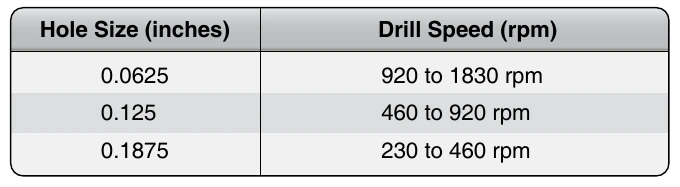
- The recommended drill motor rpm settings for hand drilling titanium are listed in Figure 4-167.
- The life of a drill bit is shorter when drilling titanium than when drilling steel. Do not use a blunt drill bit or let a drill bit rub the surface of the metal and not cut it. If one of these conditions occurs, the titanium surface becomes work hardened, and it is very difficult to start the drill again.
- When hand drilling two or more titanium parts at the same time, clamp them together tightly. To clamp them together, use temporary bolts, Cleco clamps, or tooling clamps. Put the clamps around the area to drill and as near the area as possible.
- When hand drilling thin or flexible parts, put a support (such as a block of wood) behind the part.
- Titanium has a low thermal conductivity. When it becomes hot, other metals become easily attached to it. Particles of titanium often become welded to the sharp edges of the drill bit if the drill speed is too high. When drilling large plates or extrusions, use a water soluble coolant or sulphurized oil.
Basic Principles of Sheet Metal Repair
Aircraft structural members are designed to perform a specific function or to serve a definite purpose. The primary objective of aircraft repair is to restore damaged parts to their original condition. Very often, replacement is the only way this can be done effectively. When repair of a damaged part is possible, first study the part carefully to fully understand its purpose or function.
Strength may be the principal requirement in the repair of certain structures, while others may need entirely different qualities. For example, fuel tanks and floats must be protected against leakage; cowlings, fairings, and similar parts must have such properties as neat appearance, streamlined shape, and accessibility. The function of any damaged part must be carefully determined to ensure the repair meets the requirements.
An inspection of the damage and accurate estimate of the type of repair required are the most important steps in repairing structural damage. The inspection includes an estimate of the best type and shape of repair patch to use; the type, size, and number of rivets needed; and the strength, thickness, and kind of material required to make the repaired member no heavier (or only slightly heavier) and just as strong as the original.
When investigating damage to an aircraft, it is necessary to make an extensive inspection of the structure. When any component or group of components has been damaged, it is essential that both the damaged members and the attaching structure be investigated, since the damaging force may have been transmitted over a large area, sometimes quite remote from the point of original damage. Wrinkled skin, elongated or damaged bolt or rivet holes, or distortion of members usually appears in the immediate area of such damage, and any one of these conditions calls for a close inspection of the adjacent area. Check all skin, dents, and wrinkles for any cracks or abrasions.
Nondestructive inspection methods (NDI) are used as required when inspecting damage. NDI methods serve as tools of prevention that allow defects to be detected before they develop into serious or hazardous failures. A trained and experienced technician can detect flaws or defects with a high degree of accuracy and reliability. Some of the defects found by NDI include corrosion, pitting, heat/stress cracks, and discontinuity of metals.
When investigating damage, proceed as follows:
- Remove all dirt, grease, and paint from the damaged and surrounding areas to determine the exact condition of each rivet, bolt, and weld.
- Inspect skin for wrinkles throughout a large area.
- Check the operation of all movable parts in the area.
- Determine if repair would be the best procedure.
In any aircraft sheet metal repair, it is critical to:
- Maintain original strength,
- Maintain original contour, and
- Minimize weight.