Chapter 4
Aircraft Metal Structural Repair
The rivet pattern for a repair must conform to instructions in the applicable aircraft manual. The existing rivet pattern is used whenever possible.
Corrosion Treatment
Prior to assembly of repair or replacement parts, make certain that all existing corrosion has been removed in the area and that the parts are properly insulated one from the other.
Approval of Repair
Once the need for an aircraft repair has been established, Title 14 of the Code of Federal Regulations (14 CFR) defines the approval process. 14 CFR part 43, section 43.13(a) states that each person performing maintenance, alteration, or preventive maintenance on an aircraft, engine, propeller, or appliance shall use the methods, techniques, and practices prescribed in the current manufacturer’s maintenance manual or instructions for continued airworthiness prepared by its manufacturer, or other methods, techniques, or practices acceptable to the Administrator. AC 43.13-1 contains methods, techniques, and practices acceptable to the Administrator for the inspection and repair of nonpressurized areas of civil aircraft, only when there are no manufacturer repair or maintenance instructions. This data generally pertains to minor repairs. The repairs identified in this AC may only be used as a basis for FAA approval for major repairs. The repair data may also be used as approved data, and the AC chapter, page, and paragraph listed in block 8 of FAA Form 337 when:
- The user has determined that it is appropriate to the product being repaired;
- It is directly applicable to the repair being made; and
- It is not contrary to manufacturer’s data.
Engineering support from the aircraft manufacturer is required for repair techniques and methods that are not described in the aircraft maintenance manual or SRM.
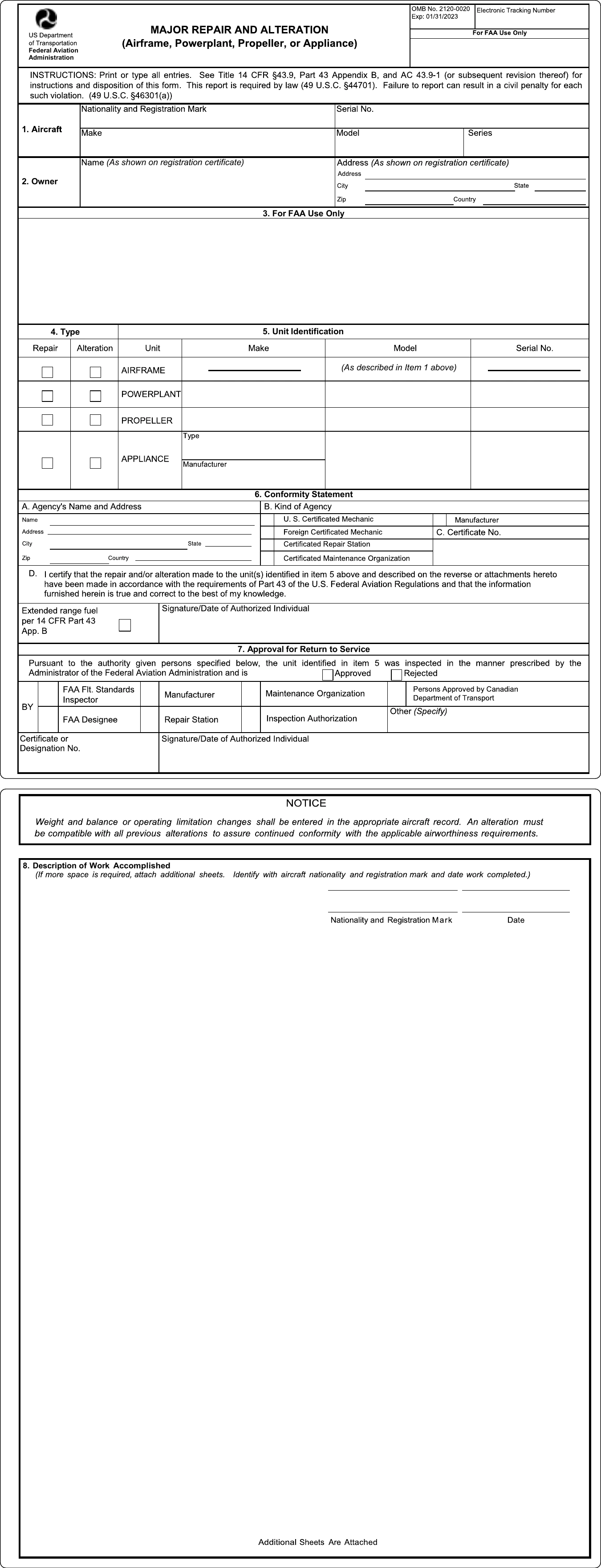
FAA Form 337, Major Repair and Alteration, must be completed for repairs to the following parts of an airframe and repairs of the following types involving the strengthening, reinforcing, splicing, and manufacturing of primary structural members or their replacement, when replacement is by fabrication, such as riveting or welding. [Figure 4-173]
- Box beams
- Monocoque or semimonocoque wings or control surfaces
- Wing stringers or chord members
- Spars
- Spar flanges
- Members of truss-type beams
- Thin sheet webs of beams
- Keel and chine members of boat hulls or floats
- Corrugated sheet compression members that act as flange material of wings or tail surfaces
- Wing main ribs and compression members
- Wing or tail surface brace struts, fuselage longerons
- Members of the side truss, horizontal truss or bulkheads
- Main seat support braces and brackets
- Landing gear brace struts
- Repairs involving the substitution of material
- Repair of damaged areas in metal or plywood stressed covering exceeding six inches in any direction
- Repair of portions of skin sheets by making additional seams
- Splicing of thin sheets
- Repair of three or more adjacent wing or control surface ribs or the leading edge of wings and control surfaces between such adjacent ribs
For major repairs made in accordance with a manual or specifications acceptable to the Administrator, a certificated repair station may use the customer’s work order upon which the repair is recorded in place of the FAA Form 337.
Repair of Stressed Skin Structure
In aircraft construction, stressed skin is a form of construction in which the external covering (skin) of an aircraft carries part or all of the main loads. Stressed skin is made from high strength rolled aluminum sheets. Stressed skin carries a large portion of the load imposed upon an aircraft structure. Various specific skin areas are classified as highly critical, semicritical, or noncritical. To determine specific repair requirements for these areas, refer to the applicable aircraft maintenance manual.
Minor damage to the outside skin of the aircraft can be repaired by applying a patch to the inside of the damaged sheet. A filler plug must be installed in the hole made by the removal of the damaged skin area. It plugs the hole and forms a smooth outside surface necessary for aerodynamic smoothness of the aircraft. The size and shape of the patch is determined in general by the number of rivets required in the repair. If not otherwise specified, calculate the required number of rivets by using the rivet formula. Make the patch plate of the same material as the original skin and of the same thickness or of the next greater thickness.
Patches
Skin patches may be classified as two types:
- Lap or scab patch
- Flush patch
Lap or Scab Patch
The lap or scab type of patch is an external patch where the edges of the patch and the skin overlap each other. The overlapping portion of the patch is riveted to the skin. Lap patches may be used in most areas where aerodynamic smoothness is not important. Figure 4-174 shows a typical patch for a crack and or for a hole.
When repairing cracks or small holes with a lap or scab patch, the damage must be cleaned and smoothed. In repairing cracks, a small hole must be drilled in each end and sharp bend of the crack before applying the patch. These holes relieve the stress at these points and prevent the crack from spreading. The patch must be large enough to install the required number of rivets. It may be cut circular, square, or rectangular. If it is cut square or rectangular, the corners are rounded to a radius no smaller than 1⁄4-inch. The edges must be chamfered to an angle of 45° for 1⁄2 the thickness of the material, and bent down 5° over the edge distance to seal the edges. This reduces the chance that the repair is affected by the airflow over it. These dimensions are shown in Figure 4-175.