
Chapter 4
Aircraft Metal Structural Repair
Throatless shears made by the Beverly Shear Manufacturing Corporation, called BeverlyTM shears, are often used.
Scroll Shears
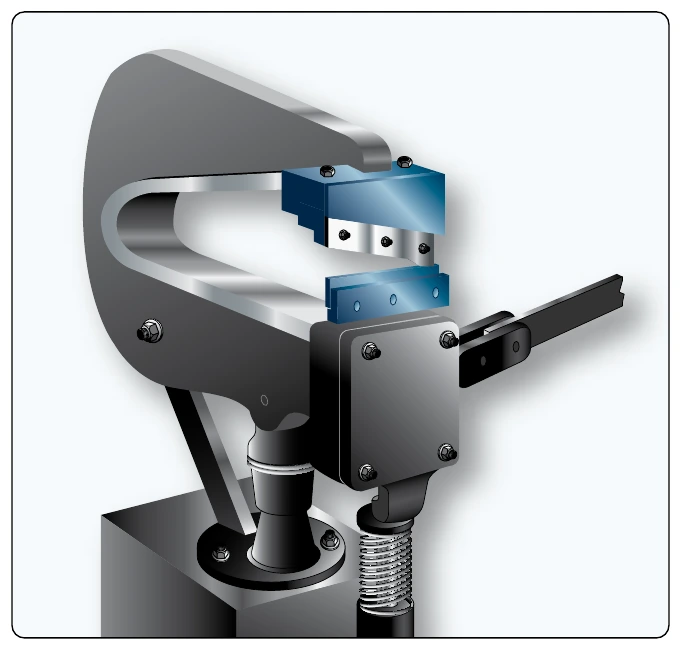
Scroll shears are used for cutting irregular lines on the inside of a sheet without cutting through to the edge. [Figure 4-26] The upper cutting blade is stationary while the lower blade is movable. A handle connected to the lower blade operates the machine.
Rotary Punch Press
Used in the airframe repair shop to punch holes in metal parts, the rotary punch can cut radii in corners, make washers, and perform many other jobs where holes are required. [Figure 4-27] The machine is composed of two cylindrical turrets, one mounted over the other and supported by the frame, with both turrets synchronized to rotate together. Index pins, which ensure correct alignment at all times, may be released from their locking position by rotating a lever on the right side of the machine. This action withdraws the index pins from the tapered holes and allows an operator to turn the turrets to any size punch desired.
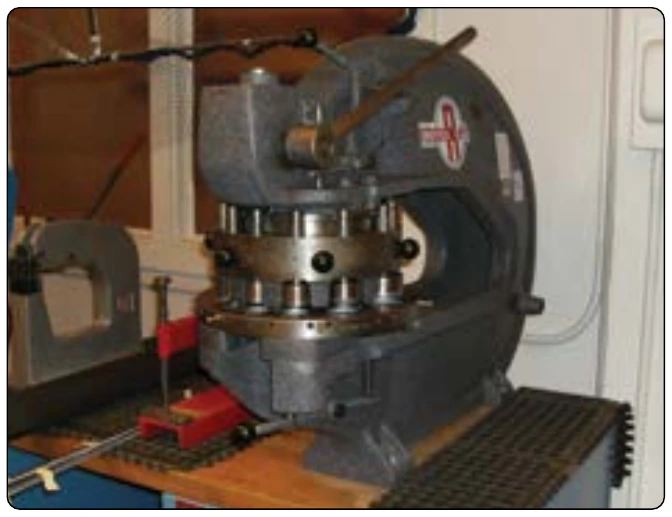
When rotating the turret to change punches, release the index lever when the desired die is within 1 inch of the ram, and continue to rotate the turret slowly until the top of the punch holder slides into the grooved end of the ram. The tapered index locking pins will then seat themselves in the holes provided and, at the same time, release the mechanical locking device, which prevents punching until the turrets are aligned. To operate the machine, place the metal to be worked between the die and punch. Pull the lever on the top of the machine toward the operator, actuating the pinion shaft, gear segment, toggle link, and the ram, forcing the punch through the metal. When the lever is returned to its original position, the metal is removed from the punch.
The diameter of the punch is stamped on the front of each die holder. Each punch has a point in its center that is placed in the center punch mark to punch the hole in the correct location.
Band Saw
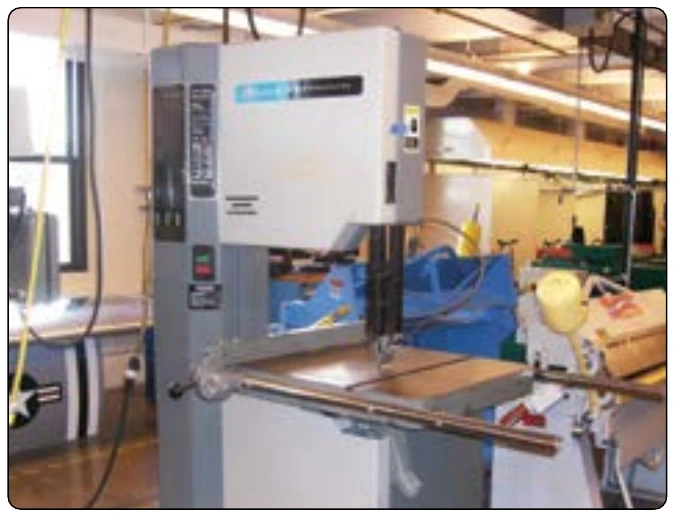
A band saw consists of a toothed metal band coupled to, and continuously driven around, the circumferences of two wheels. It is used to cut aluminum, steel, and composite parts. [Figure 4-28] The speed of the band saw and the type and style of the blade depends on the material to be cut. Band saws are often designated to cut one type of material, and if a different material is to be cut, the blade is changed. The speed is controllable and the cutting platform can be tilted to cut angled pieces.
Disc Sander
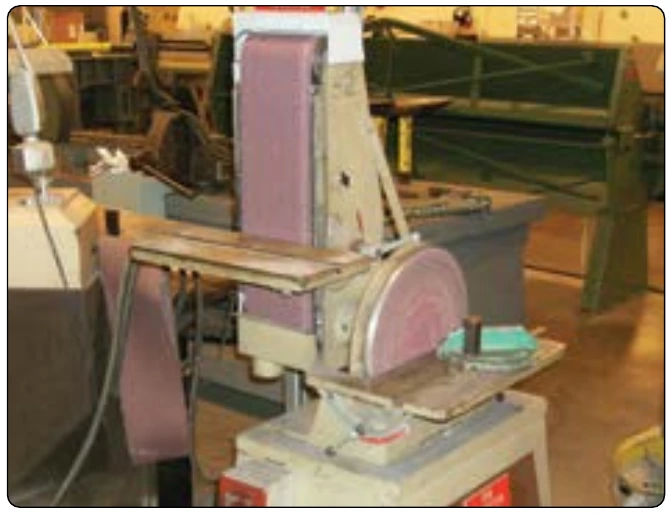
Disc sanders have a powered abrasive-covered disc or belt and are used for smoothing or polishing surfaces. The sander unit uses abrasive paper of different grits to trim metal parts. It is much quicker to use a disc sander than to file a part to the correct dimension. The combination disc and belt sander has a vertical belt sander coupled with a disc sander and is often used in a metal shop. [Figure 4-29]
Belt Sander
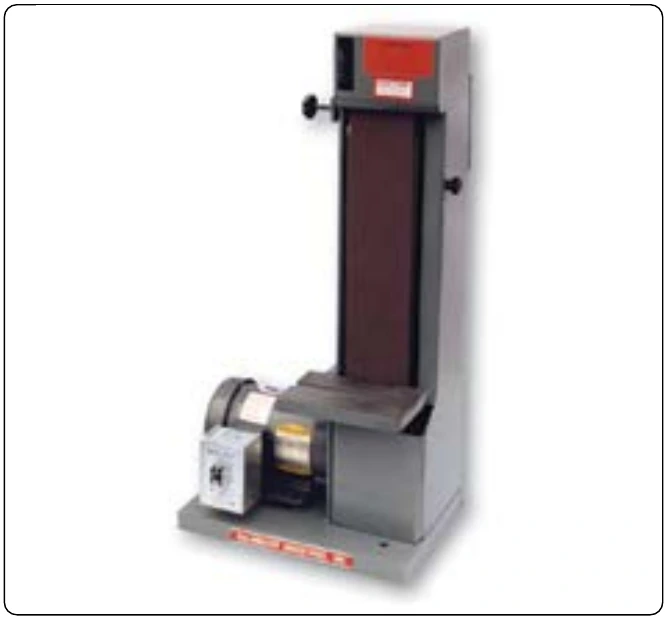
The belt sander uses an endless abrasive belt driven by an electric motor to sand down metal parts much like the disc sander unit. The abrasive paper used on the belt comes in different degrees of grit or coarseness. The belt sander is available as a vertical or horizontal unit. The tension and tracking of the abrasive belt can be adjusted so the belt runs in the middle. [Figure 4-30]
Notcher
The notcher is used to cut out metal parts, with some machines capable of shearing, squaring, and trimming metal. [Figure 4-31] The notcher consists of a top and bottom die and most often cuts at a 90° angle, although some machines can cut metal into angles up to 180°. Notchers are available in manual and pneumatic models able to cut various thicknesses of mild steel and aluminum. This is an excellent tool for quickly removing corners from sheet metal parts. [Figure 4-32]