
Chapter 4
Aircraft Metal Structural Repair
Wet or Dry Grinder
Grinding machines come in a variety of types and sizes, depending upon the class of work for which they are to be used. Dry and/or wet grinders are found in airframe repair shops. Grinders can be bench or pedestal mounted. A dry grinder usually has a grinding wheel on each end of a shaft that runs through an electric motor or a pulley operated by a belt. The wet grinder has a pump to supply a flow of water on a single grinding wheel. The water acts as a lubricant for faster grinding while it continuously cools the edge of the metal, reducing the heat produced by material being ground against the wheel. It also washes away any bits of metal or abrasive removed during the grinding operation. The water returns to a tank and can be re-used.
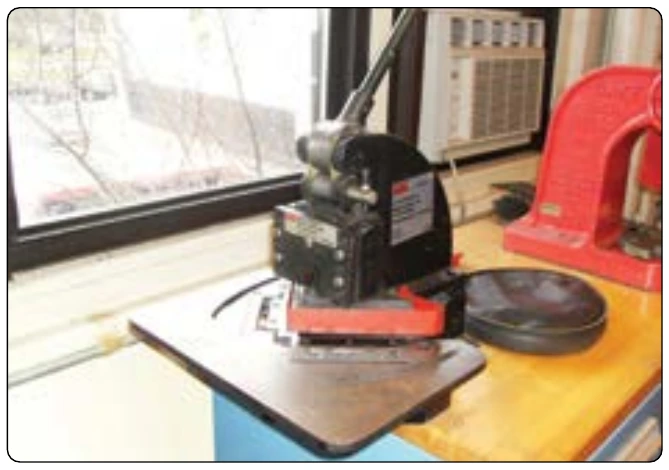
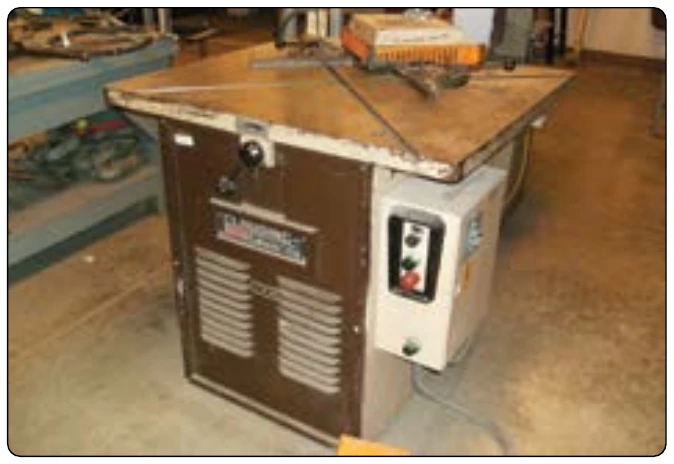
Grinders are used to sharpen knives, tools, and blades as well as grinding steel, metal objects, drill bits, and tools. Figure 4-33 illustrates a common type bench grinder found in most airframe repair shops. It can be used to dress mushroomed heads on chisels and points on chisels, screwdrivers, and drills, as well as for removing excess metal from work and smoothing metal surfaces.
The bench grinder is generally equipped with one medium-grit and one fine-grit abrasive wheel. The medium-grit wheel is usually used for rough grinding where a considerable quantity of material is to be removed or where a smooth finish tools and grinding to close limits. It removes metal more slowly, gives the work a smooth finish, and does not generate enough heat to anneal the edges of cutting tools.
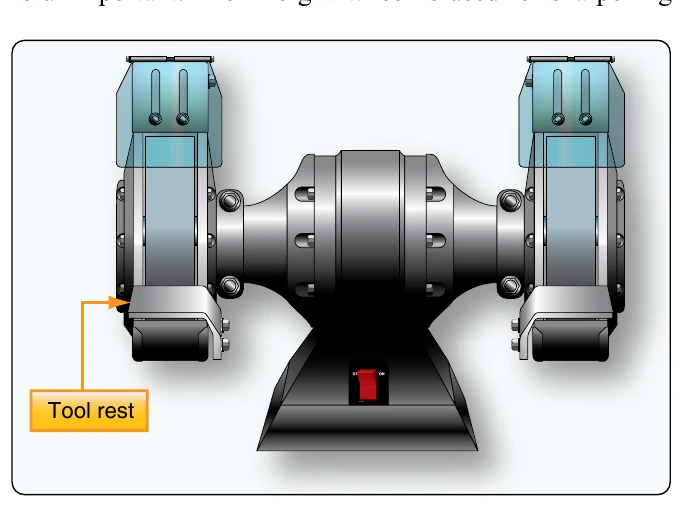
Before using any type of grinder, ensure that the abrasive wheels are firmly held on the spindles by the flange nuts. An abrasive wheel that comes off or becomes loose could seriously injure the operator in addition to ruining the grinder. A loose tool rest could cause the tool or piece of work to be “grabbed” by the abrasive wheel and cause the operator’s hand to come in contact with the wheel, possibly resulting in severe wounds.
Always wear goggles when using a grinder, even if eye shields are attached to the grinder. Goggles should fit firmly against the face and nose. This is the only way to protect the eyes from the fine pieces of steel. Goggles that do not fit properly should be exchanged for ones that do fit. Be sure to check the abrasive wheel for cracks before using the grinder. A cracked abrasive wheel is likely to fly apart when turning at high speeds. Never use a grinder unless it is equipped with wheel guards that are firmly in place.
Grinding Wheels
A grinding wheel is made of a bonded abrasive and provides an efficient way to cut, shape, and finish metals. Available in a wide variety of sizes and numerous shapes, grinding wheels are also used to sharpen knives, drill bits, and many other tools, or to clean and prepare surfaces for painting or plating.
Grinding wheels are removable and a polishing or buffing wheel can be substituted for the abrasive wheel. Silicon carbide and aluminum oxide are the kinds of abrasives used in most grinding wheels. Silicon carbide is the cutting agent for grinding hard, brittle material, such as cast iron. It is also used in grinding aluminum, brass, bronze, and copper. Aluminum oxide is the cutting agent for grinding steel and other metals of high tensile strength.
Hand Cutting Tools
Many types of hand cutting tools are available to cut light gauge sheet metal. Four cutting tools commonly found in the air frame repair shop are straight hand snips, aviation snips, files, and burring tools.
Straight Snips
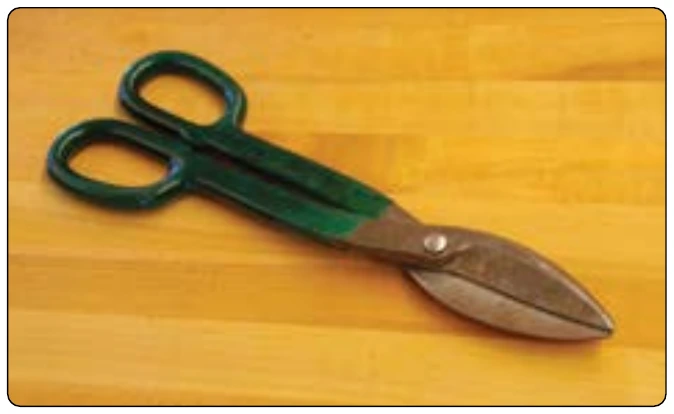
Straight snips, or sheet metal shears, have straight blades with cutting edges sharpened to an 85° angle. [Figure 4-34] Available in sizes ranging from 6 to 14 inches, they cut aluminum up to 1⁄16 of an inch. Straight snips can be used for straight cutting and large curves, but aviation snips are better for cutting circles or arcs.
Aviation Snips
Aviation snips are used to cut holes, curved parts, round patches, and doublers (a piece of metal placed under a part to make it stiffer) in sheet metal. Aviation snips have colored handles to identify the direction of the cuts: yellow aviation snips cut straight, green aviation snips curve right, and red aviation snips curve left. [Figure 4-35]