Chapter 9
Aircraft Electrical System
Position 5 The curve shown at position 5 is called a sine wave. It represents the polarity and the magnitude of the instantaneous values of the voltages generated. The horizontal baseline is divided into degrees, or time, and the vertical distance above or below the baseline represents the value of voltage at each particular point in the rotation of the loop.
The specific operating principles of both alternators and generators as they apply to aircraft is presented later in this text.
Alternating Current (AC) Introduction
Alternating current (AC) electrical systems are found on most multi-engine, high performance turbine powered aircraft and transport category aircraft. AC is the same type of electricity used in industry and to power our homes. Direct current (DC) is used on systems that must be compatible with battery power, such as on light aircraft and automobiles. There are many benefits of AC power when selected over DC power for aircraft electrical systems.
AC can be transmitted over long distances more readily and more economically than DC, since AC voltages can be increased or decreased by means of transformers. Because more and more units are being operated electrically in airplanes, the power requirements are such that a number of advantages can be realized by using AC (especially with large transport category aircraft). Space and weight can be saved since AC devices, especially motors, are smaller and simpler than DC devices. In most AC motors, no brushes are required, and they require less maintenance than DC motors. Circuit breakers operate satisfactorily under loads at high altitudes in an AC system, whereas arcing is so excessive on DC systems that circuit breakers must be replaced frequently. Finally, most airplanes using a 24-volt DC system have special equipment that requires a certain amount of 400 cycle AC current. For these aircraft, a unit called an inverter is used to change DC to AC. Inverters are discussed later in this book.
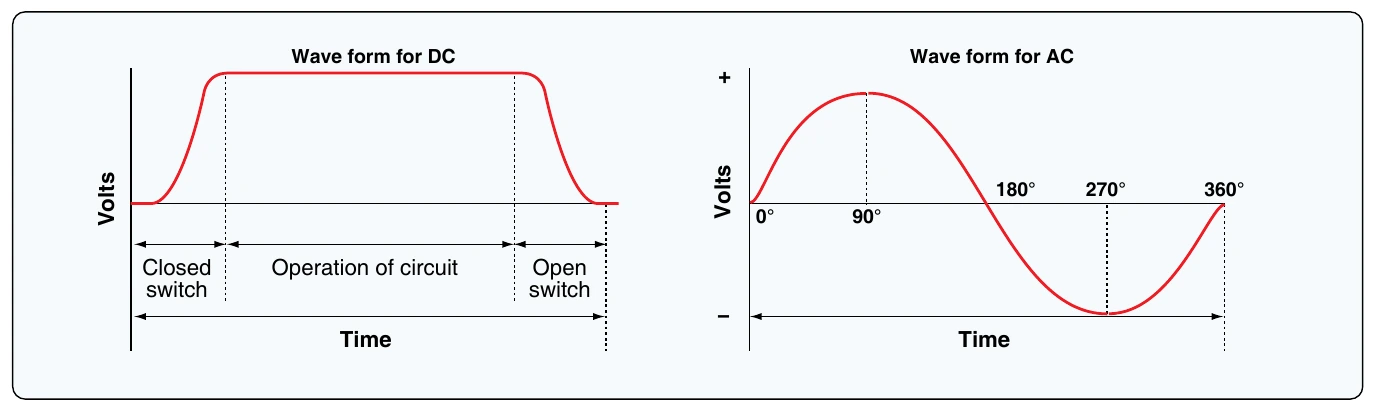
AC is constantly changing in value and polarity, or as the name implies, alternating. Figure 9-12 shows a graphic comparison of DC and AC. The polarity of DC never changes, and the polarity and voltage constantly change in AC. It should also be noted that the AC cycle repeats at given intervals. With AC, both voltage and current start at zero, increase, reach a peak, then decrease and reverse polarity. If one is to graph this concept, it becomes easy to see the alternating wave form. This wave form is typically referred to as a sine wave.
Definitions
Values of AC
There are three values of AC that apply to both voltage and current. These values help to define the sine wave and are called instantaneous, peak, and effective. It should be noted that during the discussion of these terms, the text refers to voltage. But remember, the values apply to voltage and current in all AC circuits.
Instantaneous
An instantaneous voltage is the value at any instant in time along the AC wave. The sine wave represents a series of these values. The instantaneous value of the voltage varies from zero at 0° to maximum at 90°, back to zero at 180°, to maximum in the opposite direction at 270°, and to zero again at 360°. Any point on the sine wave is considered the instantaneous value of voltage.
Peak
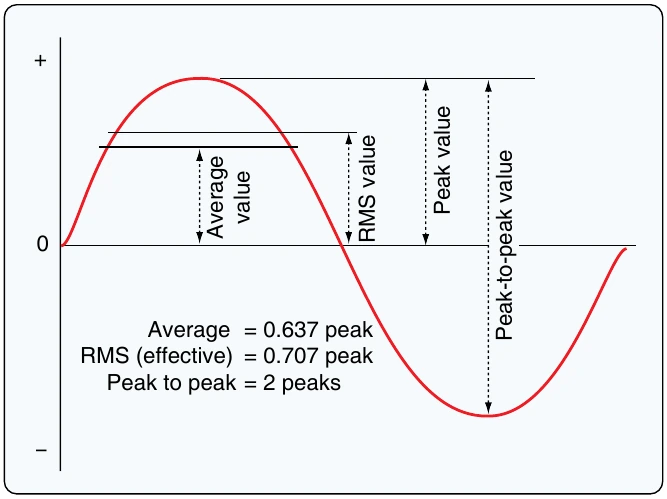
The peak value is the largest instantaneous value, often referred to as the maximum value. The largest single positive value occurs after a certain period of time when the sine wave reaches 90°, and the largest single negative value occurs when the wave reaches 270°. Although important in the understanding of the AC sine wave, peak values are seldom used by aircraft technicians.
Effective
The effective values for voltage are always less than the peak (maximum) values of the sine wave and approximate DC voltage of the same value. For example, an AC circuit of 24 volts and 2 amps should produce the same heat through a resistor as a DC circuit of 24 volts and 2 amps. The effective value is also known as the root mean square, or RMS value, which refers to the mathematical process by which the value is derived.
Most AC meters display the effective value of the AC. In almost all cases, the voltage and current ratings of a system or component are given in effective values. In other words, the industry ratings are based on effective values. Peak and instantaneous values, used only in very limited situations, would be stated as such. In the study of AC, any values given for current or voltage are assumed to be effective values unless otherwise specified. In practice, only the effective values of voltage and current are used.
The effective value is equal to.707 times the peak (maximum) value. Conversely, the peak value is 1.41 times the effective value. Thus, the 110 volt value given for AC is only 0.707 of the peak voltage of this supply. The maximum voltage is