
Chapter 1
Safety, Ground Operations, & Servicing
Most turbofan engines can be started by either air turbine or electrical starters. Air-turbine starters use compressed air from an external source as discussed earlier. Fuel is turned on either by moving the start lever to “idle/start” position or by opening a fuel shutoff valve. If an air turbine starter is used, the engine “lights off” within a predetermined time after the fuel is turned on. This time interval, if exceeded, indicates a malfunction has occurred and the start must be discontinued.
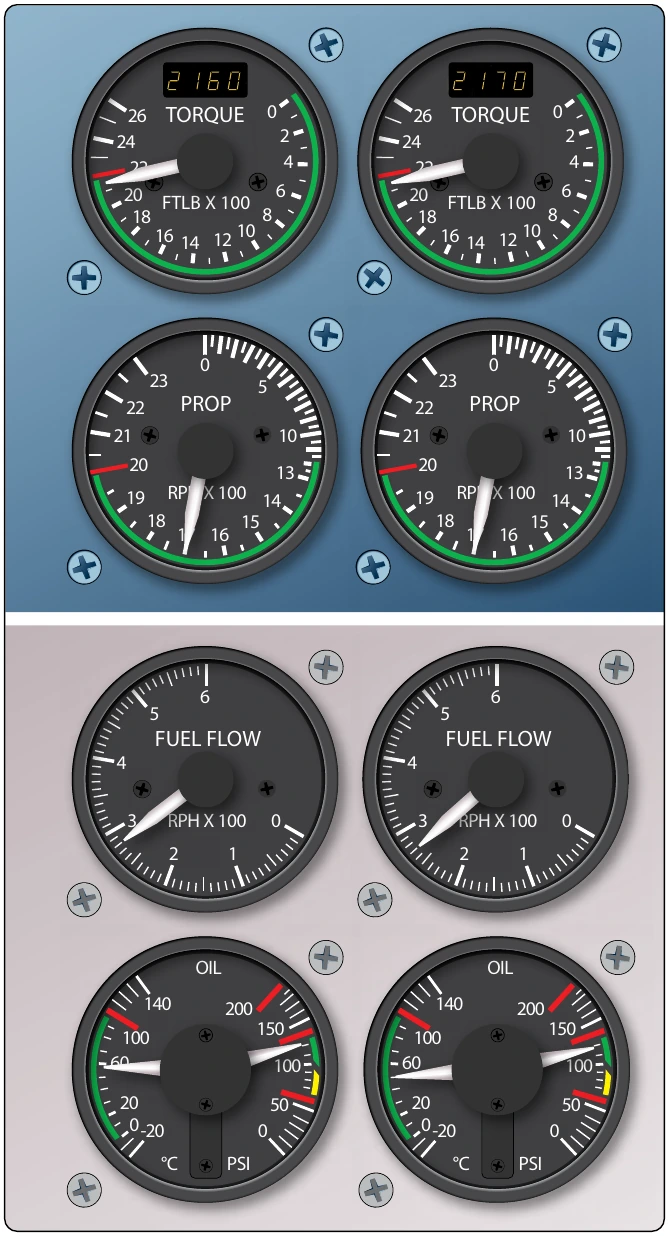
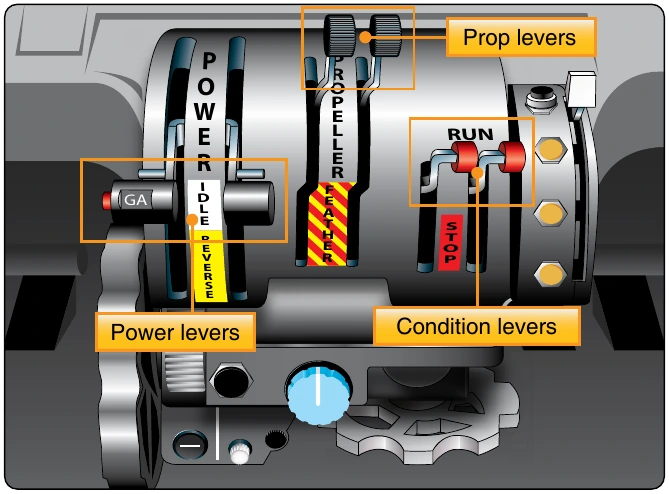
Most turbofan engine controls consist of a power lever, reversing levers, and start levers. Newer aircraft have replaced the start levers with a fuel switch. [Figure 1-18] Turbofan engines also use all the normal instruments speeds, (percent of total rpm) exhaust gas temperature, fuel flow, oil pressure, and temperature. An instrument that measures the amount of thrust being delivered is the engine pressure ratio. This measures the ratio between the inlet pressures to the outlet pressure of the turbine.
The following procedures are useful only as a general guide and are included to show the sequence of events in starting a turbofan engine.
- If the engine is so equipped, place the power lever in the “idle” position.
- Turn the fuel boost pump(s) switch on.
- A fuel inlet pressure indicator reading ensures fuel is being delivered to engine fuel pump inlet.
- Turn engine starter switch on. Note that the engine rotates to a preset limit. Check for oil pressure.
- Turn ignition switch on. (This is usually accomplished by moving the start lever toward the “on” position. A micro switch connected to the leveler turns on the ignition.)
- Move the start lever to “idle” or “start” position, this starts fuel flow into the engine.
- Engine start (light off) is indicated by a rise in exhaust gas temperature.
- If a two-spool engine, check rotation of fan or N1.
- Check for proper oil pressure.
- Turn engine starter switch off at proper speeds.
- After engine stabilizes at idle, ensure that none of the engine limits are exceeded.
- Newer aircraft drop off the starter automatically.
Auxiliary Power Units (APUs)
APUs are generally smaller turbine engines that provide compressed air for starting engines, cabin heating and cooling, and electrical power while on the ground. Their operation is normally simple. By turning a switch on and up to the start position (spring loaded to on position), the engine starts automatically. During start, the exhaust gas temperature must be monitored. APUs are at idle at 100 percent rpm with no load. After the engine reaches its operating rpm, it can be used for cooling or heating the cabin and for electrical power. It is normally used to start the main engines.
Unsatisfactory Turbine Engine Starts
Hot Start
A hot start occurs when the engine starts, but the exhaust gas temperature exceeds specified limits. This is usually caused by an excessively rich air-fuel mixture entering the combustion chamber. This condition can be caused by either too much fuel or not enough airflow. The fuel to the engine must be shut off immediately.
False or Hung Start
False or hung starts occur when the engine starts normally, but the rpm remains at some low value rather than increasing to the normal starting rpm. This is often the result of insufficient power to the starter or the starter cutting off before the engine starts self-accelerating. In this case, shut the engine down.
Engine Fails to Start
The engine failing to start within the prescribed time limit can be caused by lack of fuel to the engine, insufficient or no electrical power to the exciter in the ignition system, or incorrect fuel mixture. If the engine fails to start within the prescribed time, shut it down.
In all cases of unsatisfactory starts, the fuel and ignition must be turned off. Continue rotating the compressor for approximately 15 seconds to remove accumulated fuel from the engine. If unable to motor (rotate) the engine, allow a 30-second fuel draining period before attempting another start.
Towing of Aircraft
Movement of large aircraft about the airport, flight line, and hangar is usually accomplished by towing with a tow tractor (sometimes called a “tug”). [Figure 1-19] In the case of small aircraft, some moving is accomplished by hand pushing on the correct areas of the aircraft. Aircraft may also be taxied about the flight line but usually only by certain qualified personnel.
Towing aircraft can be a hazardous operation, causing damage to the aircraft and injury to personnel, if done recklessly or carelessly. The following paragraphs outline the general procedure for towing aircraft. However, specific instructions for each model of aircraft are detailed in the manufacturer’s maintenance instructions and are to be followed in all instances.
Before the aircraft to be towed is moved, a qualified person must be in the flight deck to operate the brakes in case the tow bar fails or becomes unhooked. The aircraft can then be stopped, preventing possible damage.