
Chapter 12
Fundamentals of Electricity & Electronics
A cycle is a repetition of a pattern. Whenever a voltage or current passes through a series of changes, returns to the starting point, and then again starts the same series of changes, the series is called a cycle. The cycle is represented by the symbol of a wavy line in a circle 0~. In the cycle of voltage shown in Figure 12-110, the voltage increases from zero to a maximum positive value, decreases to zero; then increases to a maximum negative value, and again decreases to zero. At this point, it is ready to go through the same series of changes. There are two alternations in a complete cycle: the positive alternation and the negative. Each is half a cycle.
Frequency Defined
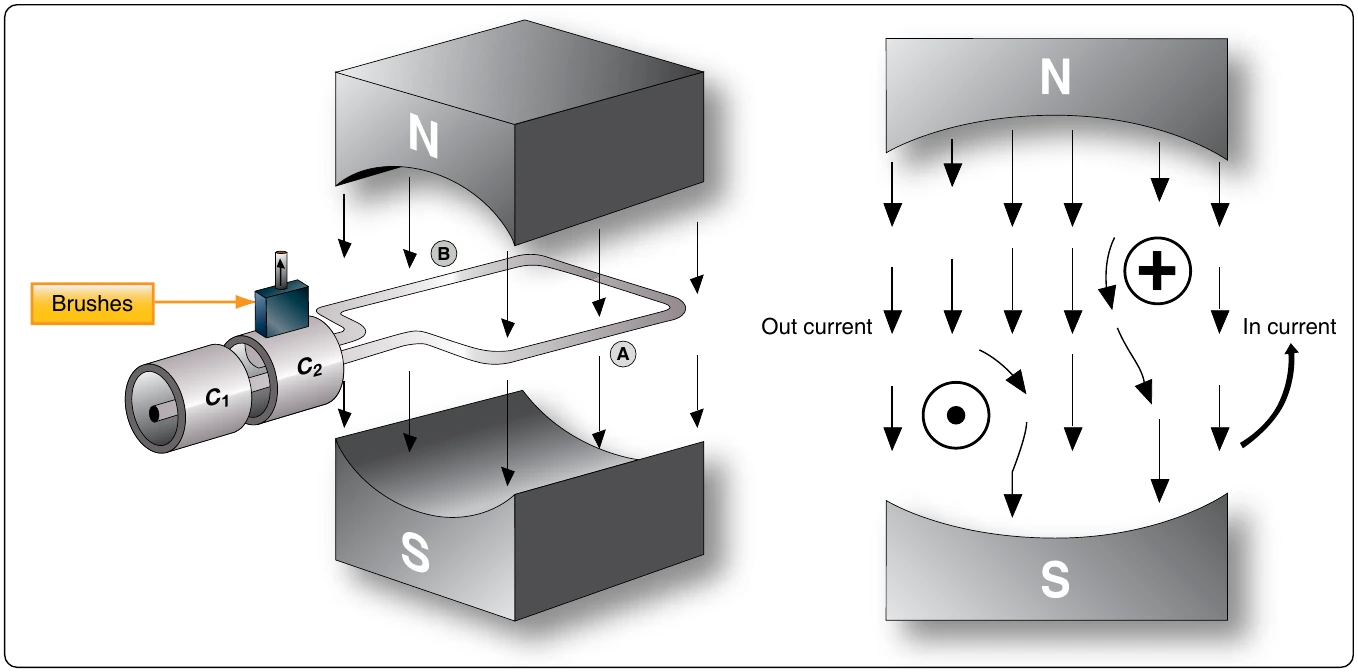
The frequency is the number of cycles of AC per second (1 a coil or conductor passes under a North and South pole of the magnet. The number of cycles for each revolution of the coil or conductor is equal to the number of pairs of poles. The frequency, then, is equal to the number of cycles in one revolution multiplied by the number of revolutions per second (rps).
Expressed in equation form:
× 60
where P⁄2 is the number of pairs of poles, and rpm/60 the number of revolutions per second. If in a 2-pole generator, the conductor is turning at 3,600 rpm, the revolutions per second are:
Since there are 2 poles, P⁄2 is 1, and the frequency is 60 cycles per second (cps). In a 4-pole generator with an armature speed of 1,800 rpm, substitute in the equation:
m as follows
0 0
Period Defined
The time required for a sine wave to complete one full cycle is called a period. [Figure 12-110] The period of a sine wave is inversely proportional to the frequency: the higher the frequency, the shorter the period. The mathematical relationship between frequency and period is given as: