
Chapter 14
Human Factors
Stress
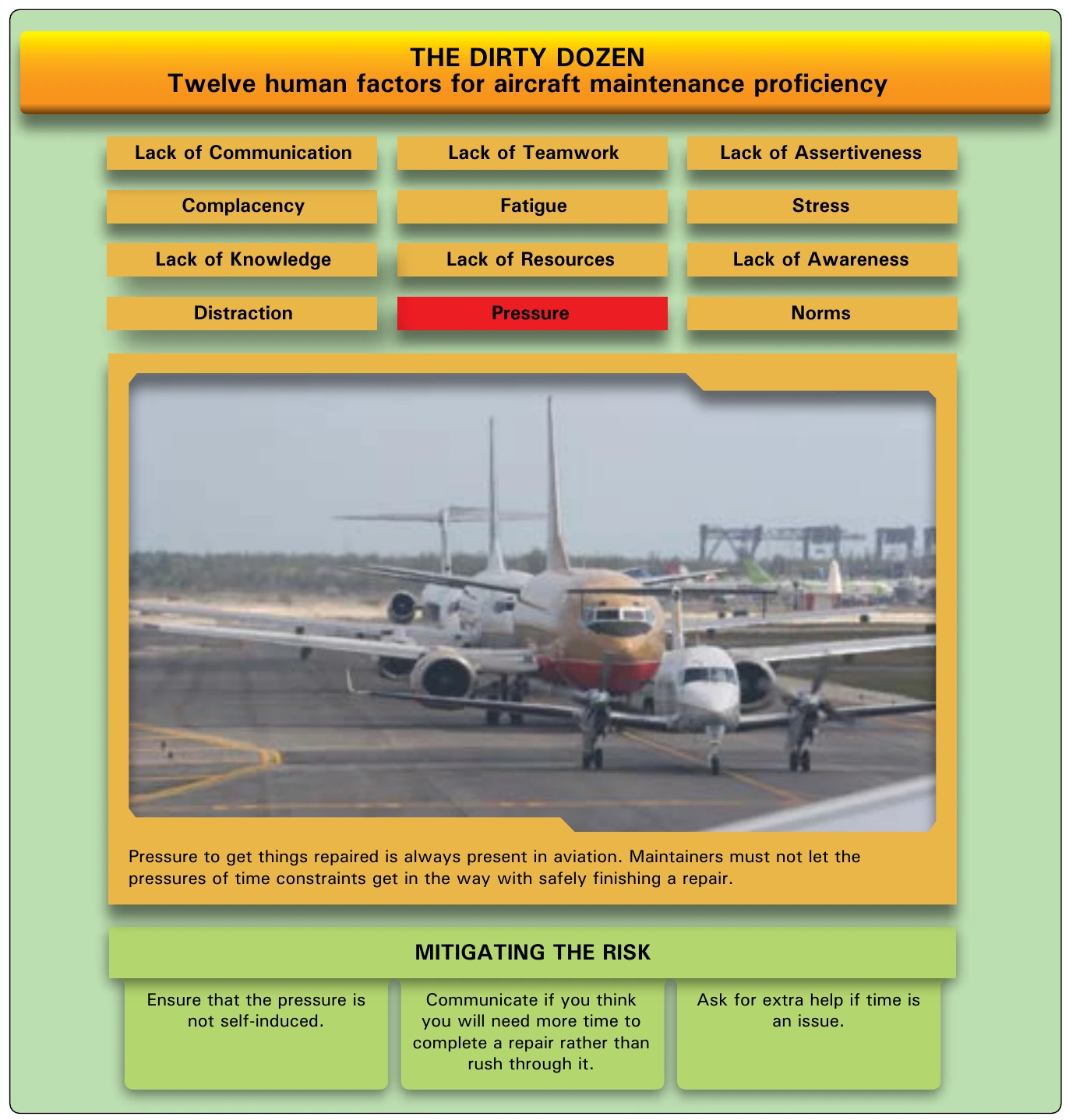
Aviation maintenance is a stressful task due to many factors. [Figure 14-29] Aircraft must be functional and flying in order for airlines to make money, which means that maintenance must be done within a short timeframe to avoid flight delays and cancellations. Fast-paced technology that is always changing can add stress to technicians. This demands that AMTs stay trained on the latest equipment. Other stressors include working in dark, tight spaces, lack of resources to get the repair done correctly, and long hours. The ultimate stress of aviation maintenance is knowing that the work they do, if not done correctly, could result in tragedy.
Everyone handles stress differently and particular situations can bring about different degrees of difficulty for different people. For example, working under a strict timeline can be a stressor for one person and normal for another. The causes of stress are referred to as “stressors” and are categorized as physical, psychological, or physiological. Following is a list of each and how they may affect maintenance.
Physical Stressors
Physical stressors add to a person’s workload and make their work environment uncomfortable.
- Temperature—high temperatures in the hangar increase perspiration and heart rate causing the body to overheat. Low temperatures can cause the body to feel cold, weak, and drowsy.
- Noise—hangars that have high noise levels (due to aircraft taking off and landing close by) can make it difficult for maintenance personnel to focus and concentrate.
- Lighting—poor lighting within a work space makes it difficult to read technical data and manuals. Likewise, working inside an aircraft with poor lighting increases the propensity to miss something or to repair something incorrectly.
- Confined spaces—small work spaces make it very
contorted into unusual positions for a long period of time.
Psychological Stressors
Psychological stressors relate to emotional factors, such as a death or illness in the family; business worries; poor interpersonal relationships with family, co-workers, or supervisors; and financial worries.
- Work-related stressors—over anxiousness can hinder performance and speed while conducting maintenance if there is any apprehension about how to do a repair or concerns about getting it done on time.
- Financial problems—impending bankruptcy, recession, loans, and mortgages are a few examples of financial problems that can create stressors.
- Marital problems—divorce and strained relationships can interfere with one’s ability to perform their job correctly.
- Interpersonal problems—problems with superiors and colleagues due to miscommunication or perceived competition and backstabbing can cause a hostile work environment.
condition, hunger, and disease.
- Poor physical condition—trying to work when ill or not feeling well can force the body to use more energy fighting the illness, leaving less energy to perform vital tasks.
- Proper meals—not eating enough, or eating foods lacking the proper nutrition, can result in low energy and induce symptoms like headaches and shaking.
- Lack of sleep—a fatigued AMT is unable to perform to standard for long periods of time and can become sloppy with repairs and make significant mistakes.
- Conflicting shift schedules—the effect of changing sleep patterns on the body’s circadian cycle can lead to a degradation of performance.
recommendations involve development or maintenance of a healthy lifestyle with adequate rest and exercise, a healthy diet, limited consumption of alcoholic drinks, and avoidance of tobacco products.
Lack of Awareness
Lack of awareness is defined as a failure to recognize all the consequences of an action or lack of foresight. [Figure 14-30] In aviation maintenance, it is not unusual to perform the same maintenance tasks repeatedly. After completing the same task multiple times, it is easy for technicians to become less vigilant and develop a lack of awareness of what they are doing and what is around them. Each time a task is completed it must be treated as if it were the first time.
Norms
Norms is short for “normal,” or the way things are normally done. [Figure 14-31] They are unwritten rules that are followed or tolerated by most organizations. Negative norms can detract from the established safety standard and cause an accident to occur. Norms are usually developed to solve problems that have ambiguous solutions. When faced with an ambiguous situation, an individual may use another’s behavior as a frame of reference around which to form their own reactions. As this process continues, group norms develop and stabilize. Newcomers to the situation are then accepted into the group based on adherence to norms. Very rarely do newcomers initiate change in a group with established norms.