
Chapter 5
Physics for Aviation
Relative Wind
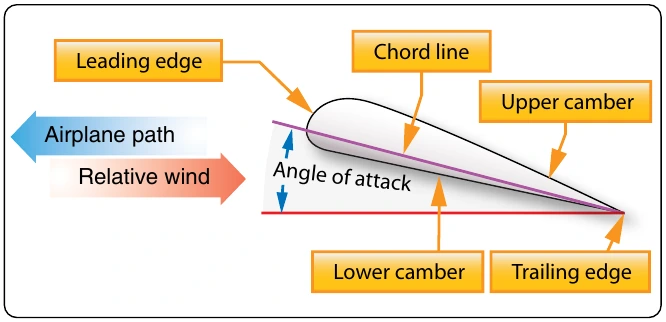
The relative wind is a relationship between the direction of airflow and the aircraft wing. In normal flight circumstances, the relative wind is the opposite direction of the aircraft flightpath.
- If the flightpath is forward then the relative wind is backward.
- If the flightpath is forward and upward, then the relative wind is backward and downward.
- If the flightpath is forward and downward, then the relative wind is backward and upward.
Therefore, the relative wind is parallel to the flightpath, and travels in the opposite direction.
Angle of Attack
The angle between the chord line and the relative wind is the angle of attack. As the angle of attack increases, the lift on the wing increases. If the angle of attack becomes too great, the airflow can separate from the wing and the lift There are a number of different shapes, known as planforms that a wing can have. A wing in the shape of a rectangle is very common on small general aviation airplanes. An elliptical shape or tapered wing can also be used, but these do not have as desirable a stall characteristic. For airplanes that operate at high subsonic speeds, sweptback wings are common, and for supersonic flight, a delta shape might be used.
The aspect ratio of a wing is the relationship between its span, or a wingtip to wingtip measurement, and the chord of the wing. If a wing has a long span and a very narrow chord, it is said to have a high aspect ratio. A higher aspect ratio produces less drag for a given flight speed, and is typically found on glider type aircraft.
The angle of incidence of a wing is the angle formed by the intersection of the wing chord line and the horizontal plane passing through the longitudinal axis of the aircraft. Many airplanes are designed with a greater angle of incidence at the root of the wing than at the tip, and this is referred to as washout. This feature causes the inboard part of the wing to stall before the outboard part, which helps maintain aileron control during the initial stages of a wing stall.
Boundary Layer Airflow
The boundary layer is a very thin layer of air lying over the surface of the wing and, for that matter, all other surfaces of the airplane. Because air has viscosity, this layer of air tends to adhere to the wing. As the wing moves forward through the air the boundary layer at first flows smoothly over the streamlined shape of the airfoil. Here the flow is called the laminar layer.
As the boundary layer approaches the center of the wing, it begins to lose speed due to skin friction and it becomes thicker and turbulent. Here it is called the turbulent layer. The point at which the boundary layer changes from laminar to turbulent is called the transition point. Where the boundary transition point also tends to move forward. With higher angles of attack and further thickening of the boundary layer, the turbulence becomes so great the air breaks away from the surface of the wing. At this point, the lift of the wing is destroyed and a condition known as a stall has occurred. In Figure 5-58, view A shows a normal angle of attack and the airflow staying in contact with the wing. View B shows an extreme angle of attack and the airflow separating and becoming turbulent on the top of the wing. In view B, the wing is in a stall.
Boundary Layer Control
One way of keeping the boundary layer air under control, or lessening its negative effect, is to make the wing’s surface as smooth as possible and to keep it free of dirt and debris. As the friction between the air and the surface of the wing increases, the boundary layer thickens and becomes more turbulent and eventually a wing stall occurs. With a smooth and clean wing surface, the onset of a stall is delayed and the wing can operate at a higher angle of attack. One of the reasons ice forming on a wing can be such a serious problem is because of its effect on boundary layer air. On a high-speed airplane, even a few bugs splattered on the wing’s leading edge can negatively affect boundary layer air.
Other methods of controlling boundary layer air include wing leading edge slots, air suction through small holes on the wing’s upper surface, and the use of devices called vortex generators.
A wing leading edge slot is a duct that allows air to flow from the bottom of the wing, through the duct, to the top of the wing. As the air flows to the top of the wing, it is directed along the wing’s surface at a high velocity and helps keep the boundary layer from becoming turbulent and separating from the wing’s surface.
Another way of controlling boundary layer air is to create suction on the top of the wing through a large number of small holes. The suction on the top of the wing draws away the slow-moving turbulent air, and helps keep the remainder of the airflow in contact with the wing.
Vortex generators are used on airplanes that fly at high subsonic speed, where the velocity of the air on the top of the wing can reach Mach 1. As the air reaches Mach 1 velocity, a shock wave forms on the top of the wing, and the subsequent shock wave causes the air to separate from the wing’s upper surface. Vortex generators are short airfoils, arranged in pairs, located on the wing’s upper surface. They are positioned such that they pull high-energy air down into the boundary layer region and prevent airflow separation.