
Chapter 6
Aircraft Weight & Balance
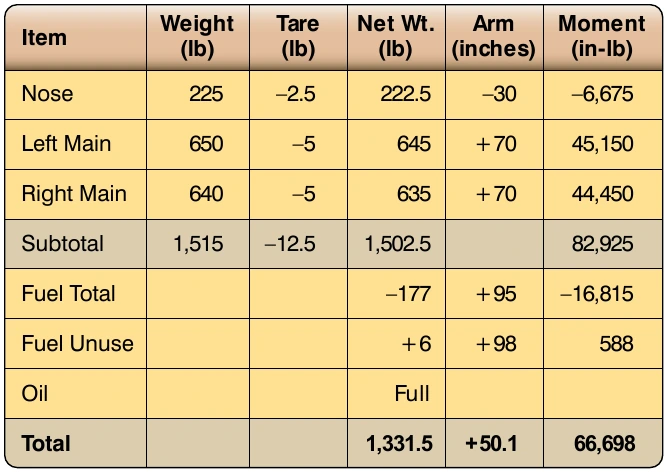
The CG is 19.7 inches behind the datum.
Datum Aft of the Main Wheels–Tail Wheel Landing Gear
The datum of the airplane in Figure 6-32 is located at the intersection of the wing root trailing edge and the fuselage. This places the arm of the main gear (D) at –80". The net weight of the tail wheel (R) is 67 lb, the distance between the main wheels and the tail wheel (L) is 222", and the total net weight (W) of the airplane is 1,218 lb.
Since the datum is aft of the main wheels, use the formula:
The CG is 67.8" forward of the datum, or 12.2" aft of the main-gear weighing points. The CG is in the same location relative to the main wheels, regardless of where the datum is located.
Loading an Aircraft for Flight
The ultimate test of whether there is a problem with an airplane’s weight and balance is when it is loaded and ready to fly. The only real importance of an airplane’s empty weight and EWCG is how it affects the loaded weight and balance of the airplane, since an airplane does not fly when it is empty. The pilot-in-command is responsible for the weight and balance of the loaded airplane, and they make the final decision on whether the airplane is safe to fly.
Example Loading of an Airplane
As an example of an airplane being loaded for flight, the Piper Seneca twin will be used. The TCDS for this airplane was shown earlier in this chapter, and its CG range and CG envelope were also shown.
The information from the TCDS that pertains to this example loading is shown in Figure 6-33.
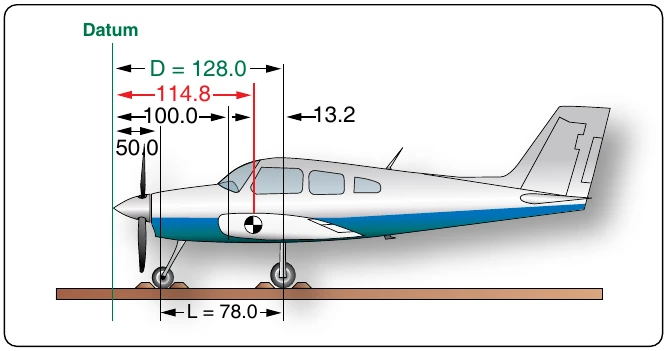
information applies:
- Airplane Serial Number: 34-7250816
- Airplane Empty Weight: 2,650 lb
- Airplane EWCG: +86.8"
For today’s flight, the following useful load items are included:
- 1 pilot at 180 lb at an arm of +85.5"
- 1 passenger at 160 lb at an arm of +118.1"
- 1 passenger at 210 lb at an arm of +118.1"
- 1 passenger at 190 lb at an arm of +118.1"
- 1 passenger at 205 lb at an arm of +155.7"
- 50 lb of baggage at an arm of +22.5"
- 100 lb of baggage at an arm of +178.7"
- 80 gal of fuel at an arm of +93.6"
To calculate the loaded weight and CG of this airplane, a four-column chart is used in Figure 6-34.
Based on the information in the TCDS, the maximum takeoff weight of this airplane is 4,200 lb and the aft-most CG limit is +94.6". The loaded airplane in Figure 6-34 is 25 lb too heavy, and the CG is 1.82" too far aft. To make the airplane safe to fly, the load needs to be reduced by 25 lb and some of the load needs to be shifted forward. For example, the baggage can be reduced by 25 lb, and a full 100 lb of it can be placed in the more forward compartment. One passenger can be moved to the forward seat next to the pilot, and the aft-most passenger can then be moved forward.