
Chapter 6
Aircraft Weight & Balance
Operating CG Range
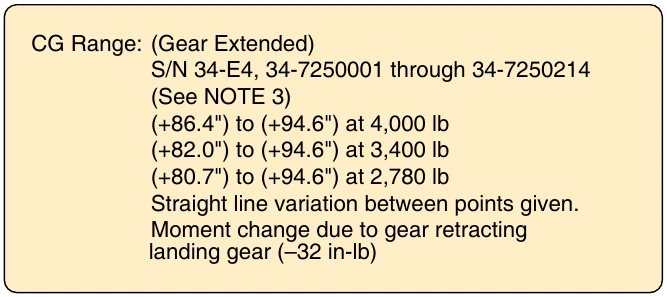
All aircraft have CG limits identified for the operational condition, with the aircraft loaded and ready for flight. If an aircraft can operate in more than one category, such as normal and utility, more than one set of limits might be listed. As shown earlier for the Piper Seneca airplane, the limits can change as the weight of the aircraft increases. To legally fly, the CG for the aircraft must fall within the CG limits.
Standard Weights Used for Aircraft Weight and Balance
Unless the specific weight for an item is known, the standard weights used in aircraft weight and balance are as follows:
- Avgas 6 lb/gal
- Turbine fuel 6.7 lb/gal
- Lubricating oil 7.5 lb/gal
- Water 8.35 lb/gal
- Crew and passengers 170 lb per person
Example Weighing of an Airplane
In Figure 6-26, a tricycle gear airplane is being weighed by using three floor scales. The specifications on the airplane and the weighing specific data are shown in Figure 6-27.
By analyzing the data identified for the airplane being weighed in Figure 6-26, the following information is determined.
- Because the airplane was weighed with the fuel tanks full, the full weight of the fuel must be subtracted and the unusable fuel added back in. The weight of the fuel being subtracted is based on the pounds per gallon determined by the hydrometer check (5.9 lb/gal).
- Because wheel chocks are used to keep the airplane from rolling off the scales, their weight must be subtracted from the scale readings as tare weight.
- Because the main wheel centerline is 70" behind the datum, its arm is a +70".
- The arm for the nosewheel is the difference between the wheelbase (100") and the distance from the datum to the main wheel centerline (70"). Therefore, the arm for the nosewheel is −30".
To calculate the airplane’s empty weight and EWCG, a six-column chart is used. Figure 6-28 shows the calculation for the airplane in Figure 6-26.
Based on the calculation shown in the chart, the CG is at +50.1", which means it is 50.1" aft of the datum. This places of 1,331.5 lb.
EWCG Formulas
The EWCG can be quickly calculated by using the following formulas. There are four possible conditions and formulas that relate the location of the CG to the datum. Notice that the formula for each condition first determines the moment of the nose F × L wheel or tail R × L wheel and then divides it W W by the total weight of the airplane. The arm is then added to or subtracted from the distance between the main wheels and the datum (distance D).
Formula 1 Nosewheel airplanes with datum forward of the main wheels.
Formula 2 Nosewheel airplanes with the datum aft of the main wheels.
Formula 3 Tail wheel airplanes with the datum forward of the main wheels.