Chapter 6
Aircraft Weight & Balance
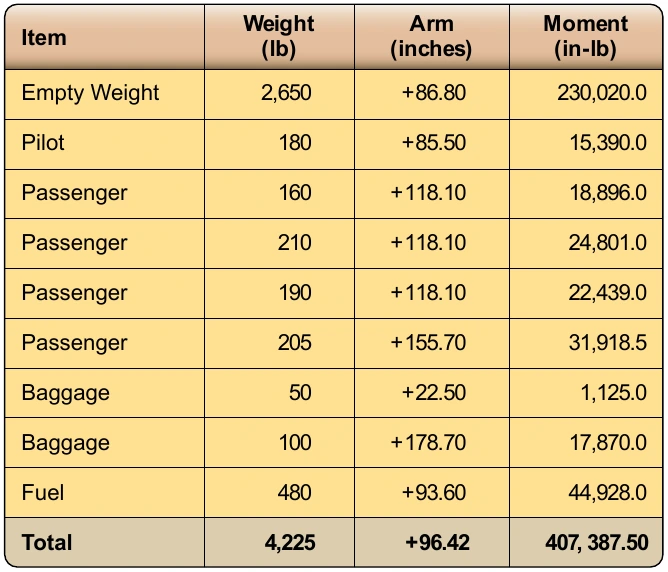
With the changes made, the loaded weight is now at the maximum allowable of 4,200 lb, and the CG has moved forward 4.42". [Figure 6-35] The airplane is now safe to fly.
Adverse-Loaded CG Checks
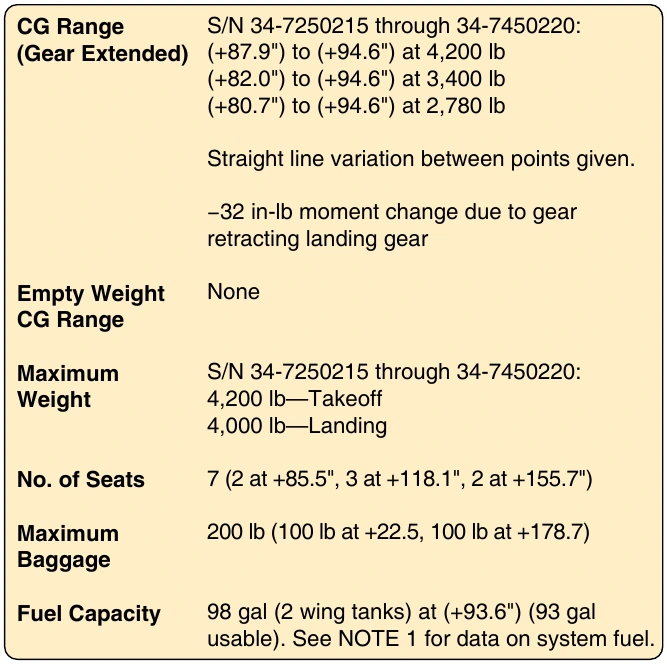
Many modern aircraft have multiple rows of seats and often more than one baggage compartment. After any repair or alteration that changes the weight and balance, the A&P mechanic or repairman must ensure that no legal condition of loading can move the CG outside of its allowable limits. To determine this, adverse-loaded CG checks must be performed and the results noted in the weight and balance revision sheet.
During a forward adverse-loaded CG check, all useful load items in front of the forward CG limit are loaded and all useful load items behind the forward CG limit are left empty. So, if there are two seats and a baggage compartment located in front of the forward CG limit, two people weighing 170 lb each are seated and the maximum allowable baggage is placed in the baggage compartment. Any seat or baggage compartment located behind the forward CG limit is left empty. If the fuel is located behind the forward CG limit, minimum fuel will be shown in the tank. Minimum fuel is calculated by dividing the engine’s METO hp by 2.
During an aft adverse-loaded CG check, all useful load items behind the aft CG limit are loaded and all useful load items in front of the aft CG limit are left empty. Even though the pilot’s seat will be in front of the aft CG limit, the pilot’s seat cannot be left empty. If the fuel tank is located forward of the aft CG limit, minimum fuel will be shown.
Example Forward & Aft Adverse-Loaded CG Checks
Using the stick airplane in Figure 6-36 as an example, adverse forward and aft CG checks are calculated. Some of the data for the airplane is shown in Figure 6-36, such as seat, baggage, and fuel information. The CG limits are shown, with arrows pointing in the direction where maximum and minimum weights are loaded. On the forward check, any useful load item located in front of 89" is loaded, and anything behind that location is left empty. On the aft check, maximum weight is added behind 99" and minimum weight in front of that location. For either of the checks, if fuel is not located in a maximum weight location, minimum fuel must forward check, the pilot’s seat will be shown at 82", and in the aft check it will be at 88". Additional specifications for the airplane shown in Figure 6-36 are as follows:
- Airplane empty weight: 1,850 lb
- EWCG: +92.45"
- CG limits: +89" to +99"
- Maximum weight: 3,200 lb
- Fuel capacity: 45 gal at +95" (44 usable) 40 gal at +102" (39 usable)
In evaluating the two extreme condition checks, the following key points should be recognized. [Figure 6-37]
- The total arm is the airplane CG and is found by dividing the total moment by the total weight.
- For the forward check, the only thing loaded behind the forward limit was minimum fuel.
- For the forward check, the pilot and passenger seats were shown at the forward position of 82".
aft limit was the pilot, at an arm of 88".
- For the aft check, the fuel tank at 102" was filled, which more than accounted for the required minimum fuel.
- For the aft check, the CG was out of limits by 0.6", so the airplane should not be flown this way.
Equipment Change & Aircraft Alteration
When the equipment in an aircraft is changed, such as the installation of a new radar system or ground proximity warning system, or the removal of a radio or seat, the weight and balance of an aircraft changes. An alteration performed on an aircraft, such as a cargo door being installed or a reinforcing plate being attached to the spar of a wing, also changes the weight and balance of an aircraft. Any time the equipment is changed or an alteration is performed, the new empty weight and EWCG must be determined. This can be accomplished by placing the aircraft on scales and weighing it, or by mathematically calculating the new weight and balance. The mathematical calculation is acceptable if the exact weight and arm of all the changes are known.