Chapter 6
Aircraft Weight & Balance
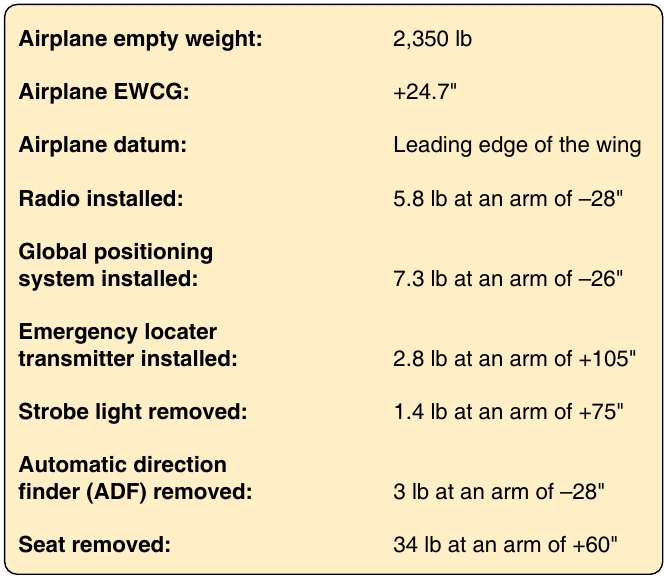
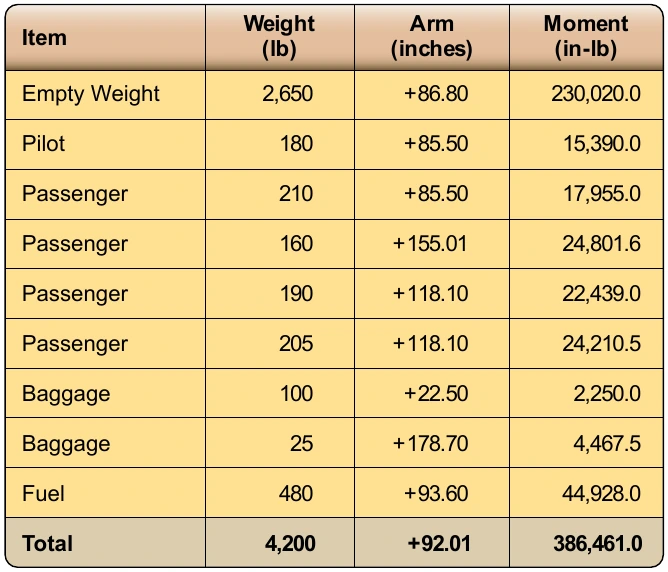
A small, twin-engine airplane has some new equipment installed and some of its existing equipment removed. The details of the equipment changes are shown in Figure 6-38. To calculate the new empty weight and EWCG, a four-column chart is used. [Figure 6-39] In evaluating the weight and balance calculation shown in Figure 6-39, the following key points should be recognized.
- The weight of the equipment needs to be identified with a plus or minus to signify whether it is being installed or removed.
- The sign of the moment (plus or minus) is determined by the signs of the weight and arm.
- The strobe and the ADF are both being removed (negative weight), but only the strobe has a negative moment. This is because the arm for the ADF is also negative, and two negatives multiplied together produce a positive result.
- The total arm is the airplane’s CG and is found by dividing the total moment by the total weight.
Use of Ballast
Ballast is used in an aircraft to attain the desired CG balance, when the CG is not within limits or is not at the location desired by the operator. It is usually located as far aft or as far forward as possible to bring the CG within limits, while using a minimum amount of weight.
Temporary Ballast
Temporary ballast, in the form of lead bars, heavy canvas bags of sand, or lead shot, is often carried in the baggage compartments to adjust the balance for certain flight conditions. The bags are marked “Ballast XX Pounds– Removal Requires Weight and Balance Check.” Temporary ballast must be secured so it cannot shift its location in flight, and the structural limits of the baggage compartment must not be exceeded. All temporary ballast must be removed before the aircraft is weighed.
Temporary Ballast Formula
The CG of a loaded airplane can be moved into its allowable range by shifting passengers or cargo or by adding temporary ballast. To determine the amount of temporary ballast needed, use this formula:
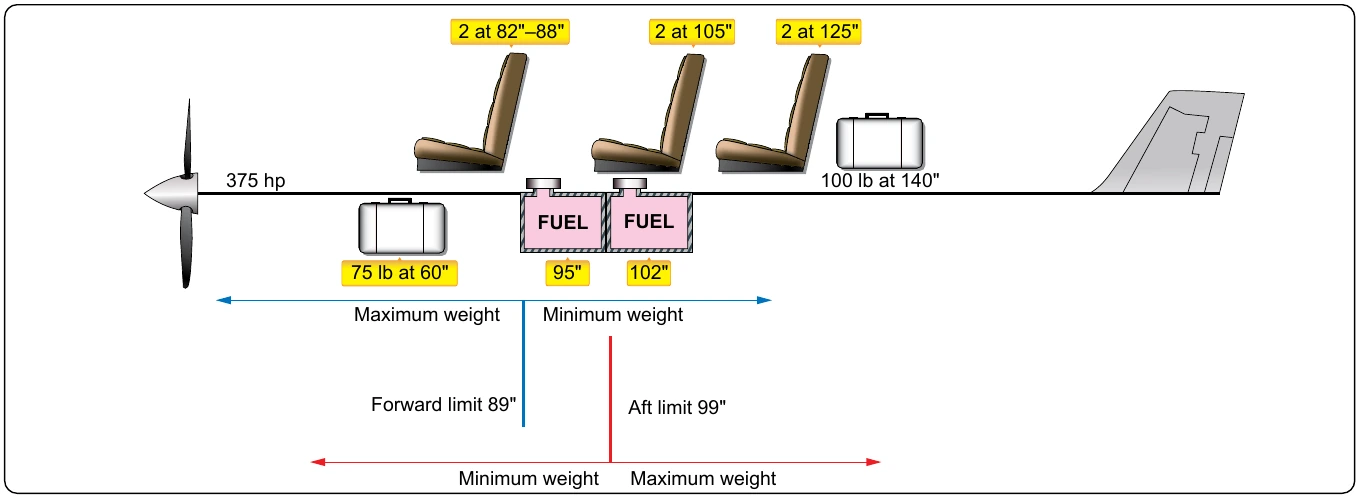
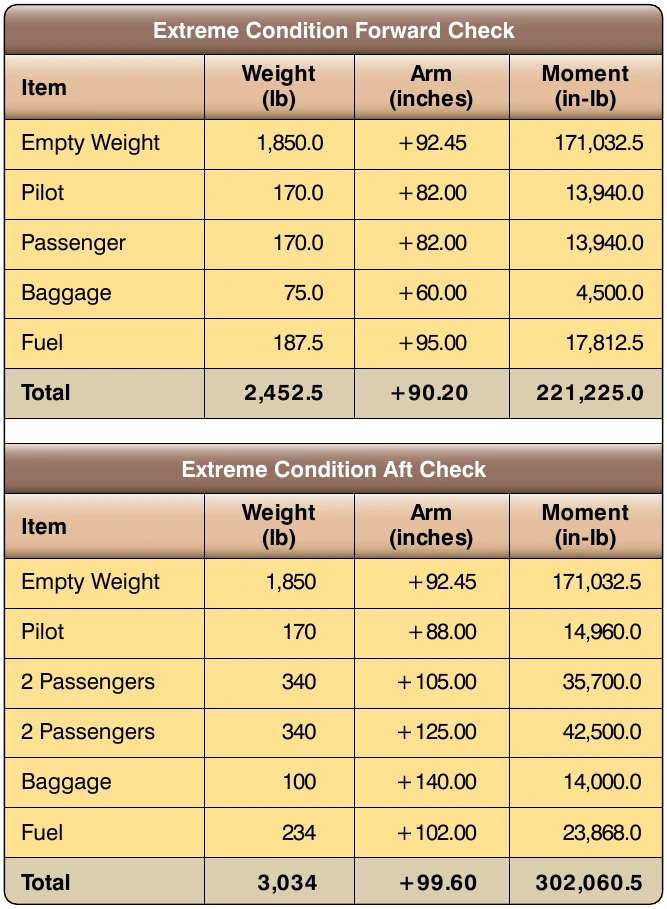
Figures 6-36 and 6-40 show an aft adverse-loaded CG check being performed on an airplane. In this previous example, the airplane’s CG was out of limits by 0.6". If there were a need or a desire to fly the airplane loaded this way, one way to make it possible would be the installation of temporary ballast in the front of the airplane. The logical choice for placement of this ballast is the forward baggage compartment. The CG for this airplane is 0.6" too far aft. If the forward baggage compartment is used as a temporary ballast location, the ballast calculation will be as shown in Figure 6-41.
When ballast is calculated, the answer should always be rounded up to the next higher whole pound, or in this case, 47 lb of ballast would be used. To ensure the ballast calculation is correct, the weight of the ballast should be plugged back into the four-column calculation and a new CG calculated.
The aft limit for the airplane was 99", and the new CG is at 98.96", which puts it within acceptable limits. The new CG did not fall exactly at 99" because the amount of needed ballast was rounded up to the next whole pound. If the ballast could have been placed farther forward, such as being bolted to the engine firewall, less ballast would have been needed. That is why ballast is always placed as far away from the affected limit as possible.
In evaluating the ballast calculation shown above, the following key points should be recognized.
- The loaded weight of the aircraft, as identified in the formula, is what the airplane weighed when the CG was out of limits.
- The distance the CG is out of limits is the difference between the CG location and the CG limit, in this case 99.6" minus 99".
- The affected limit identified in the formula is the CG limit which has been exceeded. If the CG is too far aft, it is the aft limit that has been exceeded.
- The aft limit for this example is 99", and the ballast