
Chapter 6
Aircraft Weight & Balance
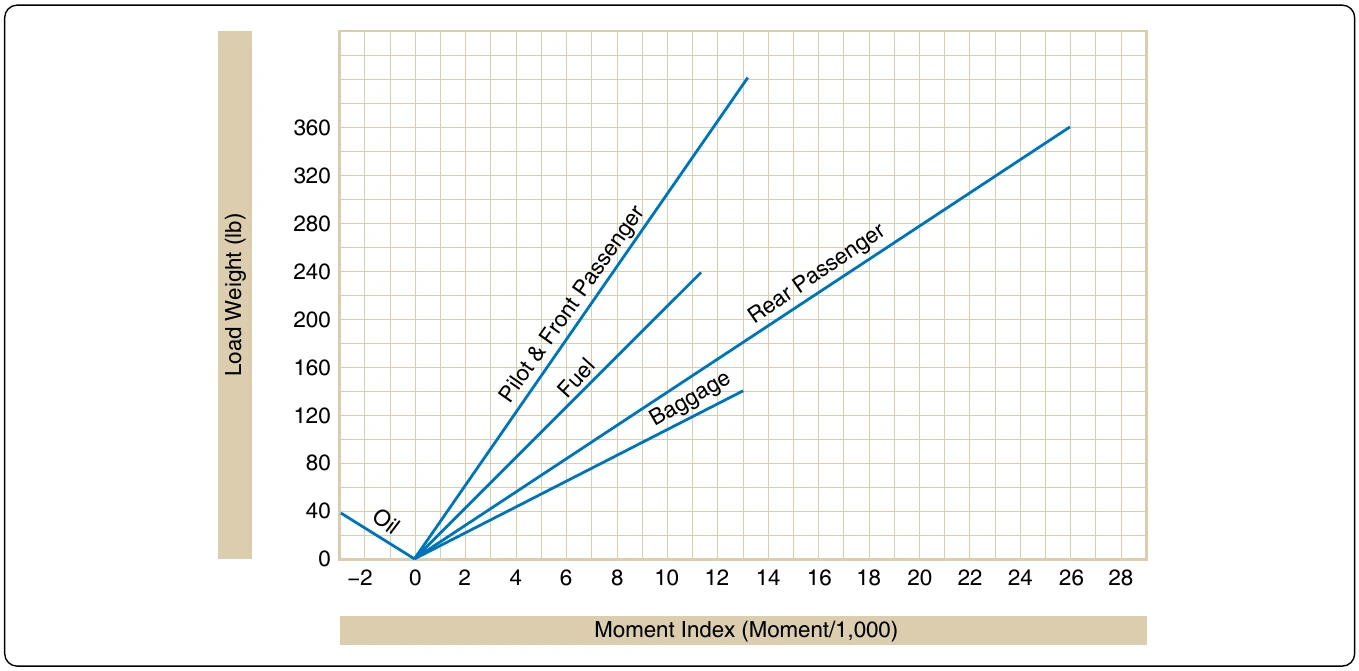
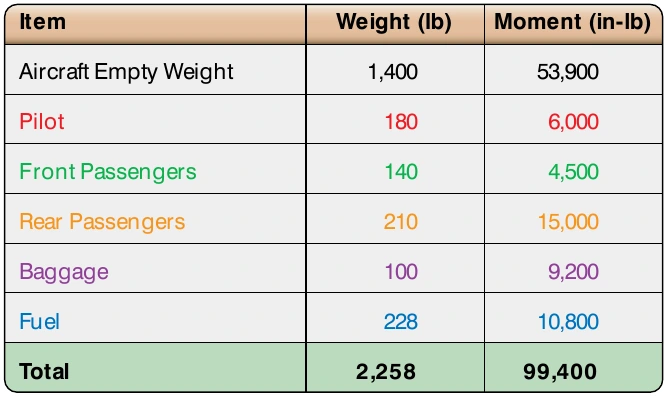
An example of loading the airplane for flight and calculating the total loaded weight and the total loaded moment is shown in Figures 6-45 and 6-46. The use of the loading graph to determine the moment for each of the useful load items is shown in Figure 6-46. The color used for each useful load item in Figure 6-45 matches the color used for the plot on the loading graph.
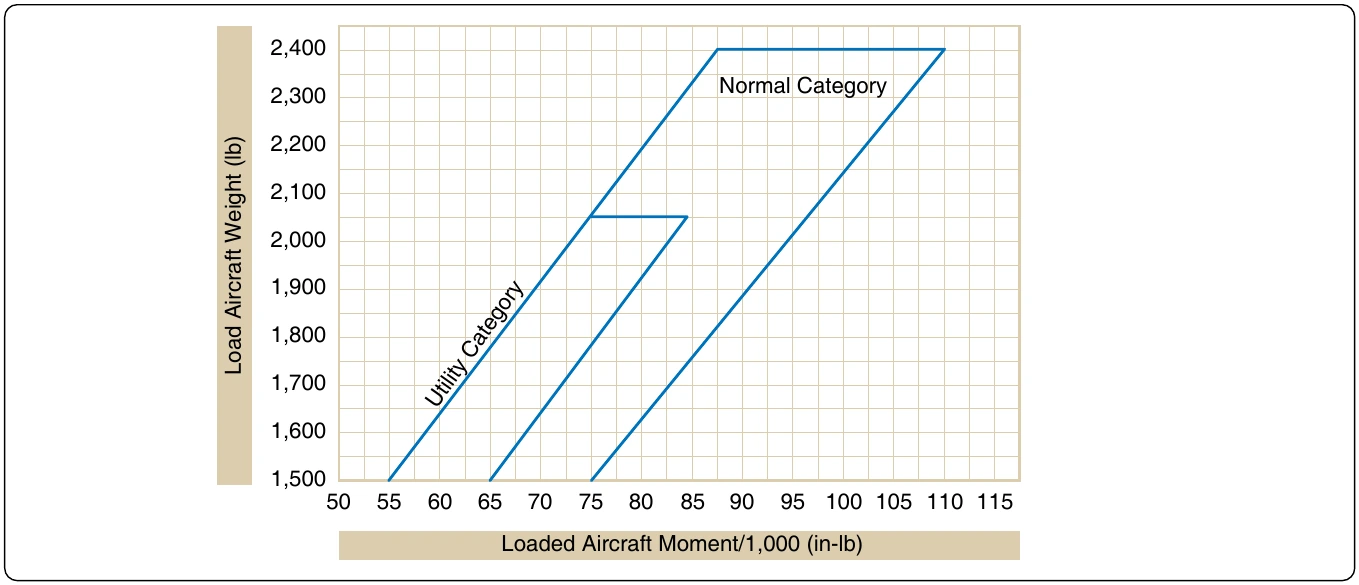
The total loaded weight of the airplane is 2,258 lb and the total loaded moment is 99,400 in-lb. These two numbers can now be plotted on the CG envelope to see if the airplane is within CG limits. Figure 6-47 shows the CG envelope with the loaded weight and moment of the airplane plotted. The CG location shown falls within the normal category envelope, so the airplane is within CG limits for this category.
It is interesting to note that the lines that form the CG envelope are graphic plots of the forward and aft CG limits. In Figure 6-47, the red line is a graphic plot of the forward limit, and the blue and green lines are graphic plots of the aft limit for the two different categories.
Helicopter Weight & Balance
General Concepts
All the terminology and concepts that apply to airplane weight and balance also apply generally to helicopter weight and balance. However, there are some specific differences that need to be identified.
Most helicopters have a much more restricted CG range than airplanes. In some cases, this range is less than 3". The exact location and length of the CG range is specified for each helicopter and usually extends a short distance fore and aft of the main rotor mast or centered between the main rotors of a dual rotor system. Whereas airplanes have a CG range only along the longitudinal axis, helicopters have both longitudinal and lateral CG ranges. Because the wings extend outward from the CG, airplanes tend to have a great deal of lateral stability. A helicopter, on the other hand, acts like a pendulum, with the weight of the helicopter hanging from the main rotor shaft.
Ideally, the helicopter should have such perfect balance that the fuselage remains horizontal while in a hover. If the helicopter is too nose heavy or tail heavy while it is hovering, the cyclic pitch control is used to keep the fuselage horizontal. If the CG location is too extreme, it may not be possible to keep the fuselage horizontal or maintain control of the helicopter.
Helicopter Weighing
When a helicopter is being weighed, the location of both longitudinal and lateral weighing points must be known to determine its empty weight and EWCG. This is because helicopters have longitudinal and lateral CG limits. As with the airplane, the longitudinal arms are measured from the datum, with locations behind the datum being positive arms and locations in front of the datum being negative arms. Laterally, the arms are measured from the butt line, which is a line from the nose to the tail running through the middle of the helicopter. When facing forward, arms to the right of the butt line are positive; to the left they are negative.
Before a helicopter is weighed, it must be leveled longitudinally and laterally. This can be done with a spirit floor. On the cabin floor is a plate bearing cross hairs that correspond to the horizontal and lateral axis of the helicopter. When the point of the plumb bob falls in the middle of the cross hairs, the helicopter is level along both axes. If the tip of the plumb bob falls forward of this point, the nose of the helicopter is too low; if it falls to the left of this point, the left side of the helicopter is too low. In other words, the tip of the plumb bob always moves toward the low point.
A Bell JetRanger helicopter is shown in Figure 6-48 with the leveling plate depicted on the bottom right of the figure. The helicopter has three jack pads, two at the front and one in the back. To weigh this helicopter, three jacks would be placed on floor scales, and the helicopter would be raised off the hangar floor. To level the helicopter, the jacks would be adjusted until the plumb bob point falls exactly in the middle of the cross hairs.
As an example of weighing a helicopter, consider the Bell JetRanger in Figure 6-48, and the following specifications and weighing data shown in Figure 6-49.
Using six-column charts for the calculations, the empty weight and the longitudinal and lateral CG for the helicopter is shown in Figure 6-50. Based on the calculations in Figure 6-50, it has been determined that the empty weight of the helicopter is 1,985 lb, the longitudinal CG is at +108.73", and the lateral CG is at –0.31".
Weight and Balance—Weight-Shift Control Aircraft and Powered Parachutes
The terminology, theory, and concepts of weight and balance that applies to airplanes also applies to weight-shift control aircraft and powered parachutes. Weight is still weight, and the balance point is still the balance point. However, there are a few differences that need to be discussed. Before reading about the specifics of weight and balance on weight-shift control aircraft and powered parachutes, be sure to read about their aerodynamic characteristics in Chapter 5, Physics. Weight-shift control aircraft and powered parachutes do not fall under the same Code of Federal Regulations that govern certified airplanes and helicopters and, therefore, do not have TCDS or the same type of FAA-mandated weight and balance reports. Weight and balance information and guidelines are left to the individual owners and the companies with which they work in acquiring this type of aircraft. Overall, the industry that is supplying these aircraft is regulating itself well, and the safety record is good for those aircraft being operated by experienced pilots.