Chapter 6
Aircraft Weight & Balance
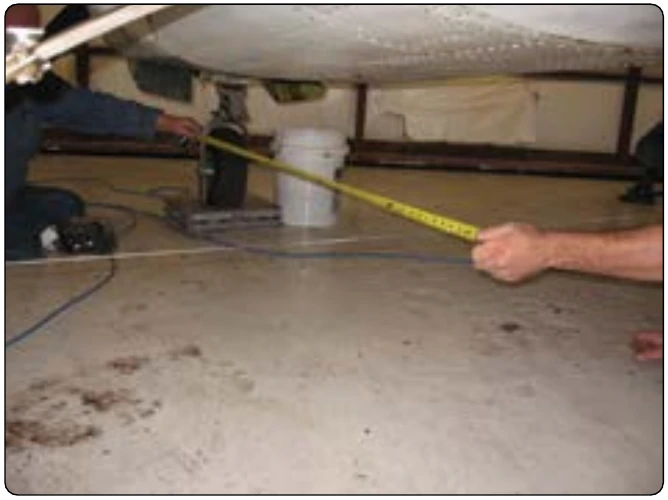
The arm for each of the weighing points is the distance from the center of the weight transfer point to the aircraft’s datum. If the arms are not known, based on previous weighing of the aircraft or some other source of data, they must be measured when the aircraft is weighed. This involves dropping a plumb bob from the center of each weighing point and from the aircraft datum, and putting a chalk mark on the hangar floor representing each point. The perpendicular distance between the datum and each of the weighing points can then be measured. In Figure 6-23, the distance from the nosewheel centerline to the datum is being measured on an airplane. The nosewheel sitting on an electronic scale can be seen in the background.
Jacking the Aircraft
Aircraft are often weighed by rolling them onto ramps in which load cells are embedded. This eliminates the problems associated with jacking the aircraft off the ground. However, many aircraft are weighed by jacking the aircraft up and then lowering them onto scales or load cells. Extra care must be used when raising an aircraft on jacks for weighing. If the aircraft has spring steel landing gear and it is jacked at the wheel, the landing gear will slide inward as the weight is taken off the tire. Care must be taken to prevent the jack from tipping over. For some aircraft, stress panels or plates must be installed before they are raised with wing jacks to distribute the weight over the jack pad. Be sure to follow the recommendations of the aircraft manufacturer in detail anytime an aircraft is jacked. When using two wing jacks, take special care to raise them simultaneously, so the aircraft does not slip off the jacks. As the jacks are raised, keep the safety collars screwed down against the jack cylinder to prevent the aircraft from tilting if one of the jacks should lose hydraulic pressure.
Leveling the Aircraft
When an aircraft is weighed, it must be in its level flight attitude so that all the components are at the correct distance from the datum. This attitude is determined by information in the TCDS. Some aircraft require a plumb line to be dropped from a specified location so that the point of the weight, the bob, hangs directly above an identifiable point. Others specify that a spirit level be placed across two leveling lugs (special screws on the outside of the fuselage). Other aircraft call for a spirit level to be placed on the upper door sill. Lateral level is not specified for all light aircraft, but provisions are normally made on helicopters for determining both longitudinal and lateral level. This may be done by built-in leveling indicators or by a plumb bob that shows the conditions of both longitudinal and lateral level. The actual adjustments to level the aircraft using load cells are made with the jacks. When weighing from the wheels, leveling is normally done by adjusting the air pressure in the nosewheel shock strut.
Safety Considerations
Special precautions must be taken when raising an aircraft on jacks.
- Stress plates must be installed under the jack pads if the manufacturer specifies them.
- If anyone is required to be in the aircraft while it is being jacked, there must be no movement.
- The jacks must be straight under the jack pads before beginning to raise the aircraft.
- All jacks must be raised simultaneously and safety devices placed against the jack cylinder to prevent the aircraft from tipping if any jack should lose pressure. Not all jacks have screw-down collars, some use drop pins or friction locks.
CG Range
The CG range for an aircraft is the limits within which the aircraft must balance. It is identified as a range and considered an arm extending from the forward most limit to the aft most limit usually expressed in inches. In the TCDS for the Piper Seneca airplane, shown earlier in this chapter, the range is given in Figure 6-24.
Because the Piper Seneca is a retractable gear airplane, the specifications identify that the range applies when the landing gear is extended, and that the airplane’s total moment is decreased by 32 when the gear retracts. To know how much the CG changes when the gear is retracted, the moment of
Based on the numbers given, up to a loaded weight of 2,780 lb, the forward CG limit is +80.7" and the aft CG limit is +94.6". As the loaded weight of the airplane increases to 3,400 lb, and eventually to the maximum of 4,000 lb, the forward CG limit moves aft. In other words, as the loaded weight of the airplane increases, the CG range gets smaller.
The range gets smaller because of the forward limit moving back, while the aft limit stays in the same place.
The data sheet identifies that there is a straight-line variation between the points given. The points being referred to are the forward and aft CG limits. From a weight of 2,780 lb to a weight of 3,400 lb, the forward limit moves from +80.7" to +82.0", and if plotted on a graph, that change would form a straight line. From 3,400 lb to 4,000 lb, the forward limit moves from +82 to +86.4", again forming a straight line. Plotted on a graph, the CG limits would look like
what is known as the CG envelope.
In Figure 6-25, the red line represents the forward limit up to a weight of 2,780 lb. The blue and green lines represent the straight-line variation that occurs for the forward limit as the weight increases up to a maximum of 4,000 lb. The yellow line represents the maximum weight for the airplane, and the purple line represents the aft limit.
Empty Weight Center of Gravity (EWCG) Range
For some aircraft, a CG range is given for the aircraft in the empty weight condition in the TCDS. This practice is not very common with airplanes, but is often done for helicopters. This range would only be listed for an airplane if the fuel tanks, seats, and baggage compartments are so located that changes in the fuel or occupant load have a very limited effect on the balance of the aircraft. If the EWCG of an aircraft falls within the EWCG limits, it is impossible to legally load the aircraft so that its loaded CG falls outside of its allowable range. If the TCDS lists an EWCG range and, after a repair or alteration is completed, the EWCG falls within this range, then there is no need to compute a fore and aft check for adverse loading. But if the TCDS lists the EWCG range as “None” (and most of them do), a check must be made to determine whether it is possible by any combination of legal loading to cause the aircraft CG to move outside of either its forward or aft limits.