
Chapter 6
Aircraft Weight & Balance
- Weigh the aircraft with absolutely no fuel in the aircraft tanks or fuel lines. If an aircraft is weighed in this condition, the technician can mathematically add the proper amount of residual fuel to the aircraft and account for its arm and moment. The proper amount of fuel can be determined by looking in the aircraft’s TCDS.
- Drain fuel from the tanks in the manner specified by the aircraft manufacturer. If there are no specific instructions, drain the fuel until the fuel quantity gauges read empty and until fuel stops draining from the tanks. The aircraft attitude may be a consideration when draining the fuel tanks and the maintenance manual should be consulted. In this case, the unusable fuel will remain in the lines and system, and its weight and arm can be determined by reference to the aircraft’s TCDS.
- Weigh the aircraft with the fuel tanks completely full. If an aircraft is weighed in this condition, the technician can mathematically subtract the weight of usable fuel and account for its arm and moment. If the weight of the fuel is in question, a hydrometer can
an aircraft is to be weighed with load cells attached to jacks, the technician should check both the load cell instruction manual and aircraft maintenance manual to make sure it is permissible to jack the aircraft with the fuel tanks full as this may add additional stress to the aircraft structure.
Never weigh an aircraft with fuel tanks partially full, because it will be impossible to determine exactly how much fuel to account for.
Oil System
The empty weight for older aircraft certificated under the Civil Air Regulations (CAR) part 3 does not include the engine lubricating oil. The oil must be drained before the aircraft is weighed, or its weight must be subtracted from the scale readings to determine the empty weight.
To weigh an aircraft that does not include the engine lubricating oil as part of the empty weight, place it in level flight attitude, then open the drain valves and allow all the oil that is able, to drain out. Any remaining is undrainable oil and is part of the empty weight.
If it is impractical to drain the oil, the reservoir can be filled to the specified level and the weight of the oil computed at 7.5 lb/gal. Then its weight and moment are subtracted from the weight and moment of the aircraft as weighed. The amount and arm of the undrainable oil are found in NOTE 1 of the TCDS, and this must be added to the empty weight.
For aircraft certificated since 1978 under 14 CFR parts 23 and 25, full engine oil is typically included in an aircraft’s empty weight. This can be confirmed by looking at the TCDS. If full oil is to be included, the oil level needs to be checked and the oil system serviced if it is less than full.
Miscellaneous Fluids
The hydraulic fluid reservoir and all other reservoirs containing fluids required for normal operation of the aircraft should be full. Fluids not considered to be part of the empty weight of the aircraft are potable (drinkable) water, lavatory precharge water, and water for injection into the engines.
Flight Controls
The position of such items as spoilers, slats, flaps, and helicopter rotor systems is an important factor when weighing an aircraft. Always refer to the manufacturer’s instructions for the proper position of these items.
Other Considerations
Inspect the aircraft to see that all items included in the certificated empty weight are installed in the proper location. Remove items that are not regularly carried in flight. Also, look in the baggage compartments to make sure they are empty. Replace all inspection plates, oil and fuel tank caps, junction box covers, cowling, doors, emergency exits, and other parts that have been removed during maintenance. All doors, windows, and sliding canopies should be in the normal flight position. Remove excessive dirt, oil, grease, and moisture from the aircraft.
Some aircraft are not weighed with the wheels on the scales, but are weighed with the scales placed either at the jacking points or at special weighing points. Regardless of what provisions are made for placing the aircraft on the scales or jacks, be careful to prevent it from falling or rolling off, thereby damaging the aircraft and equipment. When weighing an aircraft with the wheels placed on the scales, release the brakes to reduce the possibility of incorrect readings caused by side loads on the scales.
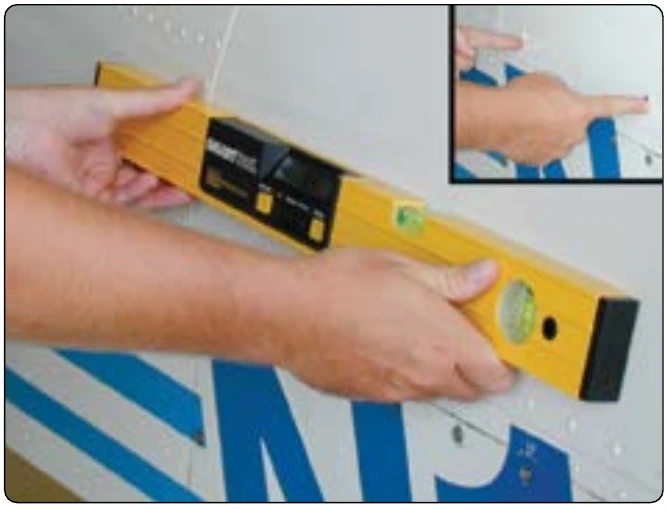
All aircraft have leveling points or lugs, and care must be taken to level the aircraft, especially along the longitudinal axis. With light, fixed-wing airplanes, the lateral level is not as critical as it is with heavier airplanes. However, a reasonable effort should be made to level the light airplanes along the lateral axis. Helicopters must be level longitudinally and laterally when they are weighed. Accuracy in leveling all aircraft longitudinally cannot be overemphasized.
Weighing Points
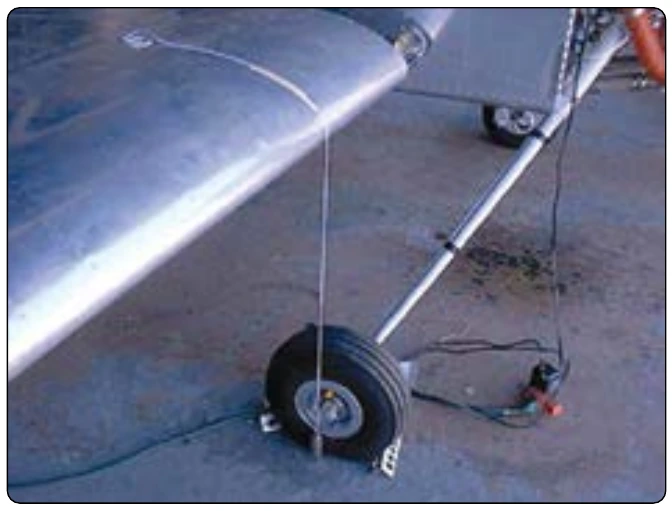
When an aircraft is being weighed, the arms must be known for the points where the weight of the aircraft is being transferred to the scales. If a tricycle gear small airplane has its three wheels sitting on floor scales, the weight transfer to each scale happens through the center of the axle for each wheel. If an airplane is weighed while it is on jacks, the weight transfer happens through the center of the jack pad. For a helicopter with skids for landing gear, determining the arm for the weighing points can be difficult if the skids are sitting directly on floor scales. The problem is that the skid is in contact with the entire top portion of the scale, and it is impossible to know exactly where the center of weight transfer is occurring. In such a case, place a piece of pipe between the skid and the scale, and the center of the pipe will now be the known point of weight transfer.