
Chapter 6
Aircraft Weight & Balance
Before an aircraft can be weighed and reliable readings obtained, it must be in a level flight attitude. One method that can be used to check for a level condition is to use a spirit level, sometimes thought of as a carpenter’s level, by placing it on or against a specified place on the aircraft. Spirit levels consist of a vial full of liquid, except for a small air bubble. When the air bubble is centered between the two black lines, a level condition is indicated.
In Figure 6-21, a spirit level is being used on a Mooney M20 to check for a flight level attitude. By looking in the TCDS, it is determined that the leveling means is two screws on the left side of the airplane fuselage, in line with the trailing edge of the wing.
d within a TCDS.
Plumb Bob
A plumb bob is a heavy metal object, cylinder or cone shape, with a sharp point at one end and a string attached to the other end. If the string is attached to a given point on an aircraft, and the plumb bob can hang down so the tip just touches the ground, the point where the tip touches will be perpendicular to where the string is attached. An example of the use of a plumb bob would be measuring the distance from an aircraft’s datum to the center of the main landing gear axle. If the leading edge of the wing was the datum, a plumb bob could be dropped from the leading edge and a landing gear, and a chalk mark made on the floor. With a tape measure, the distance between the two chalk marks could be determined, and the arm for the main landing gear would be known. Plumb bobs can also be used to level an aircraft, as described in the Helicopter Weight and Balance section of this chapter. Figure 6-22 shows a plumb bob being dropped from the leading edge of an aircraft wing.
Hydrometer
When an aircraft is weighed with full fuel in the tanks, the weight of the fuel must be accounted for by mathematically subtracting it from the scale readings. To subtract it, its weight, arm, and moment must be known. Although the standard weight for aviation gasoline (Avgas) is 6.0 lb/gal and jet fuel is 6.7 lb/gal, these values are not exact for all conditions. On a hot day versus a cold day, these values can vary dramatically. On a hot summer day in the state of Florida, Avgas checked with a hydrometer typically weighs between 5.85 and 5.9 lb/gal. If 100 gallons of fuel were involved in a calculation, using the actual weight versus the standard weight would make a difference of 10 to 15 lb.
When an aircraft is weighed with fuel in the tanks, the weight of fuel per gallon should be checked with a hydrometer. A hydrometer consists of a weighted glass tube that is sealed with a graduated set of markings on the side of the tube. The graduated markings and their corresponding number values represent units of pounds per gallon (lb/gal). When placed in a flask with fuel in it, the glass tube floats at a level dependent on the density of the fuel. Where the fuel intersects the markings on the side of the tube indicates the pounds per gallon.
Preparing an Aircraft for Weighing
Weighing an aircraft is a very important and exacting phase of aircraft maintenance and must be carried out with accuracy and good workmanship. Thoughtful preparation saves time and prevents mistakes. The aircraft should be weighed inside a hangar where wind cannot blow over the surface and cause fluctuating or false scale readings. The aircraft should be clean inside and out, with special attention paid to the bilge area to be sure no water or debris is trapped. The outside of the aircraft should be as free as possible of all mud and dirt.
To begin, assemble all the necessary equipment, such as:
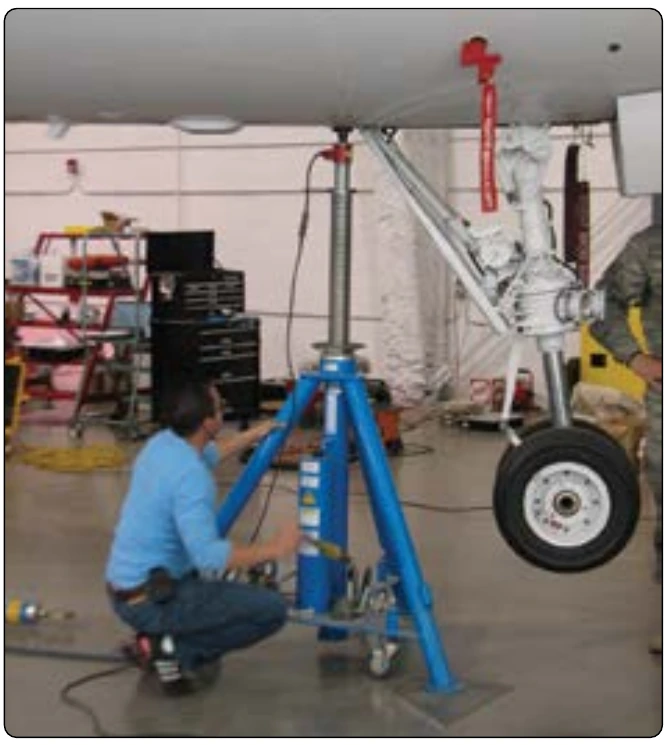
- Scales, hoisting equipment, jacks, and leveling equipment.
- Blocks, chocks, or sandbags for holding the airplane
on the scales.
- Straightedge, spirit level, plumb bobs, chalk line, and a measuring tape.
- Applicable Aircraft Specifications and weight and balance computation forms.
Fuel System
When weighing an aircraft to determine its empty weight, only the weight of residual (unusable) fuel should be included. To ensure that only residual fuel is accounted for, the aircraft should be weighed in one of the following three conditions.