
Chapter 7
Aircraft Materials, Hardware, & Processes
Airloc Fasteners
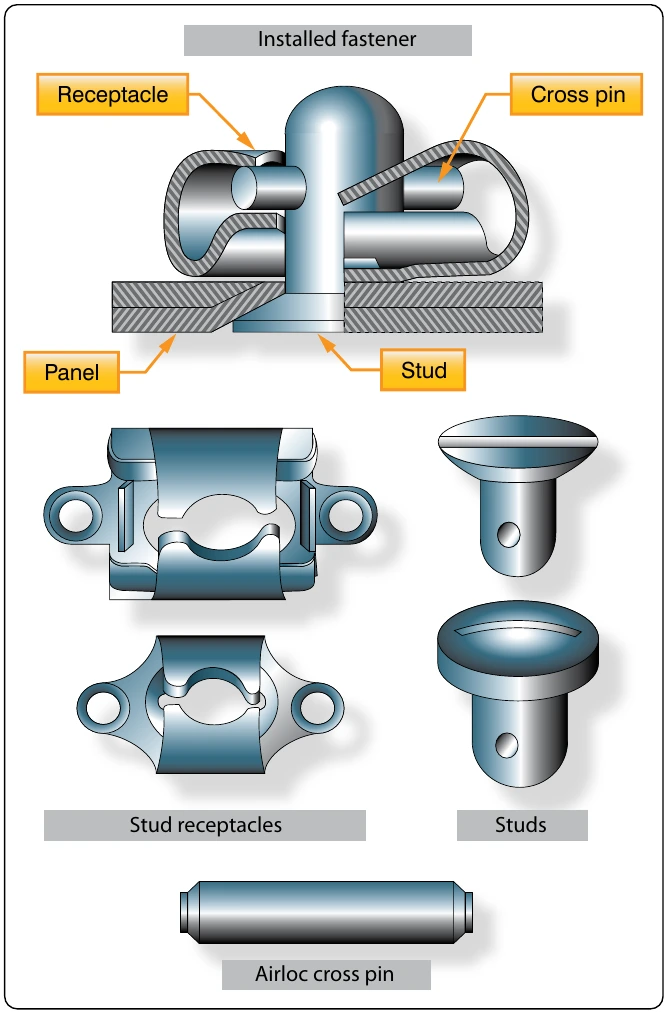
The Airloc fastener consists of three parts: a stud, a cross pin, and a stud receptacle. [Figure 7-61] The studs are manufactured from steel and case hardened to prevent excessive wear. The stud hole is reamed for a press fit of the cross pin.
The total amount of material thickness to be secured with the Airloc fastener must be known before the correct length of stud can be selected for installation. The total thickness of material that each stud satisfactorily locks together is stamped on the head of the stud in thousandths of an inch (0.040, 0.070, 0.190, and so forth). Studs are manufactured in three head styles: flush, oval, and wing.
The cross pin is manufactured from chrome-vanadium steel and heat-treated to provide maximum strength, wear, and holding power. [Figure 7-61] It should never be used the second time; once removed from the stud, replace it with a new pin.
Receptacles for Airloc fasteners are manufactured in two types: rigid and floating. Number—No. 2, No. 5, and No. 7, classifies sizes. They are also classified by the center-to-center distance between the rivet holes of the receptacle: No. 2 is 3⁄4 inch; No. 5 is 1 inch; and No. 7 is 13⁄8 inch. Receptacles are fabricated from high-carbon, heat-treated steel. An upper wing assures ejection of the stud when unlocked and enables the cross pin to be held in a locked position between the upper wing, cam, stop, and wing detent, regardless of the tension to which the receptacle is subjected.
Screws
Screws are the most commonly used threaded fastening devices on aircraft. They differ from bolts because as they are generally made of lower strength materials. They can be installed with a loose-fitting thread, and the head shapes are made to engage a screwdriver or wrench. Some screws have a clearly defined grip or unthreaded portion, while others are threaded along their entire length.
Several types of structural screws differ from the standard structural bolts only in head style. The material in them is Commonly used screws are classified in four groups:
- Structural screws, which have the same strength as equal size bolts.
- Machine screws, which include most types used for general repair.
- Self-tapping screws, which are used for attaching lighter parts.
- Drive screws, which are not actually screws but nails. They are driven into metal parts with a mallet or hammer and their heads are not slotted or recessed.
Structural Screws
Structural screws are made of alloy steel, are properly heat-treated, and can be used as structural bolts. These screws strength as a bolt of the same size. Shank tolerances are similar to AN hex head bolts, and the threads are National Fine. Structural screws are available with round, brazier, or countersunk heads. Either a Phillips or a Reed & Prince screwdriver drives the recessed head screws.
The AN509 (100°) flathead screw is used in countersunk holes where a flush surface is necessary.
The AN525 washer head structural screw is used where raised heads are not objectionable. The washer head screw provides a large contact area.
Machine Screws
Machine screws are usually of the flathead (countersunk), roundhead, or washer head types. These are general purpose screws and are available in low-carbon steel, brass, corrosion-resistant steel, and aluminum alloy.
Roundhead screws, AN515 and AN520, have either slotted or recessed heads. The AN515 screw has coarse threads, and the AN520 has fine threads.