
Chapter 7
Aircraft Materials, Hardware, & Processes
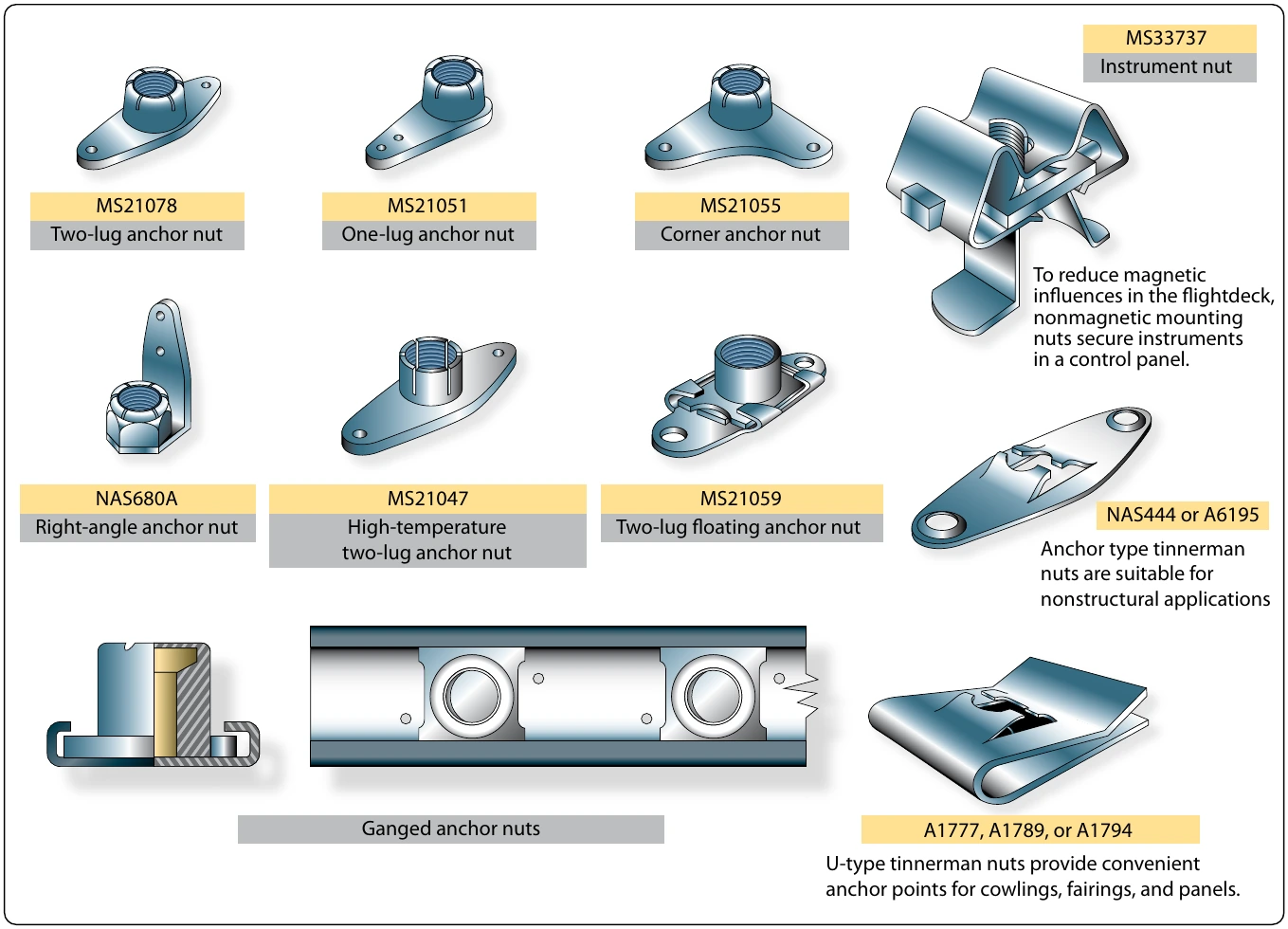
Self-locking nut plates are made under several standards and come in several shapes and sizes. Figure 7-62 shows an MS21078 two-lug nut plate with a nonmetallic insert and an MS21047 lightweight, all-metal, 450 °F (232 °C) nut plate. Nut plates can also have three riveting points if the added strength is required.
Rivnuts
This is the trade name of a hollow, blind rivet made of 6053 aluminum alloy, counter bored and threaded on the inside. One person using a special tool, which heads the rivet on the blind side of the material, can install Rivnuts. The Rivnut is threaded on the mandrel of the heading tool and inserted in the rivet hole. The heading tool is held at right angles to the material, the handle is squeezed, and the mandrel crank is turned clockwise after each stroke. Continue squeezing the handle and turning the mandrel crank of the heading tool until a solid resistance is felt, which indicates that the rivet is set.
The Rivnut is used primarily as a nut plate and in the attachment of deicer boots to the leading edges of wings. It may be used as a rivet in secondary structures or for the attachment of accessories, such as brackets, fairings, instruments, or soundproofing materials.
Rivnuts are manufactured in two head types, each with two ends: the flathead with open or closed end and the countersunk head with open or closed end. All Rivnuts, except the thin head countersunk type, are available with or without small projections (keys) attached to the head to keep the Rivnut from turning. Keyed Rivnuts are used as a nut plate, while those without keys are used for straight blind riveting repairs where no torque loads are imposed. A keyway cutter is needed when installing Rivnuts that have keys.
The countersunk style Rivnut is made with two different head angles: the 100° with 0.048 and 0.063 inch head thickness and the 115° with 0.063 inch head thickness. Each of these head styles is made in three sizes: 6-32, 8-32, and 10-32. These numbers represent the machine screw size of the threads on the inside of the Rivnut. The actual outside diameters of the shanks are 3⁄16 inch for the 6-32 size, 7⁄32 inch for the 8-32 size, and 1⁄4 inch for the 10-32 size.
Open-end Rivnuts are the most widely used and are recommended in preference to the closed end type wherever possible. However, closed-end Rivnuts must be used in pressurized compartments.
Rivnuts are manufactured in six grip ranges. The minimum dash mark until five marks indicate the maximum range.
Notice in Figure 7-63 that some part number codes consist of a “6,” an “8,” or a “10,” a “dash,” and two or three more numbers. In some, the letters “K” or “KB” replaces the dash. The first number indicates the machine screw size of the thread, and the last two or three numbers indicate the maximum grip length in thousandths of an inch. A dash between the figures indicates that the Rivnut has an open end and is keyless; a “B” in place of the dash means it has a closed end and is keyless; a “K” means it has an open end and has a key; and a “KB” indicates that it has a closed end and a key. If the last two or three numbers are divisible by five, the Rivnut has a flathead; if they are not divisible by five, the Rivnut has a countersunk head.
An example of a part number code is:
Dill Lok-Skrus and Dill Lok-Rivets
Dill “Lok-Skru” and “Lok-Rivet” are trade names for internally-threaded rivets. They are used for blind attachment of accessories, such as fairings, fillets, access door covers, door and window frames, floor panels, and the like. Lok- Skrus and Lok-Rivets are like the Rivnut in appearance and application; however, they come in two parts and require more clearance on the blind side than the Rivnut to accommodate the barrel. [Figure 7-64]
The Lok-Rivet and the Lok-Skru are alike in construction, except the Lok-Skru is tapped internally for fastening an accessory by using an attaching screw, whereas the Lok-Rivet is not tapped and can be used only as a rivet. Since both Lok-Skrus and Lok-Rivets are installed in the same manner, the following discussion for the Lok-Skru also applies to the Lok-Rivet.
The main parts of a Lok-Skru are the barrel, the head, and an attachment screw. The barrel is made of aluminum alloy and comes in either closed or open ends. The head is either aluminum alloy or steel, and the attachment screw is made of steel. All the steel parts are cadmium plated, and all of aluminum parts are anodized to resist corrosion. When installed, the barrel screws up over the head and grips the metal on the blind side. The attaching screw is then inserted if needed. There are two head types: the flathead and the countersunk head. The Lok-Skru is tapped for 7-32, 8-32, 10-32, or 10-24 screws, and the diameters vary from 0.230 inch for 6-32 screws, to 0.292 inch for 10-32 screws. Grip ranges vary from 0.010 inch to 0.225 inch.
Deutsch Rivets
This rivet is a high-strength blind rivet used on late model aircraft. It has a minimum shear strength of 75,000 psi and can be installed by one person. The Deutsch rivet consists of two parts: the stainless-steel sleeve and the hardened steel drive pin. [Figure 7-65] The pin and sleeve are coated with a lubricant and a corrosion inhibitor.
The Deutsch rivet is available in diameters of 3⁄16, 1⁄4, or 3⁄8 inch. Grip lengths for this rivet range from 3⁄16 to 1 inch. Some variation is allowed in grip length when installing the rivet. For example, a rivet with a grip length of 3⁄16 inch can be used where the total thickness of materials is between 0.198 and 0.228 inch.