
Chapter 8
Cleaning & Corrosion Control
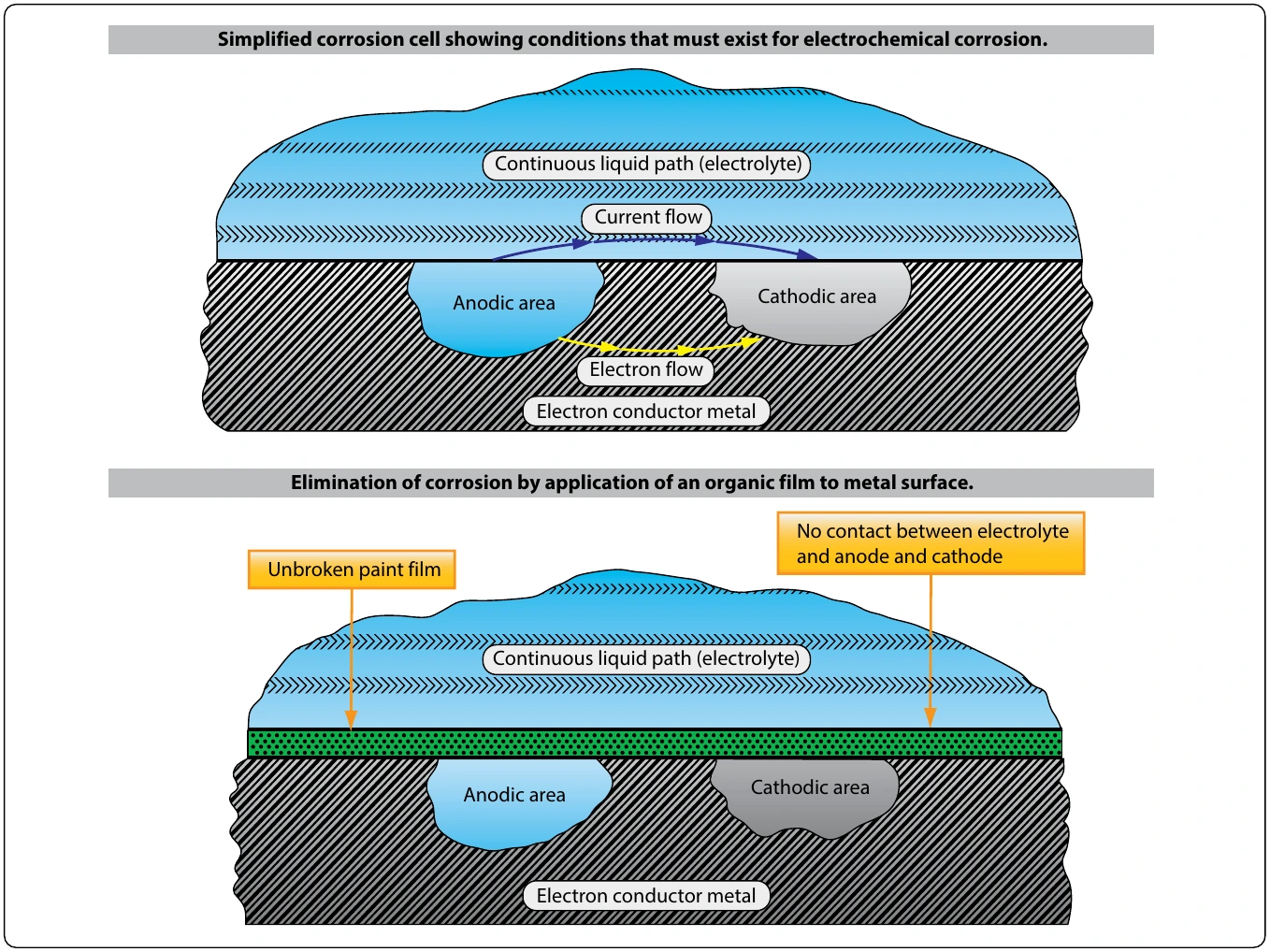
- Presence of a continuous, conductive liquid path (electrolyte)
- Electrical contact between the anode and the cathode (usually in the form of metal to metal contact, such as rivets, bolts, and corrosion)
Elimination of any one of these conditions stops electrochemical corrosion.
An electrochemical attack may be likened chemically to the electrolytic reaction that takes place in electroplating, anodizing, or in a dry cell battery. The reaction in this corrosive attack requires a medium, usually water, that is capable of conducting a tiny current of electricity. When a metal comes in contact with a corrosive agent and is also connected by a liquid or gaseous path that electrons flow through, corrosion begins as the metal decays by oxidation. [Figure 8-5] During the attack, the quantity of corrosive agent is reduced and, if not renewed or removed, may completely react with the of corrosion cells and corrosion will commence.
All metals and alloys are electrically active and have a specific electrical potential in a given chemical environment. This potential is commonly referred to as the metal’s “nobility.” [Figure 8-6] The less noble a metal is, the more easily it can be corroded. The metals chosen for use in aircraft structures are a studied compromise with strength, weight, corrosion resistance, workability, and cost balanced against the structure’s needs.
The constituents in an alloy also have specific electrical potentials that are generally different from each other. Exposure of the alloy surface to a conductive, corrosive medium causes the more active metal to become anodic and the less active metal to become cathodic, thereby establishing conditions for corrosion. These are called local cells. The greater the difference in electrical potential between the two metals, the greater the severity of a corrosive attack if the proper conditions are allowed to develop.
The conditions for these corrosion reactions are the presence of a conductive fluid and metals having a difference in potential. If, by regular cleaning and surface refinishing, the medium is removed and the minute electrical circuit eliminated, corrosion cannot occur. This is the basis for effective corrosion control. The electrochemical attack is responsible for most forms of corrosion on aircraft structure and component parts.
Forms of Corrosion
There are many forms of corrosion. The form of corrosion depends on the metal involved, its size and shape, its specific function, atmospheric conditions, and the corrosion producing agents present. Those described in this section are the more common forms found on airframe structures.
Surface Corrosion
General surface corrosion (also referred to as uniform etch or uniform attack corrosion) is the most common form of corrosion. Surface corrosion appears as a general roughening, etching, or pitting of the surface of a metal, frequently accompanied by a powdery deposit of corrosion products. Surface corrosion may be caused by either direct chemical or electrochemical attack. Sometimes corrosion spreads under the surface coating and cannot be recognized by either the roughening of the surface or the powdery deposit. Instead, closer inspection reveals the paint or plating is lifted off the surface in small blisters that result from the pressure of the underlying accumulation of corrosion products. [Figure 8-7]
Filiform Corrosion
Filiform corrosion is a special form of oxygen concentration cell that occurs on metal surfaces having an organic coating system. It is recognized by its characteristic worm-like trace of corrosion products beneath the paint film. [Figure 8-8] Polyurethane finishes are especially susceptible to filiform corrosion. Filiform occurs when the relative humidity of the air is between 78–90 percent, and the surface is slightly acidic. This corrosion usually attacks steel and aluminum surfaces. The traces never cross on steel, but they cross under one another on aluminum, making the damage deeper and more severe for aluminum. If the corrosion is not removed, the area treated, and a protective finish applied, the corrosion can lead to intergranular corrosion, especially around fasteners and at seams.
Filiform corrosion can be removed using glass bead blasting material with portable abrasive blasting equipment or sanding. Filiform corrosion can be prevented by storing aircraft in an environment with a relative humidity below 70 percent, using coating systems having a low rate of diffusion for oxygen and water vapors, and by washing the aircraft to remove acidic contaminants from the surface, such as those created by pollutants in the air.
Pitting Corrosion
Pitting corrosion is one of the most destructive and intense forms of corrosion. It can occur in any metal but is most common on metals that form protective oxide films, such as aluminum and magnesium alloys. It is first noticeable as a white or gray powdery deposit, similar to dust, which blotches the surface. When the deposit is cleaned away, tiny holes or pits can be seen in the surface. These small surface openings may penetrate deeply into structural members and cause damage completely out of proportion to its surface appearance. [Figure 8-9]