
Chapter 8
Cleaning & Corrosion Control
- Salt solutions and sea water cause stress corrosion cracking of high-strength, heat-treated steel and aluminum alloys.
- Methyl alcohol-hydrochloric acid solutions cause stress corrosion cracking of some titanium alloys.
- Magnesium alloys may stress corrode in moist air.
Stress corrosion may be reduced by applying protective coatings, stress relief heat-treatments, using corrosion inhibitors, or controlling the environment. Shot peening a metal surface increases resistance to stress corrosion cracking by creating compressive stresses on the surface which should be overcome by applied tensile stress before the surface sees any tension load. Therefore, the threshold stress level is increased.
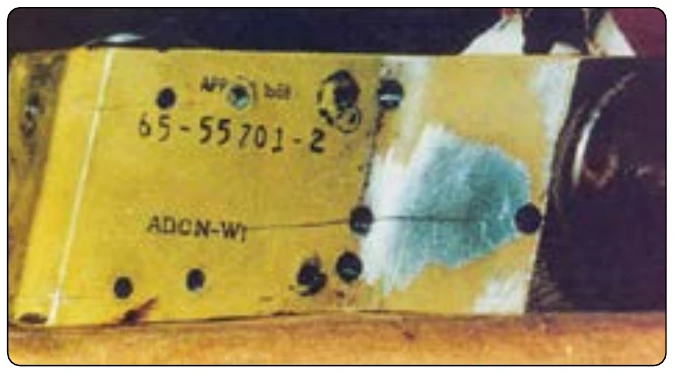
corrosive attack that occurs when two mating surfaces, normally at rest with respect to one another, are subject to slight relative motion. It is characterized by pitting of the surfaces and the generation of considerable quantities of finely divided debris. Since the restricted movements of the two surfaces prevent the debris from escaping very easily, an extremely localized abrasion occurs. [Figure 8-17] The presence of water vapor greatly increases this type of deterioration. If the contact areas are small and sharp, deep grooves resembling brinell markings or pressure indentations may be worn in the rubbing surface. As a result, this type of corrosion on bearing surfaces has also been called false brinelling. The most common example of fretting corrosion is the smoking rivet found on engine cowling and wing skins. This is one corrosion reaction that is not driven by an electrolyte, and in fact, moisture may inhibit the reaction. A smoking rivet is identified by a black ring around the rivet.
Fatigue Corrosion
Fatigue corrosion involves cyclic stress and a corrosive the endurance limit of the metal. Once the limit has been exceeded, the metal eventually cracks and fails from metal fatigue. However, when the part or structure undergoing cyclic stress is also exposed to a corrosive environment, the stress level for failure may be reduced many times. Thus, failure occurs at stress levels that can be dangerously low depending on the number of cycles assigned to the life-limited part.
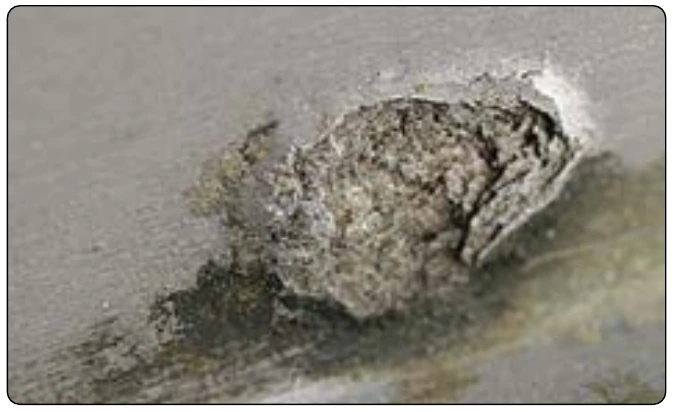
Fatigue corrosion failure occurs in two stages. During the first stage, the combined action of corrosion and cyclic stress damages the metal by pitting and crack formations to such a degree that fracture by cyclic stress occurs, even if the corrosive environment is completely removed. The second stage is essentially a fatigue stage where failure proceeds by propagation of the crack (often from a corrosion pit or pits). It is controlled primarily by stress concentration effects and the physical properties of the metal. Fracture of a metal part due to fatigue corrosion generally occurs at a stress level far to steel fastener.
Galvanic Corrosion
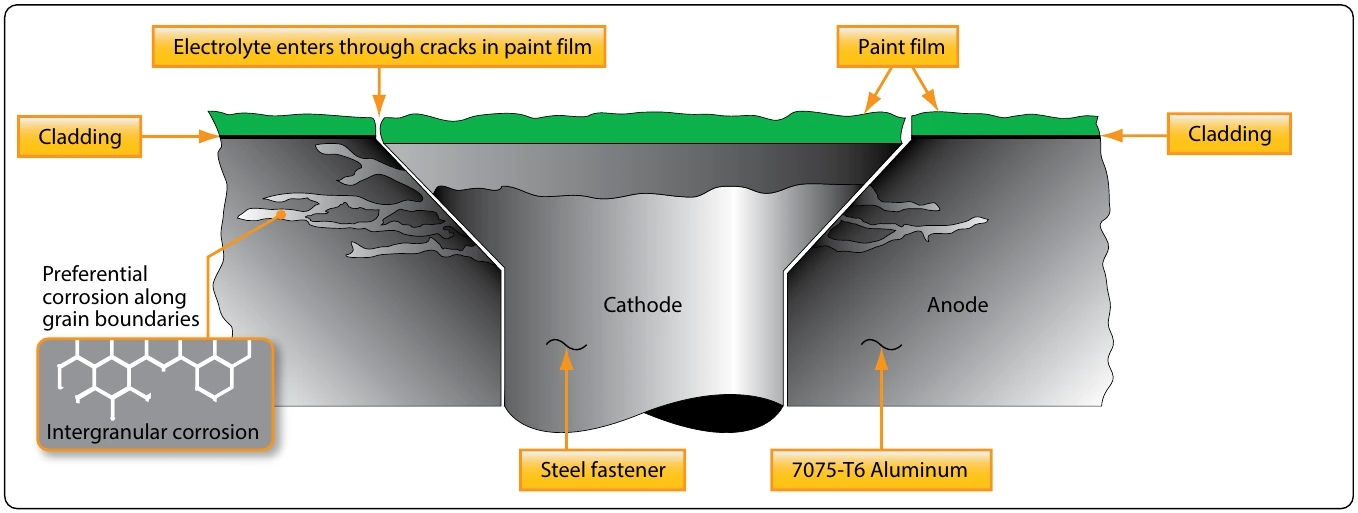
Galvanic corrosion occurs when two dissimilar metals make electrical contact in the presence of an electrolyte. [Figure 8-18] The rate which corrosion occurs depends on the difference in the activities. The greater the difference in activity, the faster corrosion occurs. The rate of galvanic corrosion also depends on the size of the parts in contact. If the surface area of the corroding metal is smaller than the surface area of the less active metal, corrosion is rapid and severe. When the corroding metal is larger than the less active metal, corrosion is slow and superficial.
Common Corrosive Agents
Substances that cause corrosion of metals are called corrosive agents. The most common corrosive agents are acids, alkalies, and salts. The atmosphere and water, the two most common media for these agents, may also act as corrosive agents.
- Acids—moderately strong acids severely corrode most of the alloys used in airframes. The most destructive are sulfuric acid (battery acid), halogen acids (hydrochloric, hydrofluoric, and hydrobromic), nitrous oxide compounds, and organic acids found in the wastes of humans and animals.
- Alkalies—as a group, alkalies are not as corrosive as acids. Aluminum and magnesium alloys are exceedingly prone to corrosive attack by many alkaline solutions unless the solutions contain a corrosion inhibitor. Substances particularly corrosive to aluminum are washing soda, potash (wood ashes), and lime (cement dust). Ammonia, an alkali, is an exception because aluminum alloys are highly resistant to it.
- Salts—most salt solutions are good electrolytes and can promote corrosive attack. Some stainless-steel alloys are resistant to attack by salt solutions but aluminum alloy, magnesium alloys, and other steels are
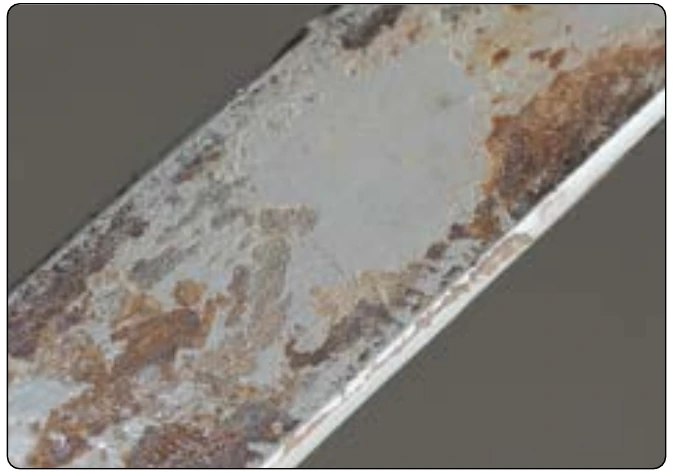
- Atmosphere—the major atmospheric corrosive agents are oxygen and airborne moisture. Corrosion often results from the direct action of atmospheric oxygen and moisture on metal, and the presence of additional moisture often accelerates corrosive attack, particularly on ferrous alloys. However, the atmosphere may also contain other corrosive gases and contaminants, particularly industrial and marine salt spray.
- Water—the corrosiveness of water depends on the type and quantity of dissolved mineral and organic impurities and dissolved gasses (particularly oxygen) in the water. One characteristic of water that determines its corrosiveness is the conductivity or ability to act as an electrolyte and conduct a current. Physical factors, such as water temperature and velocity, also have a direct bearing on its corrosiveness.