
Chapter 10
Engine Maintenance & Operation
Turbine Engine Operation
The engine operating procedures presented here apply generally to turbofan, turboprop, turboshaft, and auxiliary power units (APU). The procedures, pressures, temperatures, and rpm that follow are intended primarily to serve as a guide. It should be understood that they do not have general application. The manufacturer’s operating instructions should be consulted before attempting to start and operate any turbine engine.
A turbofan engine has only one power control lever. Adjusting the power lever, or throttle lever, sets up a thrust condition for which the fuel control meters fuel to the engine. Engines equipped with thrust reversers go into reverse thrust at throttle positions below idle. A separate fuel shutoff lever is usually provided on engines equipped with thrust reversers.
Prior to start, particular attention should be paid to the engine air inlet, the visual condition and free movement of the compressor and turbine assembly, and the parking ramp area fore and aft of the aircraft. The engine is started by using an external air power source, APU, or an already operating engine. Starter types and the engine starting cycle have been discussed previously. On multi-engine aircraft, the engines are usually started by an onboard APU that supplies the air pressure for a pneumatic starter on each engine. Air bled from the APU is used as a source of power for starting the engines.
During the start, it is necessary to monitor the tachometer, the oil pressure, and the exhaust gas temperature. The normal starting sequence is:
- Rotate the compressor with the starter;
- Turn the ignition on; and
- Open the engine fuel valve, either by moving the throttle to idle or by moving a fuel shutoff lever or turning a switch.
Adherence to the procedure prescribed for a particular engine is necessary as a safety measure and to avoid a hot or hung start. A successful start is noted first by a rise in exhaust gas temperature. If the engine does not light up, meaning that fuel starts to burn inside of the engine within a prescribed period of time, or if the exhaust gas starting temperature limit is exceeded, a hot start, the starting procedure should be aborted. Hot starts are not common, but when they do occur, they can usually be stopped in time to avoid excessive temperature by observing the exhaust gas temperature constantly during the start. When necessary, the engine is cleared of trapped fuel or gases by continuing to rotate the compressor with the starter, but with the ignition and fuel turned off. If the engine did not light off during start after the allotted time, about 10 seconds although this time varies from engine to engine, the fuel must be shut off as the engine is being filled with unburned fuel. A hung start is when the engine lights off, but the engine will not accelerate to idle rpm.
Ground Operation Engine Fire
Move the fuel shutoff lever to the off position if an engine fire occurs, or if the fire warning light is illuminated during the starting cycle. Continue cranking or motoring the engine until the fire has been expelled from the engine. If the fire persists, CO can be discharged into the inlet duct while it is 2 being cranked. Do not discharge CO directly into the engine 2 exhaust, because it may damage the engine. If the fire cannot be extinguished, secure all switches and leave the aircraft. If the fire is on the ground under the engine overboard drain, discharge the CO on the ground rather than on the engine. 2 This also is true if the fire is at the tailpipe and the fuel is dripping to the ground and burning.
Engine Checks
Checking turbofan engines for proper operation consists primarily of simply reading the engine instruments and then comparing the observed values with those known to be correct for any given engine operating condition. After the engine has started, idle rpm has been attained, and the instrument readings have stabilized, the engine should be checked for satisfactory operation at idling speed. The oil pressure indicator, tachometer, and the exhaust gas temperature readings should be compared with the allowable ranges.
Checking Takeoff Thrust
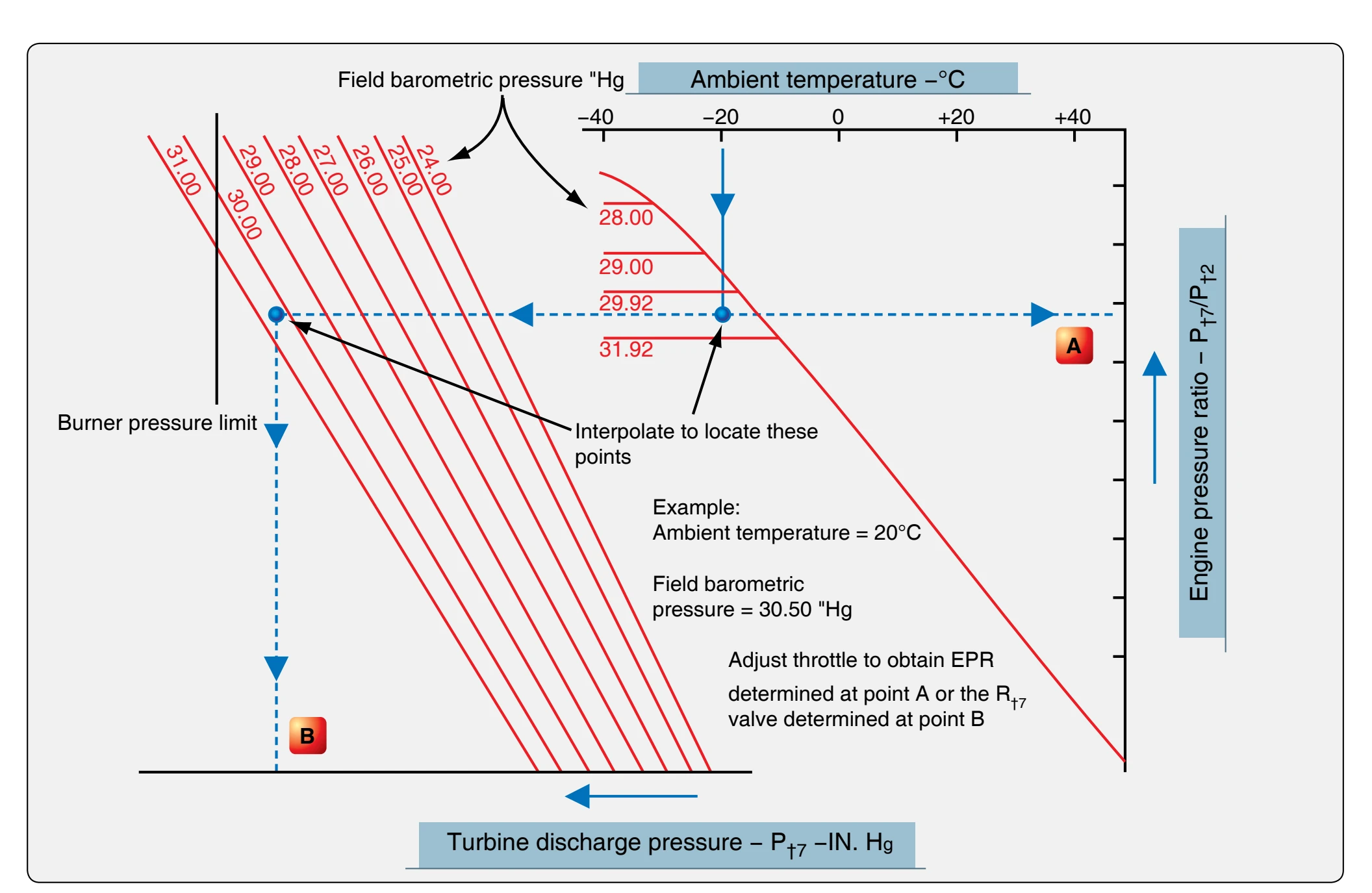
Takeoff thrust is checked by adjusting the throttle to obtain a single, predicted reading on the engine pressure ratio indicator in the aircraft. The value for engine pressure ratio, which represents takeoff thrust for the prevailing ambient atmospheric conditions, is calculated from a takeoff thrust setting curve or, on newer aircraft, is a function of the onboard computer. This curve has been computed for static conditions. [Figure 10-74] Therefore, for all precise thrust checking, the aircraft should be stationary, and stable engine operation should be established. If it is needed for calculating thrust during an engine trim check, turbine discharge pressure (Pt7) is also shown on these curves. Appropriate manuals should be consulted for the charts for a specific make and model engine. Engine trimming procedure is also covered in Chapter 2, Engine Fuel & Fuel Metering Systems. The engine pressure ratio computed from the thrust setting curve represents thrust or a lower thrust call part power thrust used for testing. The aircraft throttle is advanced to obtain this predicted reading on the engine pressure ratio indicator, or the part power stop is engaged in the aircraft. If an engine develops the predicted thrust and if all the other engine instruments are reading within their proper ranges, engine operation is considered satisfactory. Full authority digital engine controls (FADEC) (computer controls) also have means of checking the engine with the results displayed on the flight deck.
Ambient Conditions
The sensitivity of gas turbine engines to compressor inlet air temperature and pressure necessitates that considerable care be taken to obtain correct values for the prevailing ambient air conditions when computing takeoff thrust. Some things to remember are:
- The engine senses the air temperature and pressure at the compressor inlet. This is the actual air temperature just above the runway surface. When the aircraft is stationary, the pressure at the compressor inlet is the static field or true barometric pressure, and not the barometric pressure corrected to sea level that is normally reported by airport control towers as the altimeter setting. On FADEC engines, the computer reads this information and sends it to the engine controls.
- Temperature sensed is the total air temperature (TAT) that is used by several onboard computers. The engine controls set the engine computers according to the TAT.
- Relative humidity, which affects reciprocating engine power appreciably, has a negligible effect on turbine engine thrust, fuel flow, and rpm. Therefore, relative humidity is not usually considered when computing thrust for takeoff or determining fuel flow and rpm for routine operation.
Engine Shutdown
On turbine engines that have a thrust reverser, retarding the aircraft throttle to idle or power lever to OFF cuts the fuel supply to the engine and shuts down the engine. On engines equipped with thrust reversers, this is accomplished by means of a separate fuel shutoff lever or switch. When an engine has been operated at high power levels for extended periods of time, a cool down time should be allowed before shutting down. It is recommended the engine be operated at below a low power setting, preferably at idle for a period of 5 minutes to prevent possible seizure of the rotors. This applies, in particular, to prolonged operation at high rpm on the ground, such as during engine trimming. The turbine case and the turbine wheels operate at approximately the same temperature
when the engine is running. However, the turbine wheels are relatively massive, compared with the case, and are not cooled so readily. The turbine case is exposed to cooling air from both inside and outside the engine. Consequently, the case and the wheels lose their residual heat at different rates after the engine has been shut down. The case, cooling faster, tends to shrink upon the wheels, that are still rotating. Under extreme conditions, the turbine blades may squeal or seize; thus, a cooling period is required if the engine has been operating at prolonged high speed. Should the turbine wheels seize, no harm normally results, provided no attempt is made to turn the engine over until it has cooled sufficiently to free the wheels. In spite of this, every effort should be made to avoid seizure.