Chapter 11
Light-Sport Aircraft Engines
The ignition system is fully redundant, self-generating, and does not depend on battery power. The crankshaft is designed with a double bearing at the propeller flange end and a main bearing between each big end. Thrust bearings are located fore and aft of the front double bearing, allowing either tractor or pusher installation. Pistons are remachined to include a piston pin, circlip, and groove. They are all fitted with three rings, the top rings being cast iron to complement the chrome molybdenum cylinder bores. Valves are 7mm (stem diameter) and are manufactured specifically for the Jabiru engine. The valve drive train includes pushrods from the camshaft from the camshaft followers to valve rockers. The valves are Computer Numerical Control (CNC) machined from steel billet, induction hardened, polished on contact surfaces, and mounted on a shaft through Teflon coated bronze-steel bush. Valve guides are manufactured from aluminum/ bronze. Replaceable valve seats are of nickel steel and are shrunk into the aluminum cylinder heads. The valve train is lubricated from the oil gallery. Engines use hydraulic lifters that automatically adjust valve clearance. An internal gear pump is driven directly by the camshaft and provides engine lubrication via an oil circuit that includes an automotive spinon filter, oil cooler and built-in relief valve.
The standard engines are supplied with two ram-air cooling ducts, that have been developed by Jabiru to facilitate the cooling of the engine by directing air from the propeller to the critical areas of the engine, particularly the cylinder heads and barrels. The use of these ducts remove the need to design and manufacture baffles and the establishment of a plenum chamber, which is the traditional method of cooling air-cooled, aircraft engines. The fact that these baffles and plenum chamber are not required also ensures a cleaner engine installation, which in turn facilitates maintenance and inspection of the engine and engine components.
The engine is fitted with a 1.5 kilowatt starter motor that is also manufactured by Jabiru and provides very effective starting. The engine has very low vibration level; however, it is also supported by four large rubber shock mounts attached to the engine mounts at the rear of the engine. The fuel induction system uses a pressure compensating carburetor. Following the carburetor, the air-fuel mixture is drawn through a swept plenum chamber bolted to the sump casting, in which the mixture is warmed prior to entering short induction tubes attached to the cylinder heads.
An effective stainless steel exhaust and muffler system is fitted as standard equipment ensuring very quiet operations. For owners wanting to fit vacuum instruments to their aircraft, the Jabiru engines are designed with a vacuum pump drive direct mounted through a coupling on the rear of the crankshaft.
Jabiru 2200 Aircraft Engine
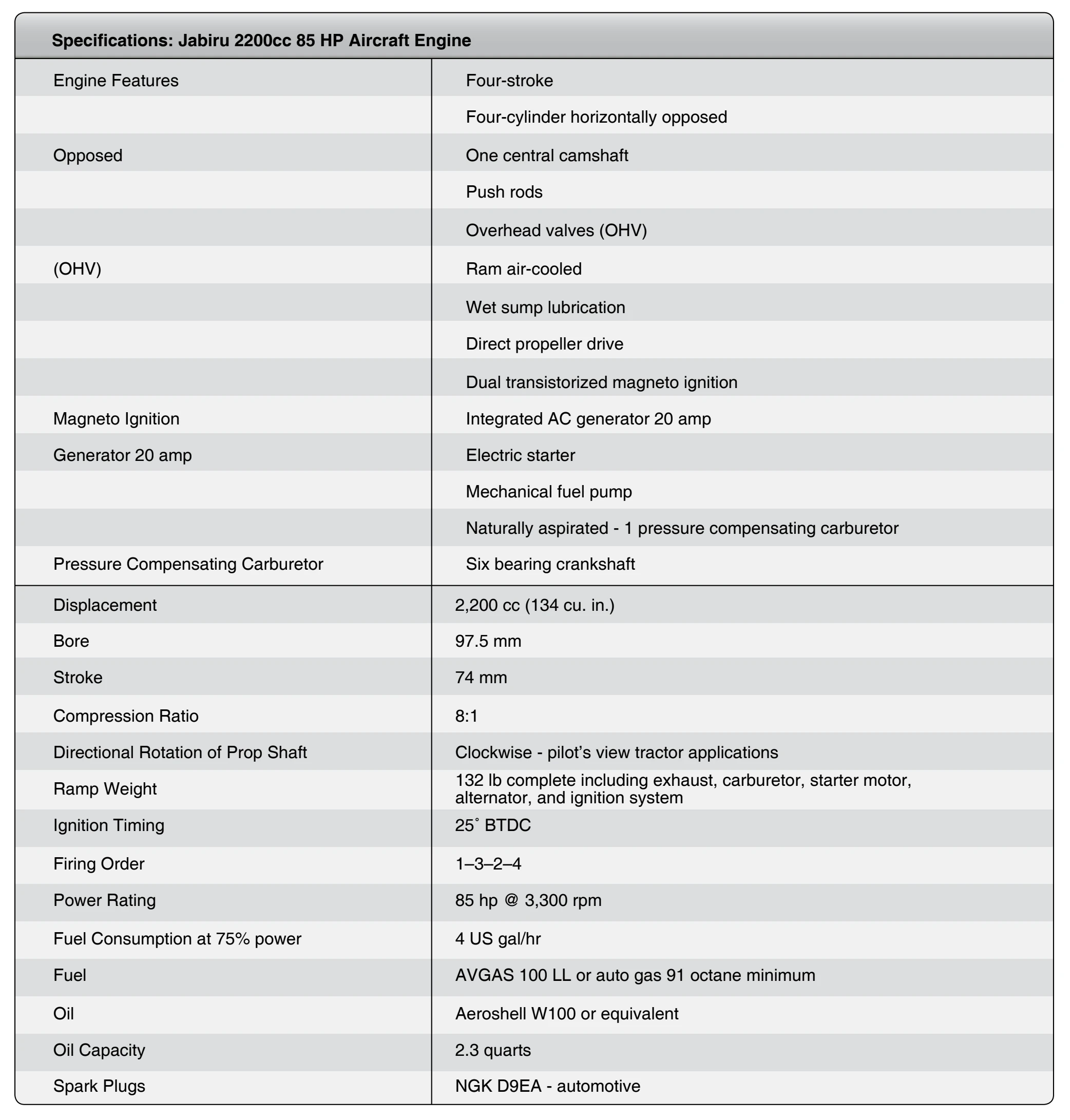
The Jabiru 2,200 cc aircraft engine is a four-cylinder, fourstroke horizontally opposed air-cooled engine. At 132 pounds (60 kgs) installed weight, it is one of the lightest four-cylinder, four-stroke aircraft engines. Small overall dimensions give it a small frontal area width (23.46 in, 596 mm) that makes it a good engine for tractor applications. The Jabiru engine is designed for either tractor or pusher installation. The Jabiru engine specifications are listed in Figure 11-16.
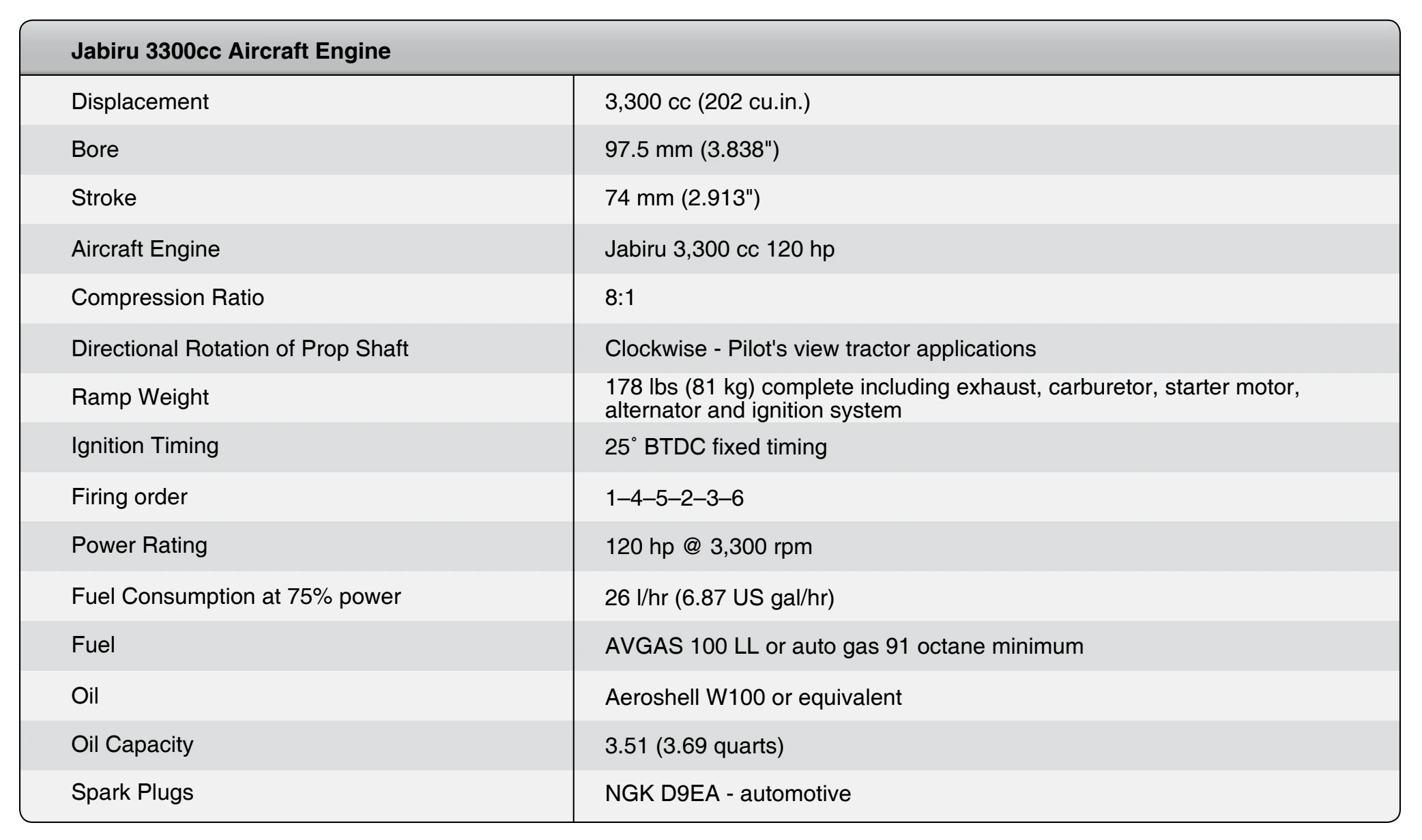
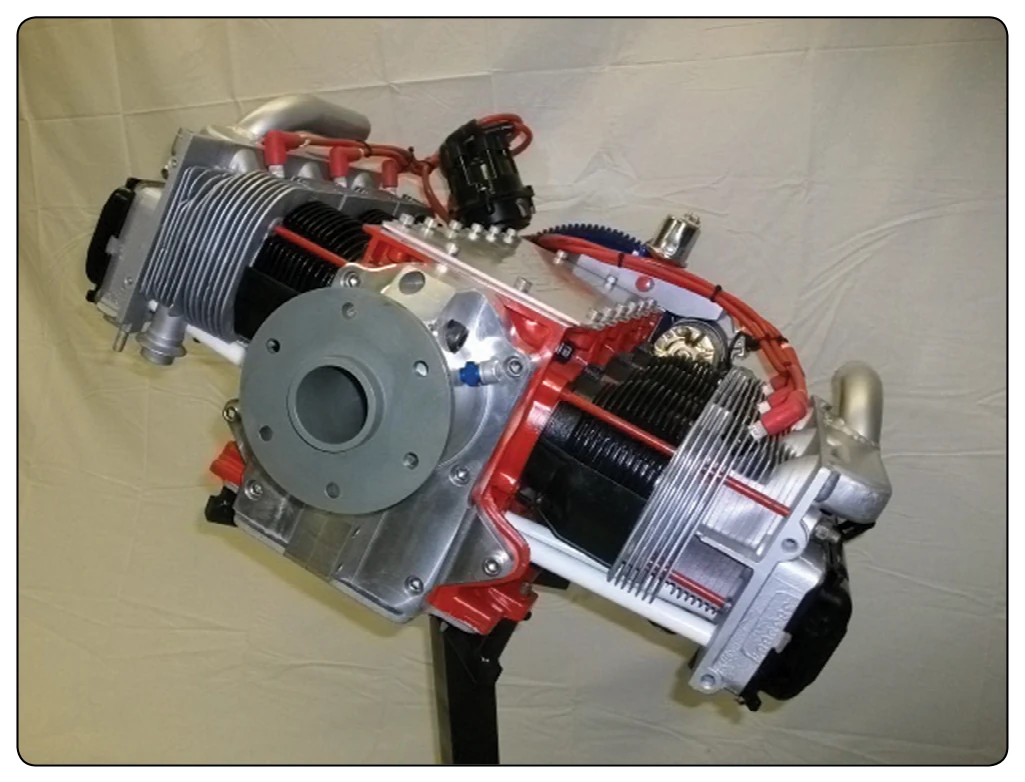
The Jabiru 3300 (120 hp) engine features [Figure 11-17]:
- 4-stroke,
- 3,300 cc engine (200 cubic inches),
- 6-cylinder horizontally opposed,
- 1 central camshaft,
- Fully machined aluminum alloy crankcase,
- Overhead valves (OHV) - push rod operated,
- Ram air-cooled,
- Wet sump lubrication - 4 liter capacity,
- Direct propeller drive,
- Dual transistorized magneto ignition,
- Integrated AC generator,
- Electric starter,
- Mechanical fuel pump, and
- Naturally aspirated - 1 pressure compensation carburetor.
Aeromax Aviation 100 (IFB) Aircraft Engine
Aeromax Aviation produces a version of a 100 hp engine called the Integral Front Bearing. The engine features a special made integral front bearing. [Figure 11-18] The engine uses an integral permanent magnet 35 amp alternator, lightweight starter, and dual ignition. The compact alternator and starter allow for a streamlined and aerodynamic cowl which improves the fuel efficiency of an experimental aircraft. The Aeromax aircraft engine is an opposed sixcylinder, air-cooled, and direct drive. Being a six-cylinder engine, it has smooth operation. The Aeromax engines are known for their heat dissipation qualities, provided the proper amount of cooling air is provided.
It features a crank extension supported by a massive integral front bearing (IFB) and bearing housing. These engines start out as a GM Corvair automobile core engine. These basic core engines are disassembled and each component that is reused is refurbished and remanufactured. The crankshaft in the Areomax 100 IFB aircraft engine is thoroughly inspected, including a magnaflux inspection. After ensuring the crank is free of any defects, it is extended by mounting the crank extension hub on its front. Then, the crank is ground true, with all five bearings’ surfaces (four original and the new extended crank’s front bearing), being true to each other and perpendicular to the crank’s prop flange. [Figure 11-19]
All radiuses are smooth with no sharp corners where stress could concentrate. Every crankshaft is nitrated, which is a heat-chemical process that hardens the crank surfaces. The crank reinforcement coupled with the IFB is required to counter the additional dynamic and bending loads introduced on the crank in an aircraft application. The engine case is totally refurbished and checked for wear. Any studs or bolts that show wear are replaced. The engine heads are machined to proper specifications and all new valves, guides, and valve train components are installed. A three-angle valve grind and lapping ensure a good valve seal.
Once the engine is assembled, it is installed on a test stand, pre-lubricated, and inspected. The engine is, then, run several times for a total of two hours. The engine is carefully inspected after each run to ensure it is in excellent
operating condition. At the end of test running the engine, the oil filter is removed and cut for inspection. Its internal condition is recorded. This process is documented and kept on file for each individual engine. Once the engine’s proper performance is assured, it is removed and packaged in a custom built crate for shipping. Each engine is shipped with its engine service and operations manual. This manual contains information pertaining to installation, break–in, testing, tune-up, troubleshooting, repair, and inspection procedures. The specifications for the Aeromax 100 engine are outlined in Figure 11-20.
Direct Drive VW Engines
Revmaster R-2300 Engine
The Revmaster R-2300 engine maintains Revmaster’s systems and parts, including its RM-049 heads that feature large fins and a hemispherical combustion chamber. [Figure 11-21] It maintains the earlier R-2200 engine’s top