
Chapter 7
Propellers
Fixed-Pitch Propeller
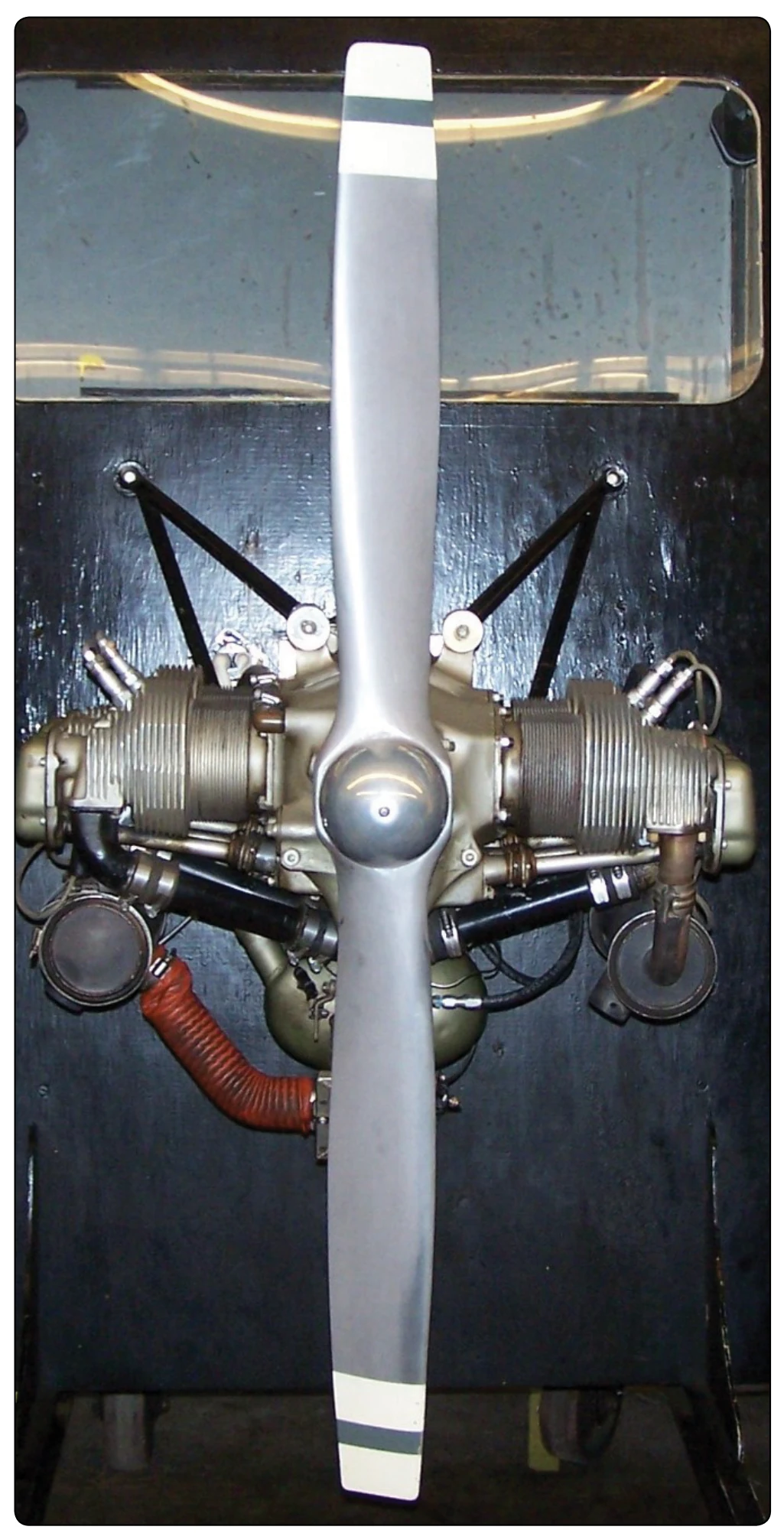
As the name implies, a fixed-pitch propeller has the blade pitch, or blade angle, built into the propeller. [Figure 7-11] The blade angle cannot be changed after the propeller is built. Generally, this type of propeller is one piece and is constructed of wood or aluminum alloy.
Fixed-pitch propellers are designed for best efficiency at one rotational and forward speed. They are designed to fit a set of conditions of both aircraft and engine speeds and any change in these conditions reduces the efficiency of both the propeller and the engine. The fixed-pitch propeller is used on aircraft of low power, speed, range, or altitude. Many singleengine aircraft use fixed-pitch propellers and the advantages of these are less expense and their simple operation. This type of propeller does not require any control inputs from the pilot in flight.
Test Club Propeller
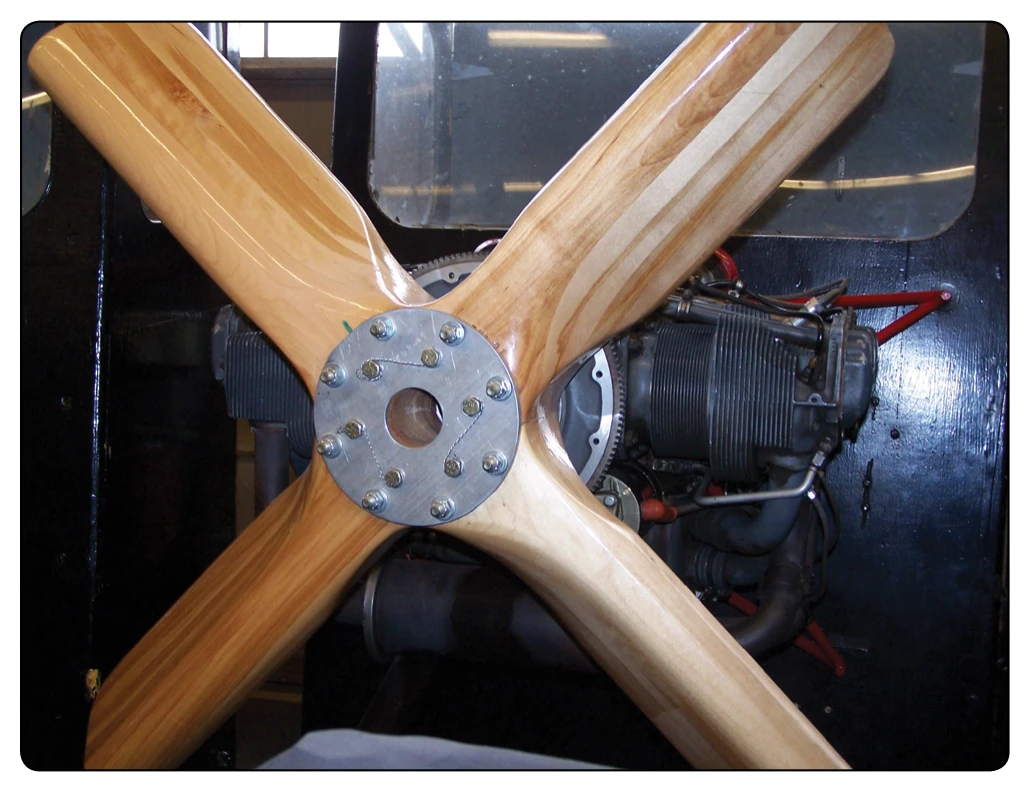
A test club is used to test and break in reciprocating engines. [Figure 7-12] They are made to provide the correct amount of load on the engine during the test break-in period. The multi-blade design also provides extra cooling air flow during testing.
Ground-Adjustable Propeller
The ground-adjustable propeller operates as a fixed-pitch propeller. The pitch, or blade angle, can be changed only when the propeller is not turning. This is done by loosening the clamping mechanism that holds the blades in place. After the clamping mechanism has been tightened, the pitch of the blades cannot be changed in flight to meet variable flight requirements. The ground-adjustable propeller is not often used on present-day aircraft.
Controllable-Pitch Propeller
The controllable-pitch propeller permits a change of blade pitch, or angle, while the propeller is rotating. This allows
the propeller to assume a blade angle that gives the best performance for particular flight conditions. The number of pitch positions may be limited, as with a two-position controllable propeller, or the pitch may be adjusted to any angle between the minimum and maximum pitch settings of a given propeller. The use of controllable-pitch propellers also makes it possible to attain the desired engine rpm for a particular flight condition.
This type of propeller is not to be confused with a constantspeed propeller. With the controllable-pitch type, the blade angle can be changed in flight, but the pilot must change the propeller blade angle directly. The blade angle will not change again until the pilot changes it. The use of a governor is the next step in the evolution of propeller development, making way for constant-speed propellers with governor systems. An example of a two-position propeller is a Hamilton Standard flyweight two-position propeller. These types of propeller are not in wide use today.
Constant-Speed Propellers
The propeller has a natural tendency to slow down as the aircraft climbs and to speed up as the aircraft dives because the load on the engine varies. To provide an efficient propeller, the speed is kept as constant as possible. By using propeller governors to increase or decrease propeller pitch, the engine speed is held constant. When the aircraft goes into a climb, the blade angle of the propeller decreases just enough to prevent the engine speed from decreasing. The engine can maintain its power output if the throttle setting is not changed. When the aircraft goes into a dive, the blade angle increases sufficiently to prevent overspeeding and, with the same throttle setting, the power output remains unchanged. If the throttle setting is changed instead of changing the speed of the aircraft by climbing or diving, the blade angle increases or decreases as required to maintain a constant engine rpm. The power output (not the rpm) changes in accordance with changes in the throttle setting. The governor-controlled, constant-speed propeller changes the blade angle automatically, keeping engine rpm constant.
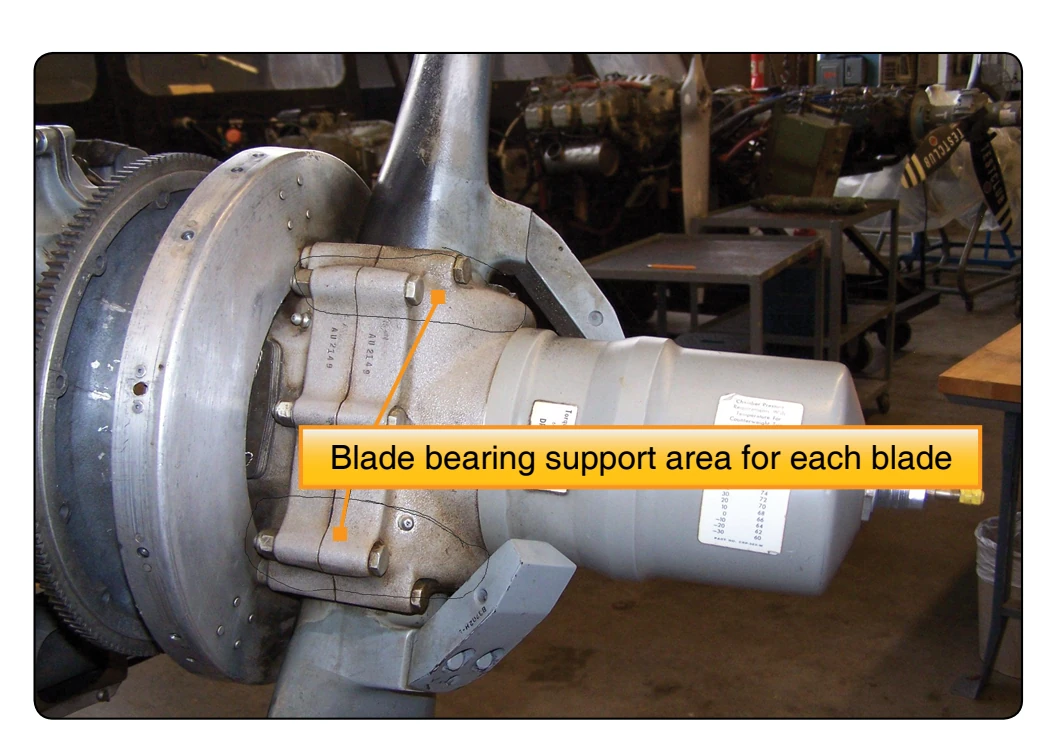
One type of pitch-changing mechanism is operated by oil pressure (hydraulically) and uses a piston-and-cylinder arrangement. The piston may move in the cylinder, or the cylinder may move over a stationary piston. The linear motion of the piston is converted by several different types of mechanical linkage into the rotary motion necessary to change the blade angle. The mechanical connection may be through gears, the pitch-changing mechanism that turns the butt of each blade. Each blade is mounted with a bearing that allows the blade to rotate to change pitch. [Figure 7-13]
In most cases, the oil pressure for operating the different types of hydraulic pitch-changing mechanisms comes directly from the engine lubricating system. When the engine lubricating system is used, the engine oil pressure is usually boosted by a pump that is integral with the governor to operate the propeller. The higher oil pressure (approximately 300 pounds per square inch (psi)) provides a quicker blade-angle change. The governors direct the pressurized oil for operation of the hydraulic pitch-changing mechanisms.
The governors used to control hydraulic pitch-changing mechanisms are geared to the engine crankshaft and are sensitive to changes in rpm. When rpm increases above the value for which a governor is set, the governor causes the propeller pitch-changing mechanism to turn the blades to a higher angle. This angle increases the load on the engine, and rpm decreases. When rpm decreases below the value for which a governor is set, the governor causes the pitchchanging mechanism to turn the blades to a lower angle; the load on the engine is decreased, and rpm increases. Thus, a propeller governor tends to keep engine rpm constant.
In constant-speed propeller systems, the control system adjusts pitch through the use of a governor, without attention by the pilot, to maintain a specific preset engine rpm within the set range of the propeller. For example, if engine speed increases, an overspeed condition occurs and the propeller needs to slow down. The controls automatically increase the blade angle until desired rpm has been reestablished. A good constantspeed control system responds to such small variations of rpm that for all practical purposes, a constant rpm is maintained.