
Chapter 7
Propellers
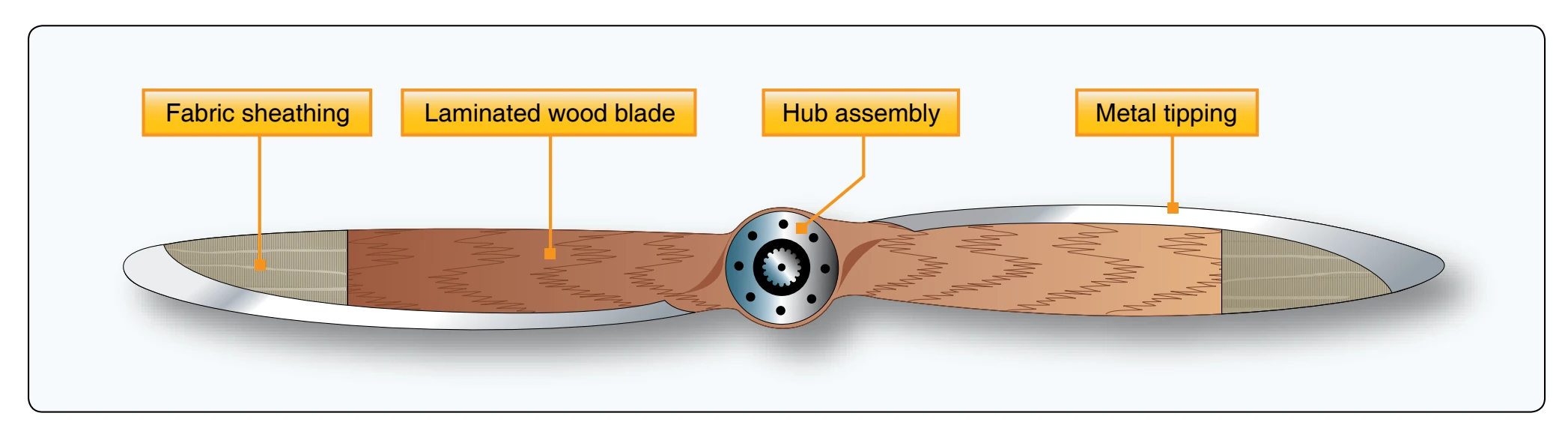
to make a smooth surface. Since moisture condenses on the tipping between the metal and the wood, the tipping is provided with small holes near the blade tip to allow this moisture to drain away or be thrown out by centrifugal force. It is important that these drain holes be kept open at all times. Since wood is subject to swelling, shrinking, and warping because of changes of moisture content, a protective coating is applied to the finished propeller to prevent a rapid change of moisture content. The finish most commonly used is a number of coats of water-repellent, clear varnish. After these processes are completed, the propeller is mounted on a spindle and very carefully balanced.
Several types of hubs are used to mount wooden propellers on the engine crankshaft. The propeller may have a forged steel hub that fits a splined crankshaft; it may be connected to a tapered crankshaft by a tapered, forged steel hub; or it may be bolted to a steel flange forged on the crankshaft. In any case, several attaching parts are required to mount the propeller on the shaft properly.
Hubs fitting a tapered shaft are usually held in place by a retaining nut that screws onto the end of the shaft. On one model, a locknut is used to safety the retaining nut and to provide a puller for removing the propeller from the shaft. This nut screws into the hub and against the retaining nut. The locknut and the retaining nut are safetied together with lock-wire or a cotter pin.
Front and rear cones may be used to seat the propeller properly on a splined shaft. The rear cone is a one-piece bronze cone that fits around the shaft and against the thrust nut (or spacer) and seats in the rear-cone seat of the hub. The front cone is a two-piece, split-type steel cone that has a groove around its inner circumference so that it can be fitted over a flange of the propeller retaining nut. Then, the retaining nut is threaded into place and the front cone seats in the front cone hub. A snap ring is fitted into a groove in the hub in front of the front cone so that when the retaining nut is unscrewed from the propeller shaft, the front cone acts against the snap ring and pulls the propeller from the shaft.
One type of hub incorporates a bronze bushing instead of a front cone. When this type of hub is used, it may be necessary to use a puller to start the propeller from the shaft. A rearcone spacer is sometimes provided with the splined-shaft propeller assembly to prevent the propeller from interfering with the engine cowling. The wide flange on the rear face of some types of hubs eliminates the use of a rear-cone spacer.
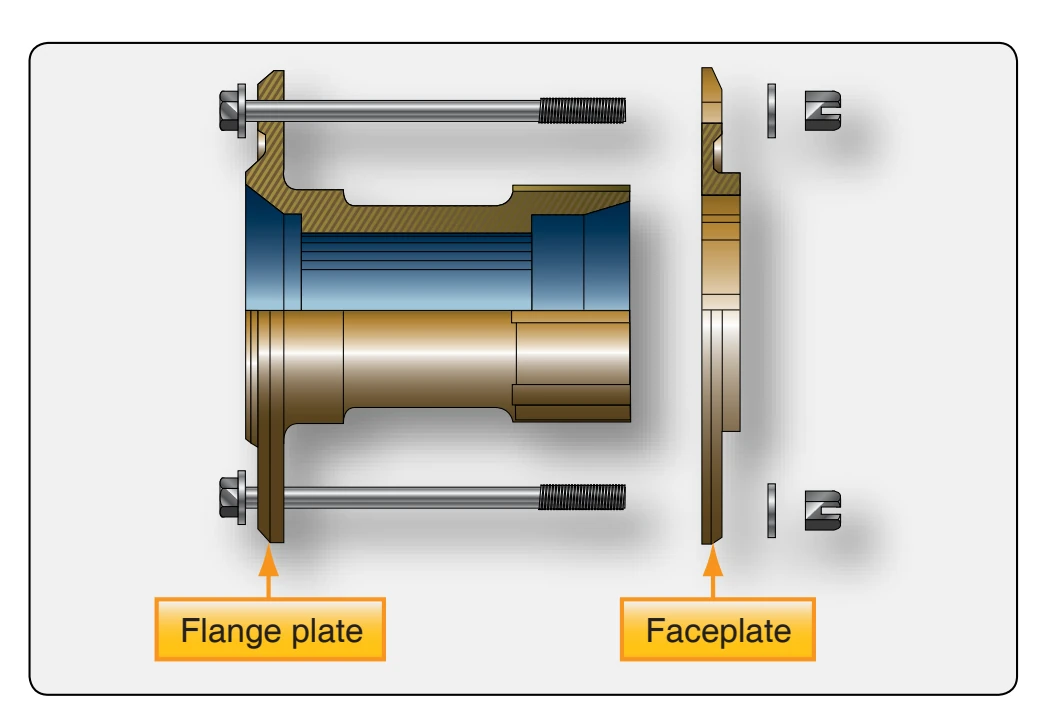
One type of hub assembly for the fixed-pitch, wooden propeller is a steel fitting inserted in the propeller to mount it on the propeller shaft. It has two main parts: the faceplate and the flange plate. [Figure 7-22] The faceplate is a steel disc that forms the forward face of the hub. The flange plate is a steel flange with an internal bore splined to receive the propeller shaft. The end of the flange plate opposite the flange disc is externally splined to receive the faceplate; the faceplate bore has splines to match these external splines. Both faceplate and flange plates have a corresponding series of holes drilled on the disc surface concentric with the hub center. The bore of the flange plate has a 15° cone seat on the rear end and a 30° cone seat on the forward end to center the hub accurately on the propeller shaft.
Metal Fixed-Pitch Propellers
Metal fixed-pitch propellers are similar in general appearance to a wooden propeller, except that the sections are usually thinner. The metal fixed-pitch propeller is widely used on many models of light aircraft and LSA. Many of the earliest metal propellers were manufactured in one piece of forged Duralumin. Compared to wooden propellers, they were lighter in weight because of elimination of blade-clamping devices, offered a lower maintenance cost because they were made in one piece, provided more efficient cooling because of the effective pitch nearer the hub, and, because there was no joint between the blades and the hub, the propeller pitch could be changed, within limits, by twisting the blade slightly by a propeller repair station.
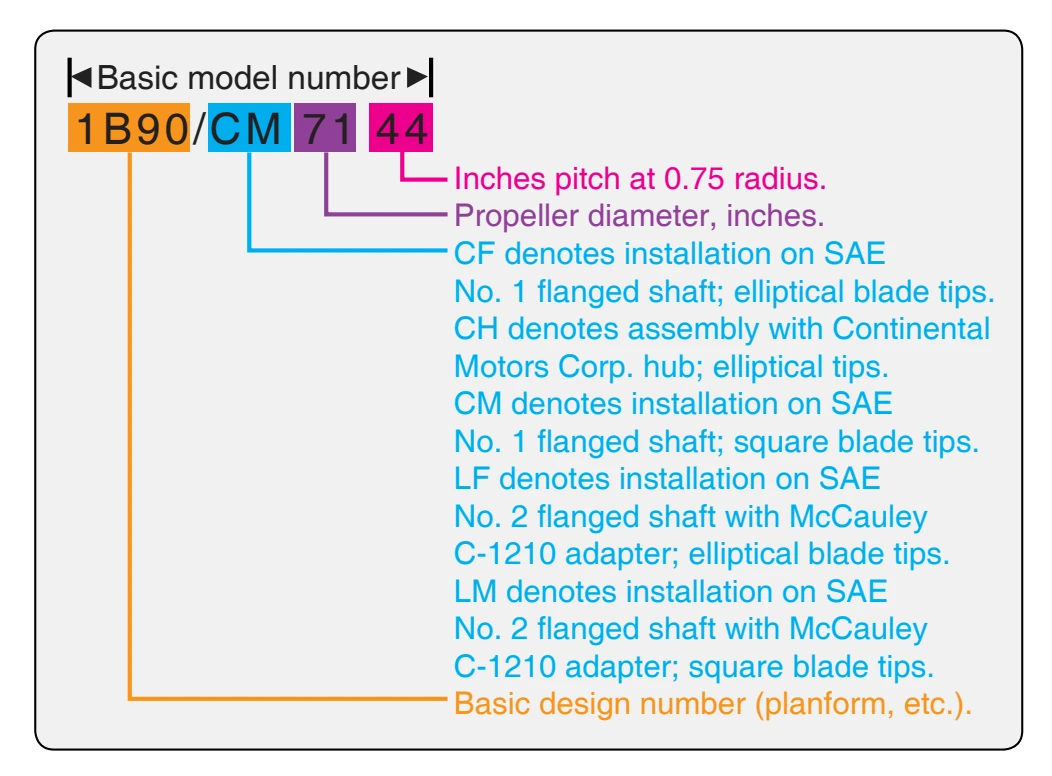
Propellers of this type are now manufactured as one-piece anodized aluminum alloy. They are identified by stamping the propeller hub with the serial number, model number, Federal Aviation Administration (FAA) type certificate number, production certificate number, and the number of times the propeller has been reconditioned. The complete model number of the propeller is a combination of the basic model number and suffix numbers to indicate the propeller diameter and pitch. An explanation of a complete model number, using the McCauley 1B90/CM propeller, is provided in Figure 7-23.
Constant-Speed Propellers
Hartzell Constant-Speed, Nonfeathering
Hartzell propellers can be divided by Aluminum hub (compact) and steel hub. Hartzell compact aluminum propellers represent new concepts in basic design. They combine low weight and simplicity in design and rugged construction. In order to achieve these ends, the hub is made as compact as possible, utilizing aluminum alloy forgings for most of the parts. The hub shell is made in two halves, bolted together along the plane of rotation. This hub shell carries the pitch change mechanism and blade roots internally. The hydraulic cylinder, which provides power for changing the pitch, is mounted at the front of the hub. The propeller can be installed only on engines with flanged mounting provisions.
One model of nonfeathering aluminum hub constant-speed propeller utilizes oil pressure from a governor to move the blades into high pitch (reduced rpm). The centrifugal twisting moment of the blades tends to move them into low pitch (high rpm) in the absence of governor oil pressure. This is an exception to most of the aluminum hub models and feathering models. Most of the Hartzell propeller aluminum and steel hub models use centrifugal force acting on blade flyweights to increase blade pitch and governor oil pressure for low pitch. Many types of light aircraft use governor-regulated, constantspeed propellers in two-bladed and up to six-bladed versions. These propellers may be the nonfeathering type, or they may be capable of feathering and reversing. The steel hub contains a central “spider,” that supports aluminum blades with a tube extending inside the blade roots. Blade clamps connect the blade shanks with blade retention bearings. A hydraulic cylinder is mounted on the rotational axis connected to the blade clamps for pitch actuation. [Figure 7-24]
The basic hub and blade retention is common to all models described. The blades are mounted on the hub spider for angular adjustment. The centrifugal force of the blades,
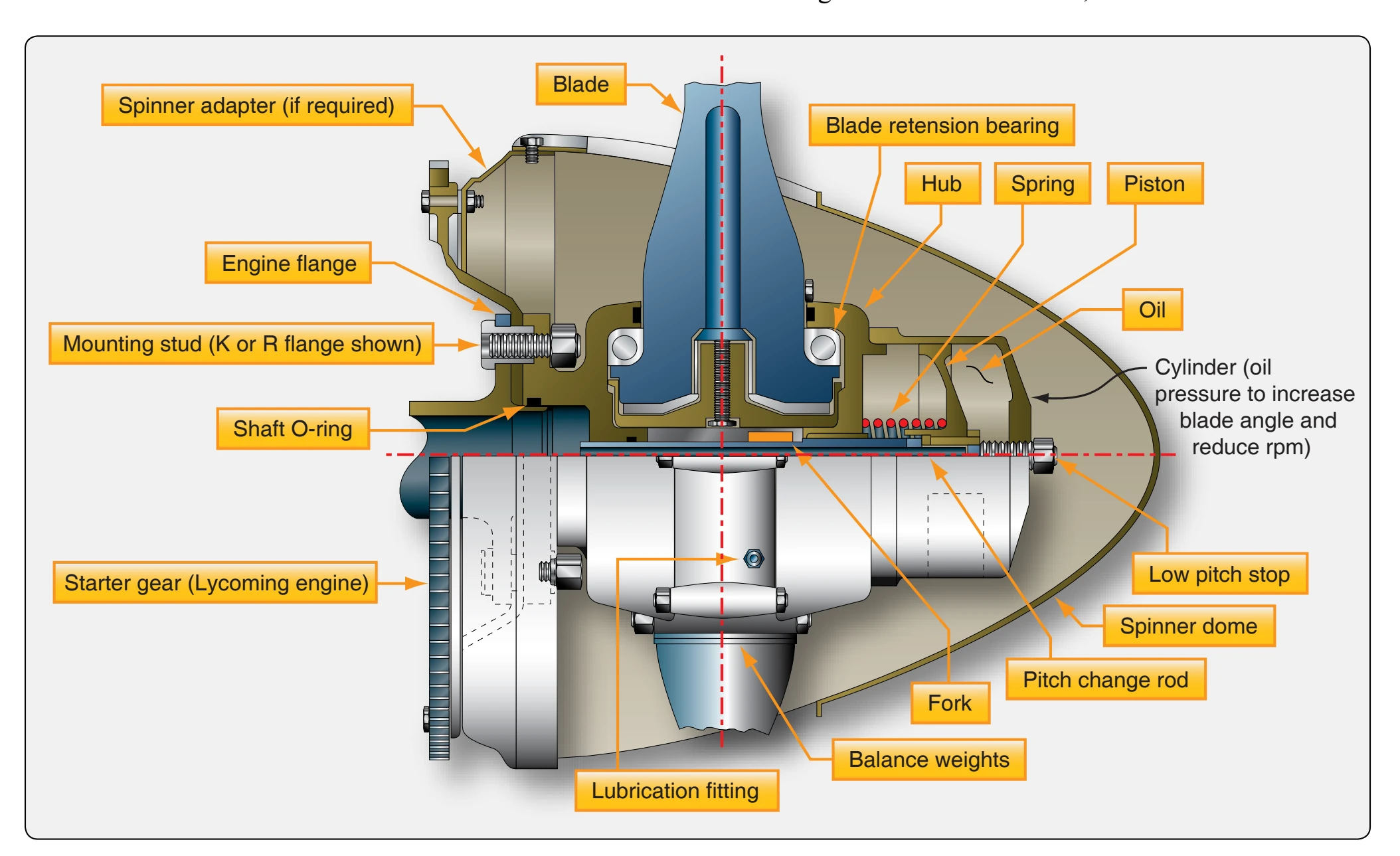
spider through blade clamps and then through ball bearings. The propeller thrust and engine torque is transmitted from the blades to the hub spider through a bushing inside the blade shank. In order to control the pitch of the blades, a hydraulic piston-cylinder element is mounted on the front of the hub spider. The piston is attached to the blade clamps by means of a sliding rod and fork system for nonfeathering models and a link system for the feathering models. The piston is actuated in the forward direction by means of oil pressure supplied by a governor, which overcomes the opposing force created by the flyweights. Hartzell and McCauley propellers for light aircraft are similar in operation. The manufacturer’s specifications and instructions must be consulted for information on specific models.