
Chapter 15
Weather Radar
Attenuation is any process that reduces energy within the radar beam. This reduces the amount of backscattered energy.
15.2.5.1 Precipitation Attenuation
Precipitation attenuation (see Figure 15-4) is the decrease of the intensity of energy within the radar beam due to absorption or scattering of the energy from precipitation particles.
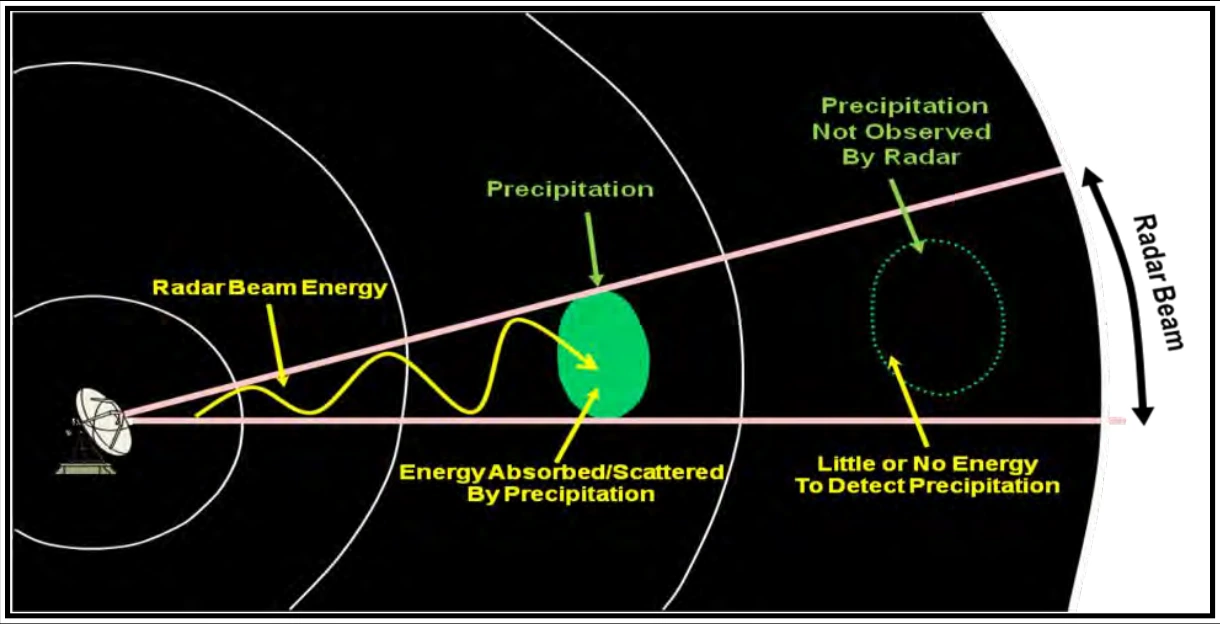
Precipitation close to the radar absorbs and scatters energy within the radar beam. Therefore, very little, if any, energy will reach targets beyond the initial area of precipitation. Because of precipitation attenuation, distant targets (i.e., precipitation) may not be displayed on a radar image.
The amount of precipitation attenuation is related to the wavelength of the radar (see Figure 15-5).
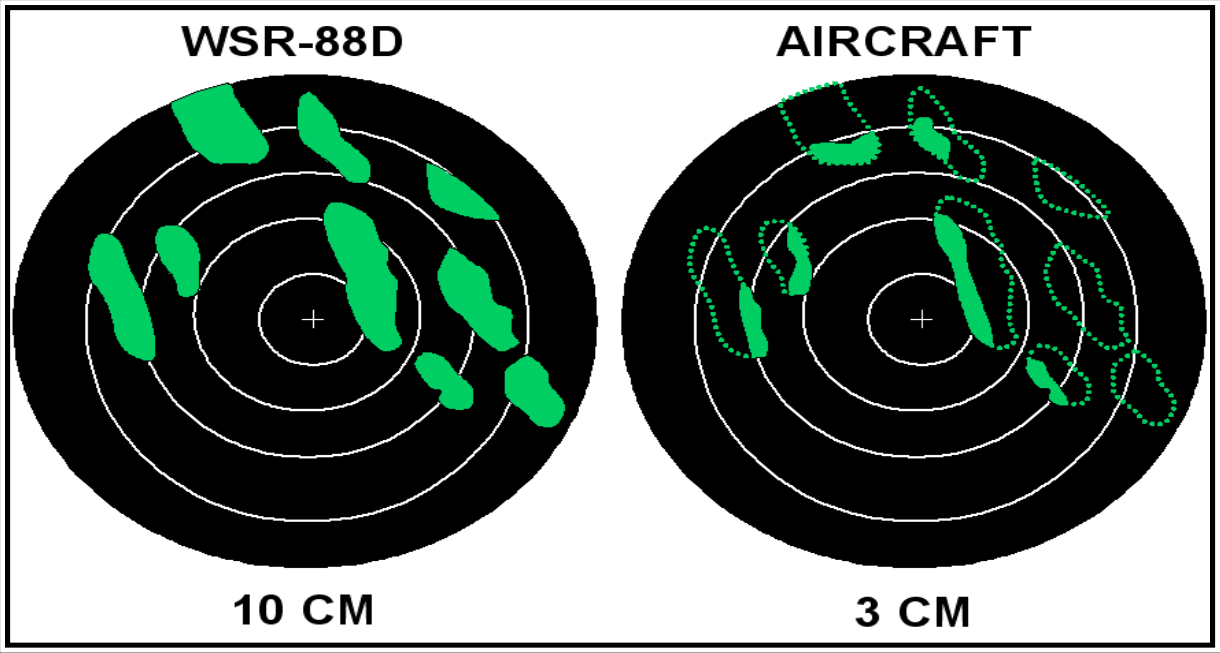
As the wavelength of the radar decreases, the amount of precipitation attenuation increases.
The WSR-88D’s 10-cm wavelength is not significantly attenuated by precipitation. However, aircraft radars, which typically have 3-cm wavelengths, have a significant precipitation attenuation problem. As a result, aircraft weather radar typically only shows the leading edge of extreme intensity echoes.
15.2.5.2 Range Attenuation
Range attenuation is the decrease of the intensity of energy within the radar beam as the beam gets farther away from the antenna. If not compensated for, a target that is farther away from the radar will appear less intense than an identical target closer to the radar.
Range attenuation is automatically compensated for by the WSR-88D. However, most airborne radars only compensate for range attenuation out to a distance of 50 to 75 NM. Targets beyond these ranges will appear less intense than they actually are.
15.2.6 Resolution
Resolution is the ability of the radar to show targets separately.
15.2.6.1 Beam Resolution
Beam resolution is the ability of the radar to identify targets separately at the same range but with different azimuths (see Figure 15-6).
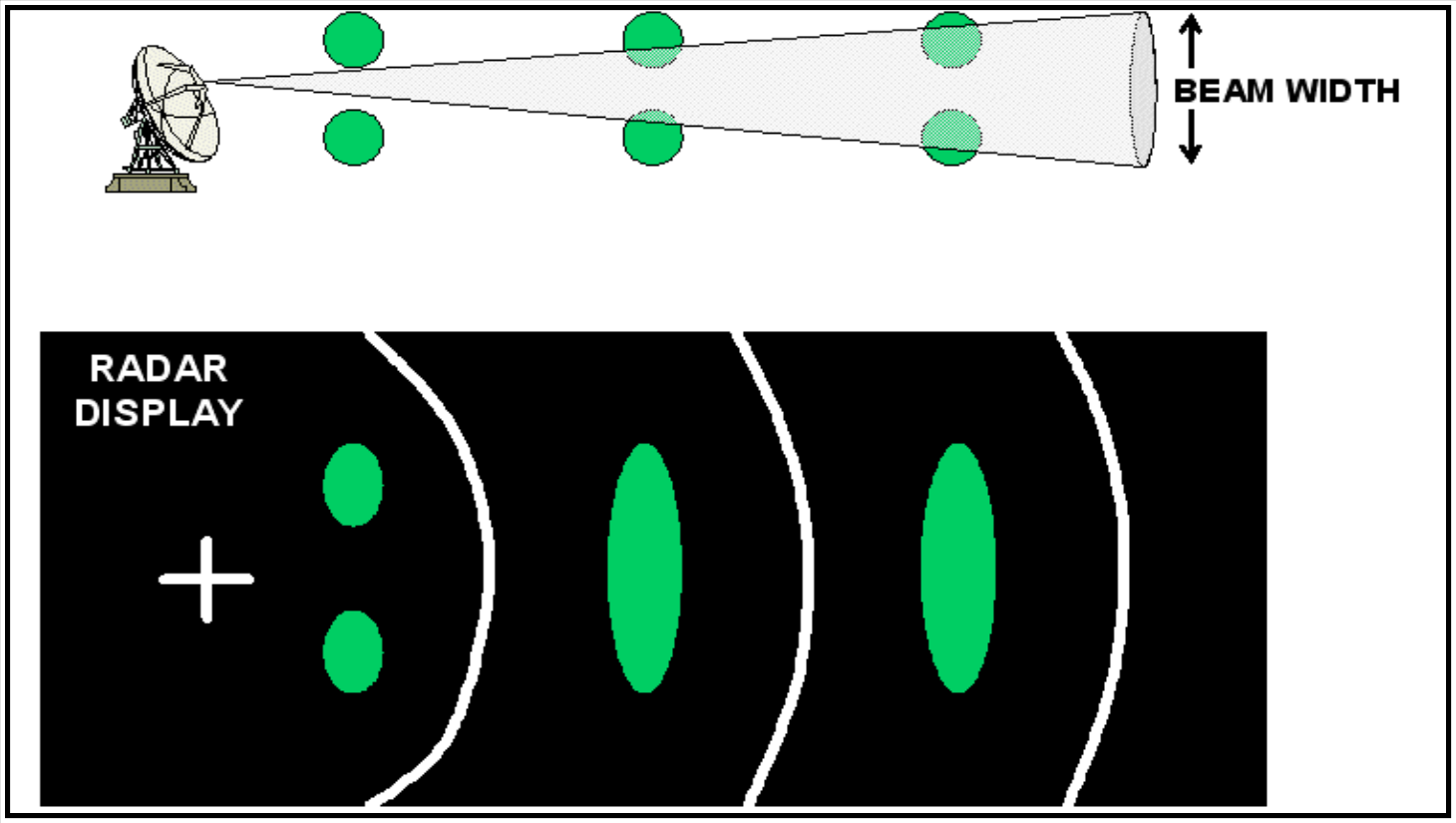
Two targets must be separated by at least one beam width (diameter) in order to be displayed as two separate echoes on a radar image.
The WSR-88D has a beam width of 0.95°. Therefore, at a range of 60 NM, targets separated by at least 1 NM will be displayed separately. At a range of 120 NM, targets separated by at least 2 NM will be displayed separately.
Aircraft radars have beam widths that vary between 3° and 10°. Assuming an average beam width of 5° at a range of 60 NM, targets separated by at least 5.5 NM will be displayed separately. At a range of 120 NM, targets separated by at least 10 NM will be displayed separately.