Chapter 15
Weather Radar
The beam resolution is better for the WSR-88D than aircraft radar (see Figure 15-7).
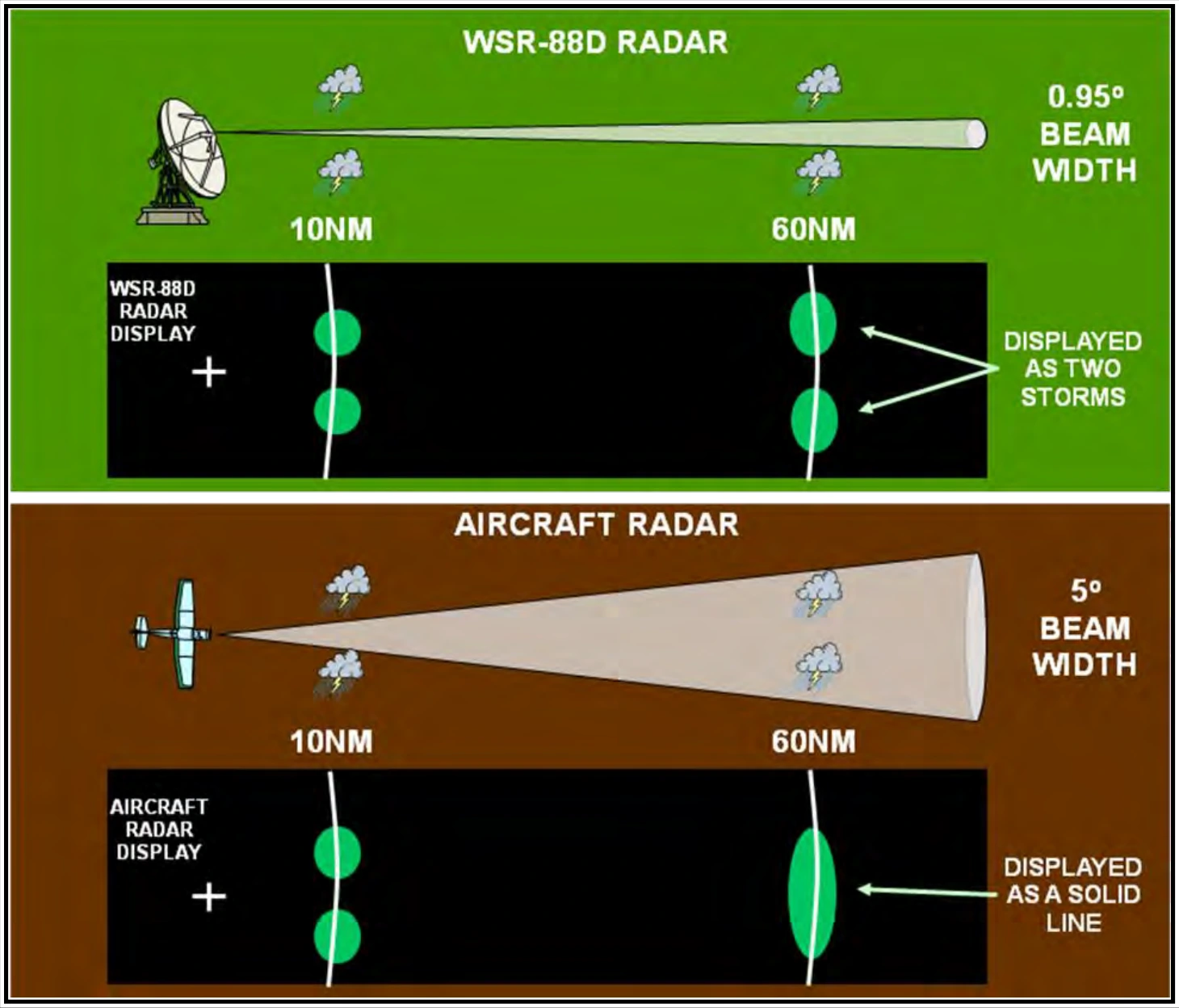
In the example above, the targets (thunderstorms) are at the same range in azimuths for both the aircraft and WSR-88D radar. At 10 NM, the beam width is small enough for both the WSR-88D and aircraft radar to display the thunderstorms separately. At 60 NM, the WSR-88D beam width is still small enough to display both thunderstorms separately. However, the aircraft radar beam width is larger, which results in the two thunderstorms being displayed as one echo.
Note that the beam becomes wider at greater distances from the radar. Therefore, the beam resolution decreases with increasing range from the radar. As a result, lines of precipitation may appear to break up as they move closer to the radar. In reality, the breaks in the precipitation were most likely always there.
15.2.7 Wave Propagation
Radar beams do not travel in a straight line. The beam is bent due to differences in atmospheric density. These density differences, caused by variations in temperature, moisture, and pressure, occur in both the vertical and horizontal directions and affect the speed and direction of the radar beam.
In a denser atmosphere, the beam travels slower. Conversely, in the less dense atmosphere, the beam travels faster. Changes in density can occur over very small distances, so it is common for the beam to be in areas of different densities at the same time as it gets larger. The beam will bend in the direction of the slower portion of the wave.
15.2.7.1 Normal (Standard) Refraction
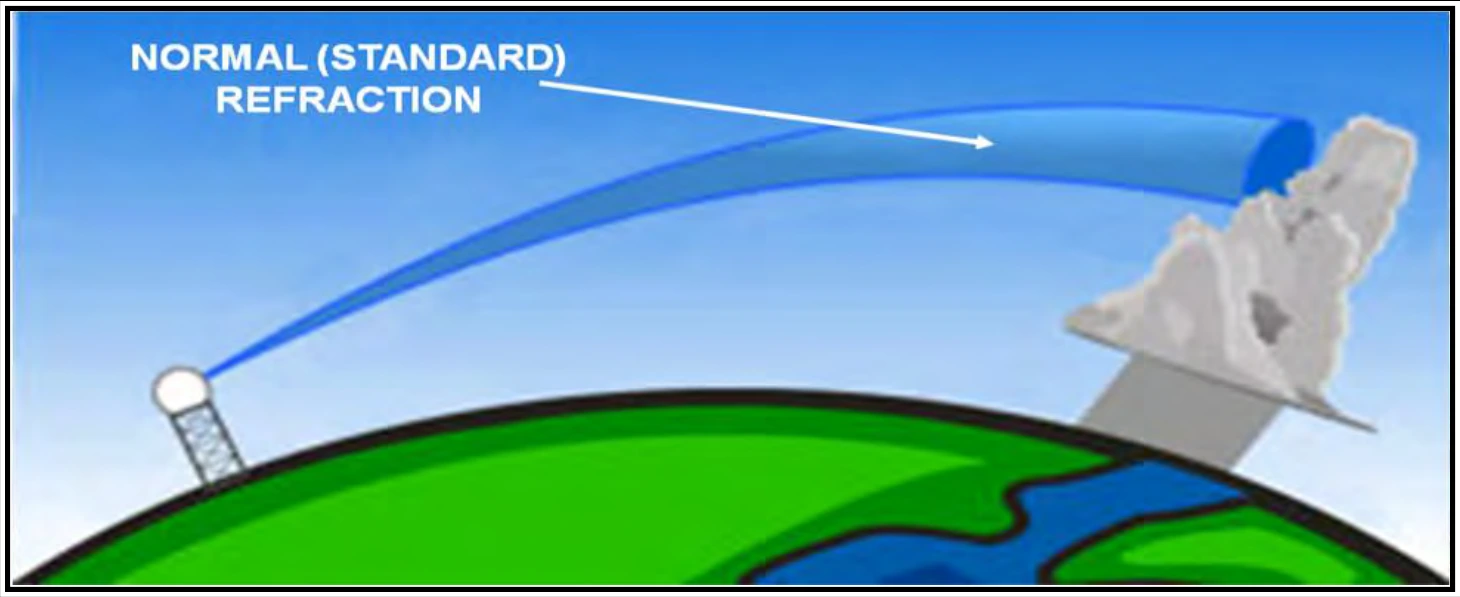
Under normal (i.e., standard) conditions, the atmosphere’s density gradually decreases with increasing height. As a result, the upper portion of a radar beam travels faster than the lower portion of the beam. This causes the beam to bend downward (see Figure 15-8).
The radar beam curvature is less than the curvature of the Earth. Therefore, the height of the radar beam above the Earth’s surface increases with an increasing range.
15.2.7.2 Subrefraction
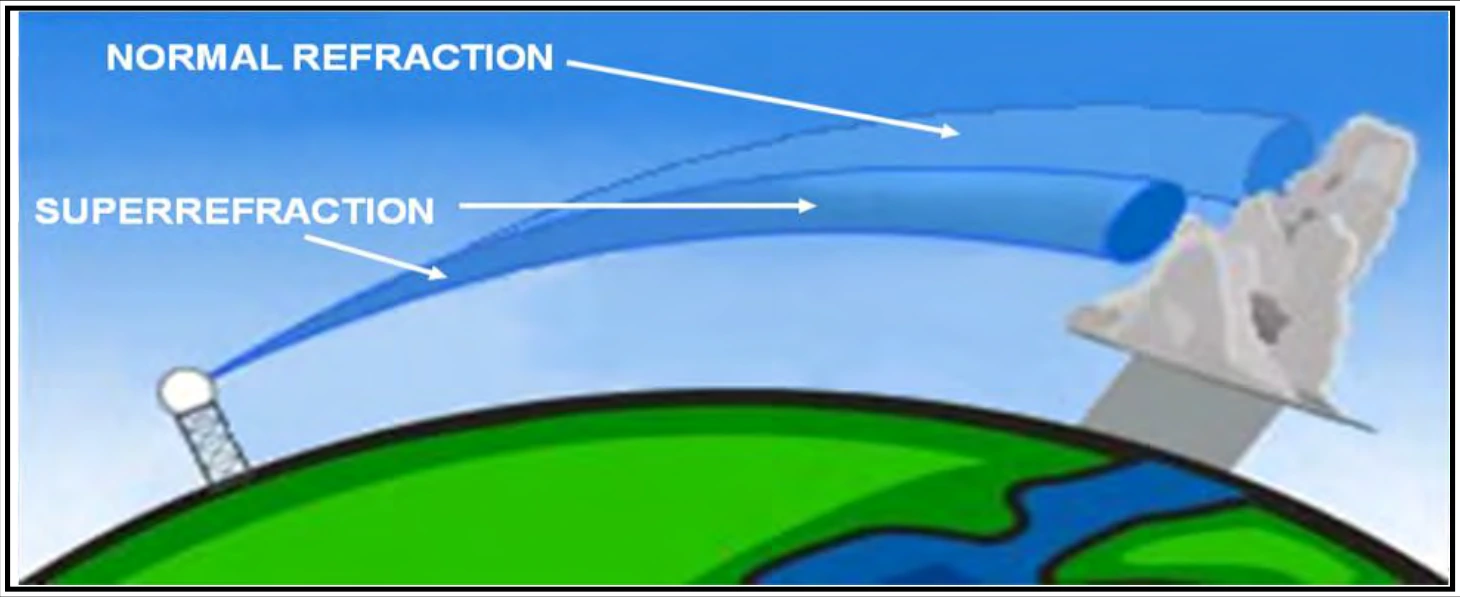
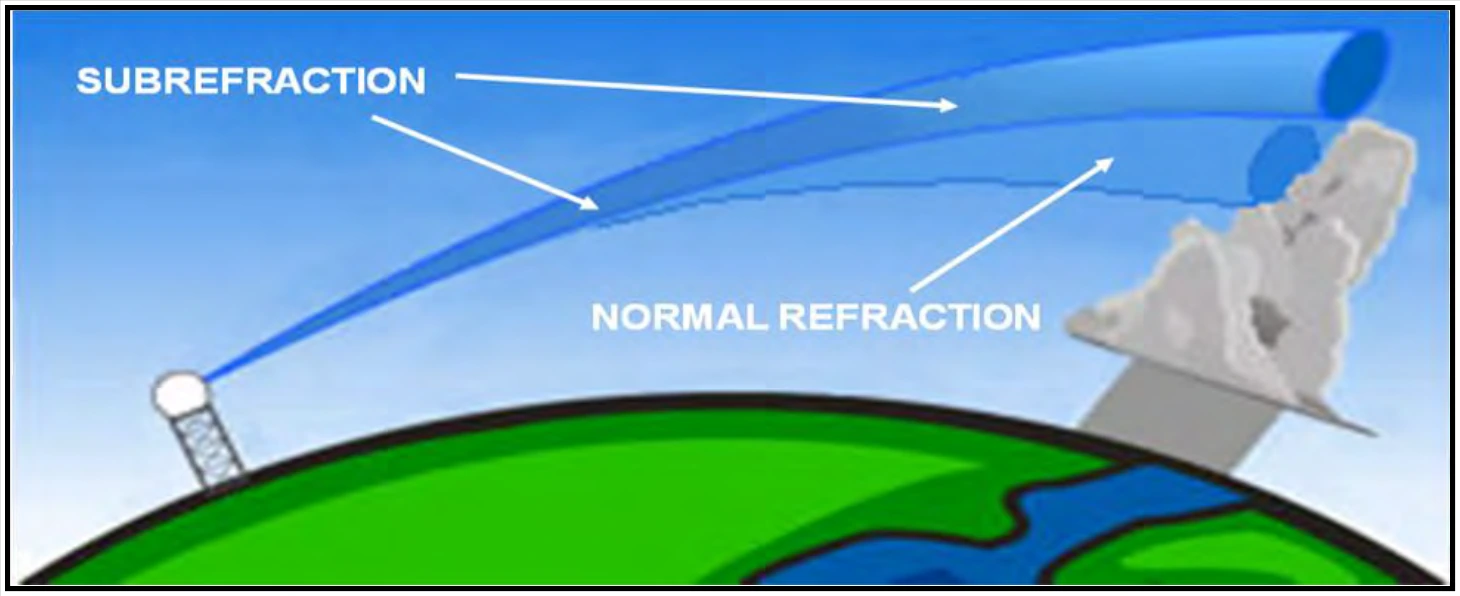
Atmospheric conditions are never normal or standard. Sometimes, the density of the atmosphere decreases with height at a more-than-normal rate (actual density is less than normal). When this occurs, the radar beam bends less than normal and climbs skyward. This phenomenon is known as subrefraction (see Figure 15-9).
Subrefraction may cause the radar beam to overshoot objects that would normally be detected. For example, distant thunderstorms may not be detected with subrefraction. Subrefraction may also cause radar to underestimate the true strength of a thunderstorm. Thunderstorms may appear weaker on radar because subrefraction causes the radar beam to strike the thunderstorm near the top of the cumulonimbus cloud, where the precipitation particles tend to be smaller.
15.2.7.3 Superrefraction
Conversely, sometimes the density of the atmosphere decreases with height at a less-than-normal rate (actual density is greater than normal) or even increases with height. When this occurs, the radar beam will bend more than normal toward the Earth’s surface. This phenomenon is called superrefraction (see Figure 15-10).
Superrefraction causes the radar beam to travel closer to the Earth’s surface than what would occur in a normal atmosphere. This can lead to overestimating the strength of a thunderstorm, as the beam would detect the stronger core of the storm, where precipitation-sized particles are larger.