
Chapter 22
Thunderstorms
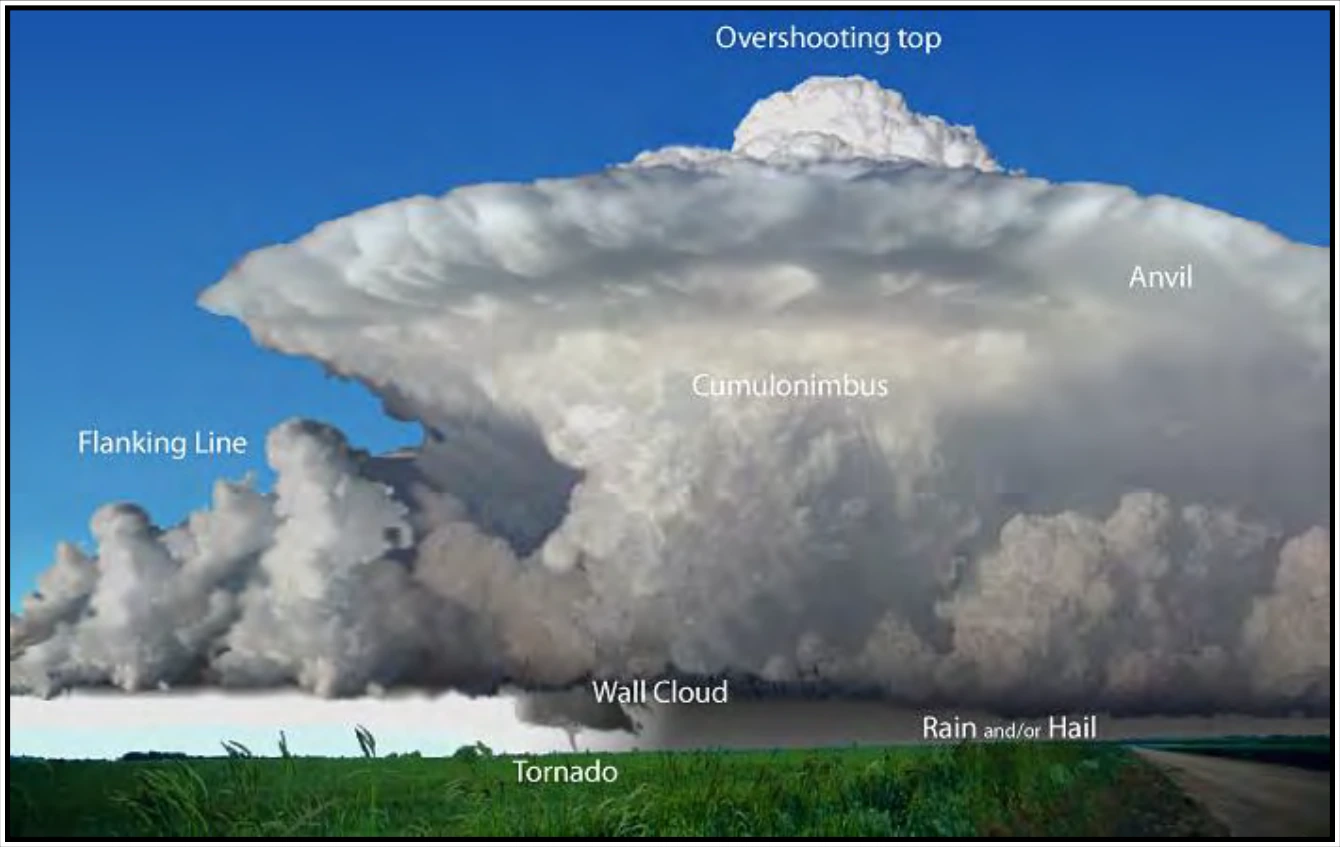
A supercell’s size and persistence make it a bit tougher to circumnavigate than a single-cell thunderstorm. Also, multicell clusters and lines may have supercells incorporated as part of the system as well.
22.5 Factors that Influence Thunderstorm Motion
A thunderstorm is a process, not a solid object or block of wood. Storm motion equals the combined effects of both advection and propagation (see Figure 22-6). Advection is the component of storm motion due to individual cells moving with the average wind throughout the vertical depth of the cumulonimbus cloud. The wind at FL180 (500 mb) usually provides a good approximation. Propagation is the component of storm motion due to old cell dissipation and the new cell development. Storm motion may deviate substantially from the motion of the individual cells, which comprise the storm.
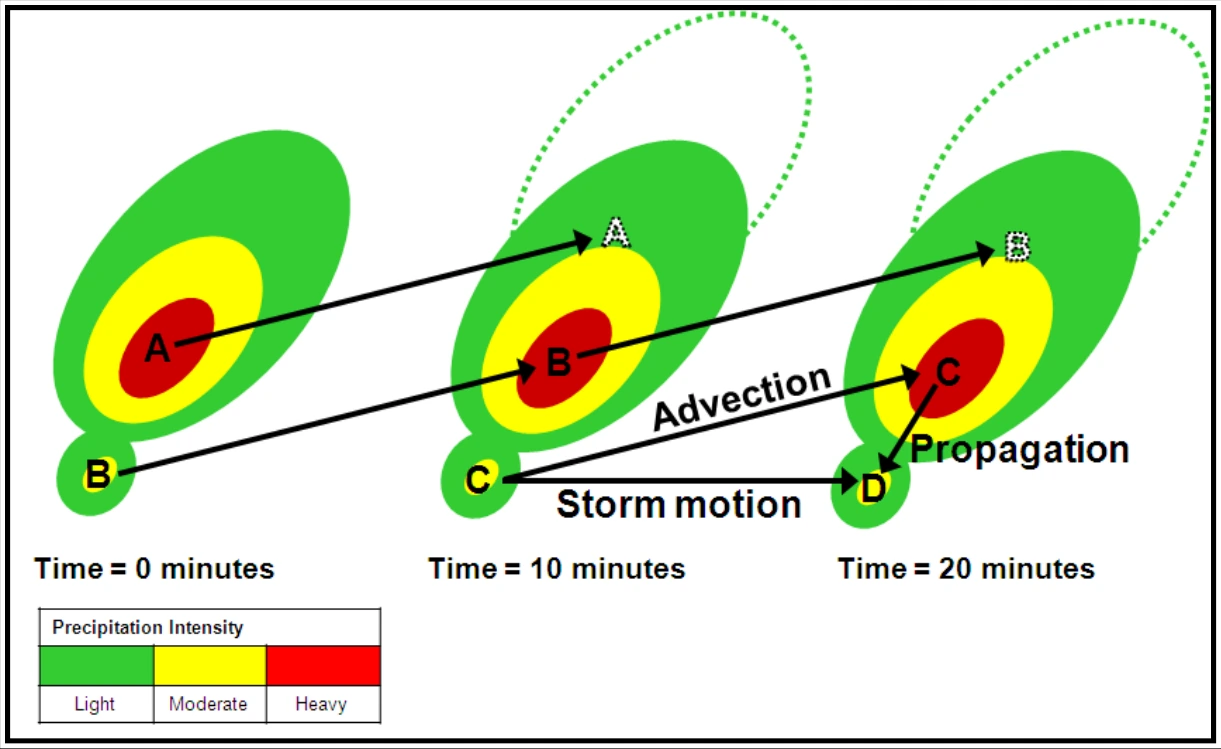
Individual cells that comprise the storm move northeast (advection) but dissipate and are replaced by new cells (propagation). Storm motion equals the combined effects of both advection and propagation.
22.6 Thunderstorm Terminology
Anvil. The flat, spreading top of a cumulonimbus cloud, often shaped like an anvil. Thunderstorm anvils may spread hundreds of miles downwind from the thunderstorm itself and sometimes may spread upwind.
Bow Echo. A radar echo that is linear but bent outward in a bow shape.
Derecho. A widespread, long-lived, straight-line windstorm that is associated with a fast-moving band of severe thunderstorms.
Downdraft. A small-scale column of air that rapidly sinks toward the ground, usually accompanied by precipitation as in a shower or thunderstorm. A microburst is the result of a strong downdraft.
Gust Front. The leading edge of gusty surface winds from thunderstorm downdrafts that is sometimes associated with a shelf cloud or roll cloud. May also be referred to as a gustnado or outflow boundary.
Mesoscale Convective System (MCS). A complex of multiple thunderstorms that becomes organized on a scale larger than the individual thunderstorms but smaller than extratropical cyclones and normally persists for several hours or more.
Roll Cloud. A low, horizontal tube-shaped arcus cloud associated with a thunderstorm gust front. Roll clouds are relatively rare; they are completely detached from the thunderstorm base or other cloud features, thus, differentiating them from the more familiar shelf clouds.
Severe Thunderstorm. A thunderstorm that produces hail with a diameter of one inch (U.S. quarter size) or larger, convective winds of 50 kt (58 mph) or greater, and/or tornadoes.
Shelf Cloud. A low, horizontal wedge-shaped cloud associated with a thunderstorm gust front. Unlike a roll cloud, a shelf cloud is attached to the base of the parent cloud above it, which is usually a thunderstorm.
Updraft. A small-scale current of rising air. If the air is sufficiently moist, then the moisture condenses to become a cumulus cloud or an individual tower of a towering cumulus or cumulonimbus.
22.7 Hazards
All thunderstorms have conditions that are hazards to aviation. These hazards occur in numerous combinations. While not every thunderstorm contains all hazards, it is not possible to visually determine which hazards a thunderstorm contains. Hazards include low ceiling and visibility, lightning, adverse winds, downbursts, turbulence, icing, hail, rapid altimeter changes, static electricity, tornadoes, and engine water ingestion.