
Chapter 22
Thunderstorms
Generally, visibility is near zero within a thunderstorm cloud. Ceiling and visibility also may be restricted in precipitation and dust between the cloud base and the ground. The restrictions create the same problem as all ceiling and visibility restrictions, but the hazards are increased when associated with the other thunderstorm hazards of turbulence, hail, and lightning that make precision instrument flying virtually impossible.
22.7.2 Lightning
Every thunderstorm produces lightning and thunder by definition. Lightning is a visible electrical discharge produced by a thunderstorm. The discharge may occur within or between clouds, between a cloud and air, between a cloud and the ground, or between the ground and a cloud.
Lightning can damage or disable an aircraft. It can puncture the skin of an aircraft, and it can damage communications and electronic navigational equipment. Lightning has been suspected of igniting fuel vapors causing an explosion; however, serious accidents due to lightning strikes are extremely rare. Nearby lightning can blind the pilot, rendering the pilot momentarily unable to navigate either by instrument or by visual reference. Nearby lightning can also induce permanent errors in the magnetic compass. Lightning discharges, even distant ones, can disrupt radio communications on low and medium frequencies. Though lightning intensity and frequency have no simple relationship to other storm parameters, severe storms, as a rule, have a high frequency of lightning.
22.7.3 Downburst and Microburst
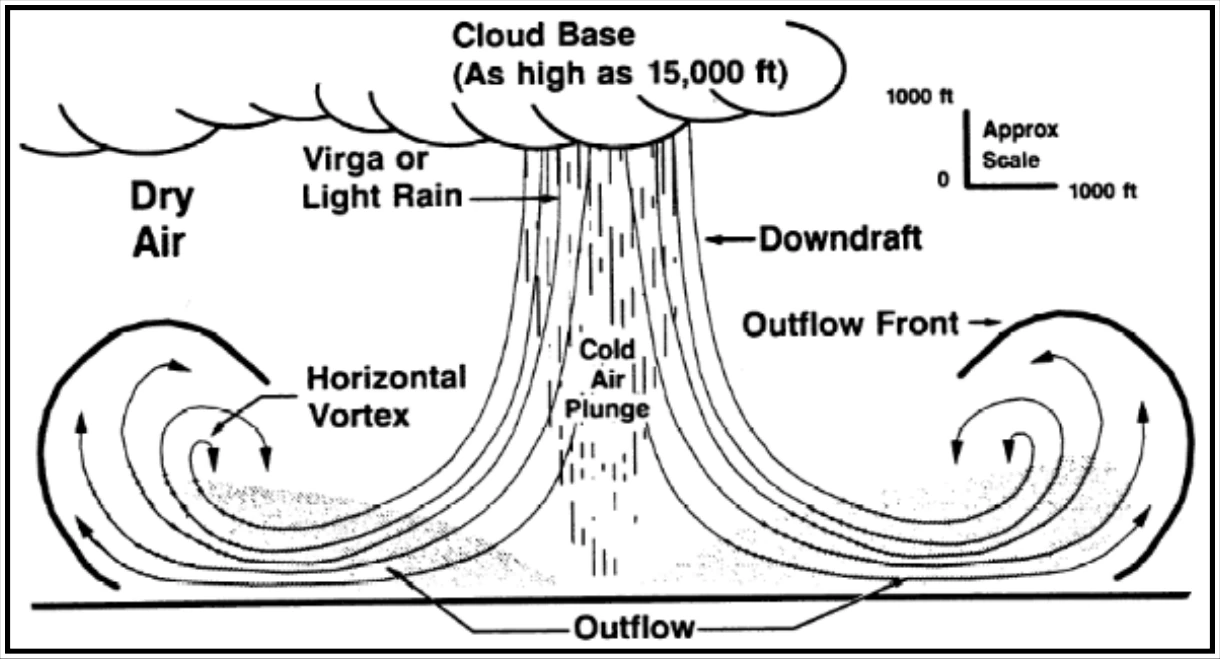
The downward moving column of air in a typical thunderstorm is large. Convective clouds, shower cells, and thunderstorm cells sometimes produce intense downdrafts called downbursts that create strong, often damaging winds and wind shear. Downbursts (see Figure 22-7) can create hazardous conditions for pilots and have been responsible for many LLWS accidents. Smaller, shorter-lived downbursts are called microbursts.
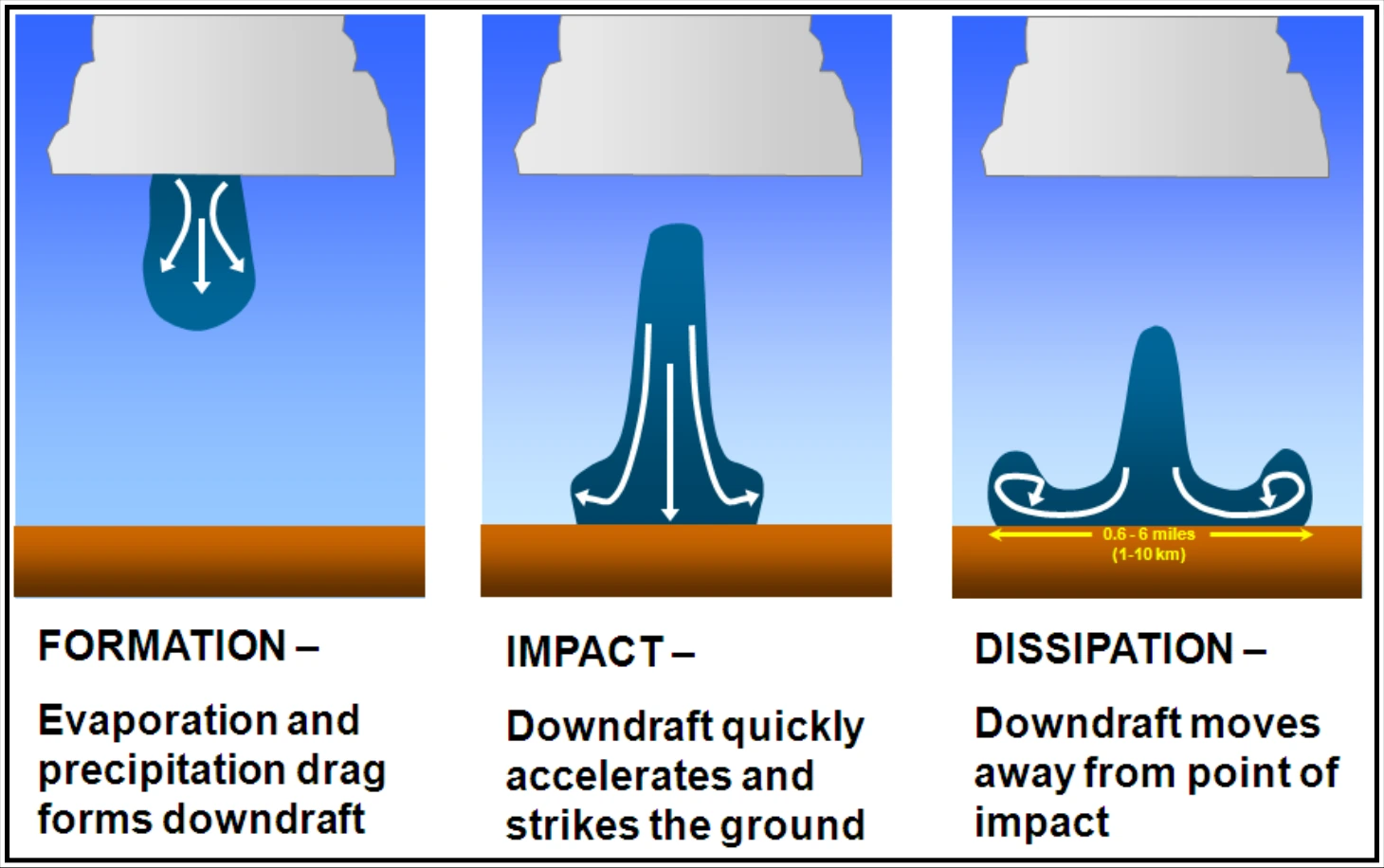
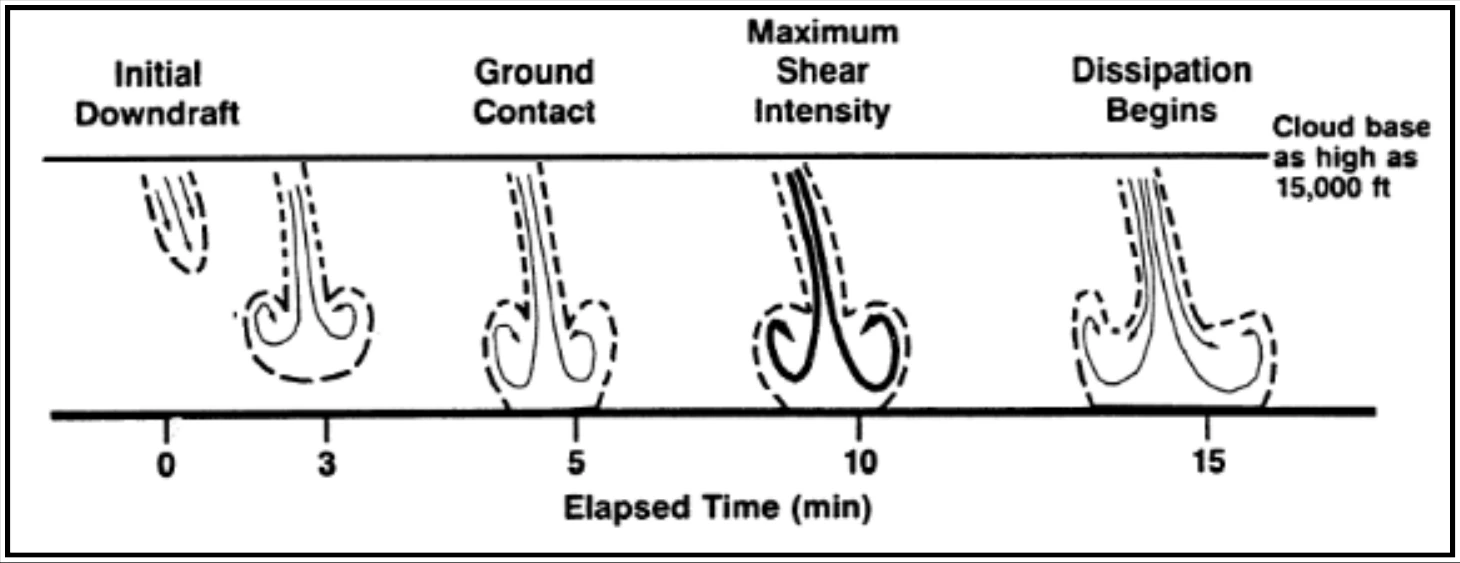
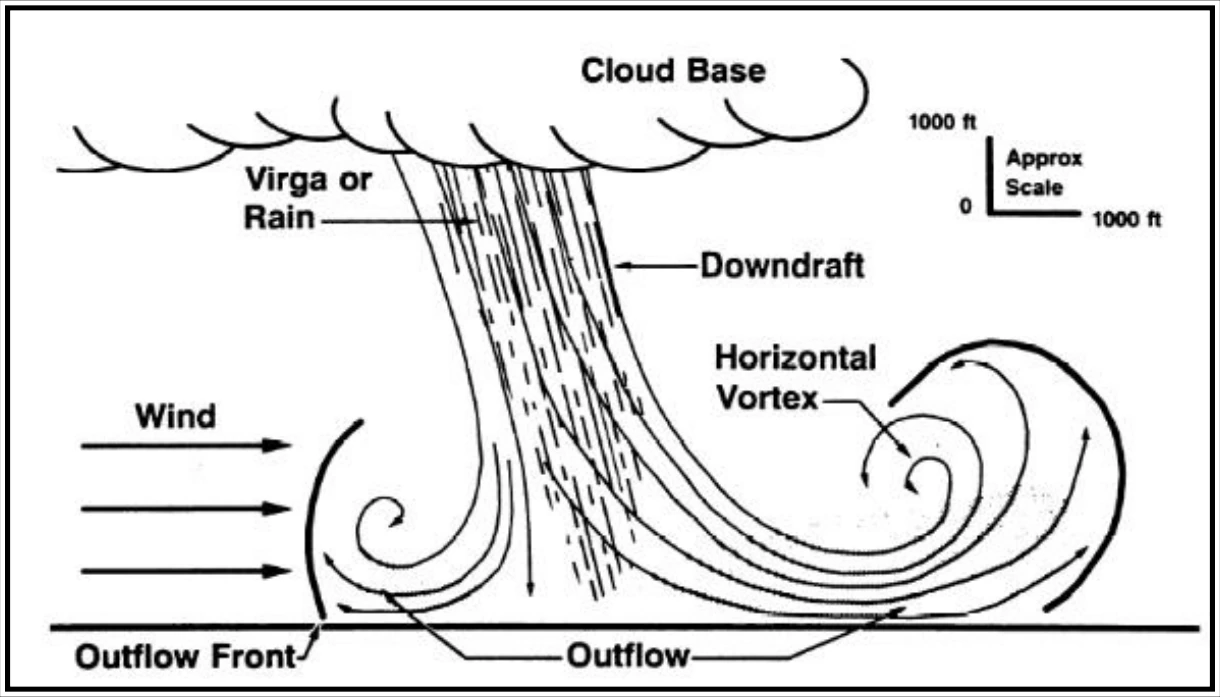
A microburst (see Figure 22-8) is a small-scale, intense downdraft that, when reaching the surface, spreads outward symmetrically (see Figure 22-9) or asymmetrically (see Figure 22-10), in all directions from the downdraft center. It is the most severe type of wind shear. Microburst activity may be indicated by an intense rain shaft at the surface, but virga (i.e., streaks of precipitation falling from a thunderstorm cloud but not reaching the ground) at the cloud base and/or a ring of blowing dust is sometimes the only visible clue (see Figure 22-11).
A typical microburst has a horizontal diameter of less than 2.5 mi and a nominal depth of 1,000 ft. The lifespan of a microburst is about 5–15 minutes, during which time it can produce downdrafts of up to 6,000 fpm; increasing headwind and headwind losses of 30–90 kt, seriously degrading performance. It can also produce strong turbulence and hazardous wind direction changes.
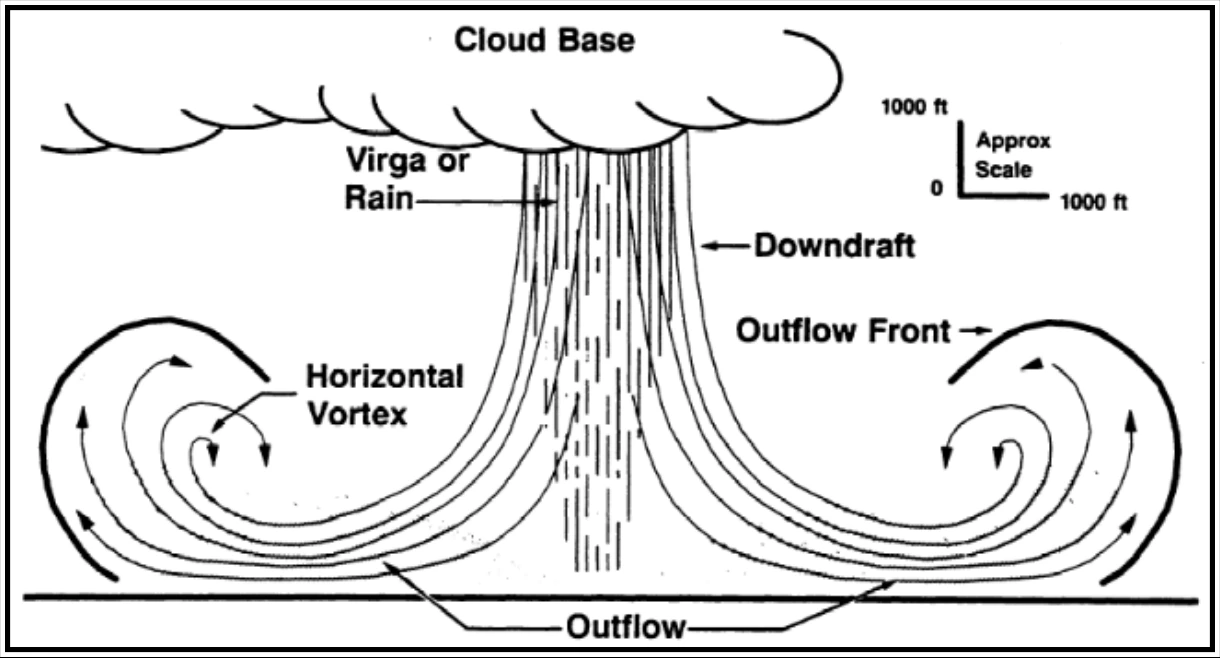
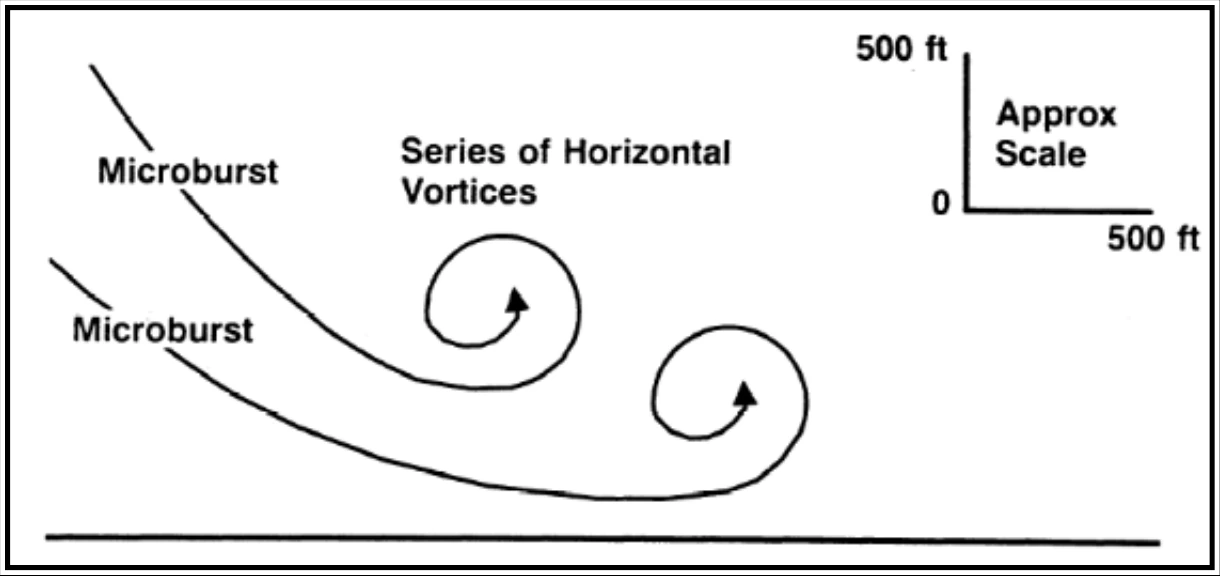
More than one microburst can occur in the same weather system. Pilots are therefore cautioned to be alert for additional microbursts if one has already been encountered or observed. If several microbursts are present, a series of horizontal vortices can form near the ground due to several microbursts being embedded in one another (see Figure 22-12). Conditions associated with these vortices may produce very powerful updrafts and roll forces in addition to downdrafts.
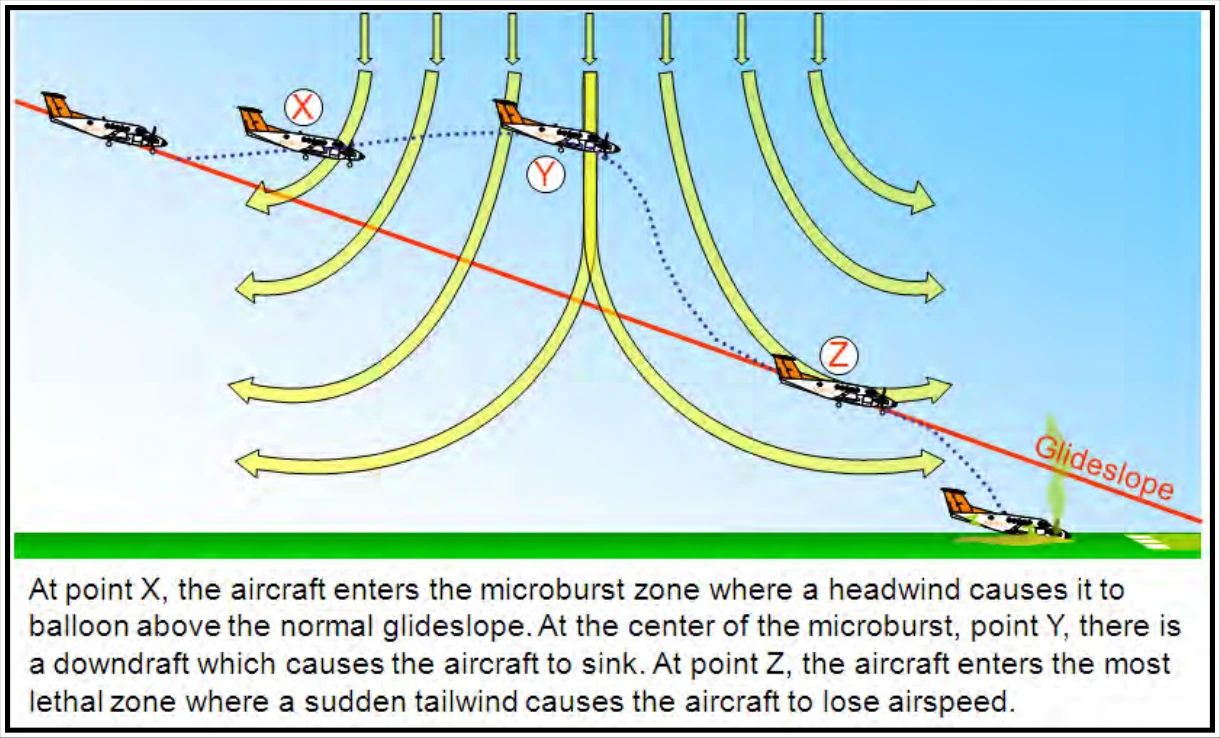
A downburst or microburst is dangerous to aircraft when climbing from takeoff or approaching to land. During these phases, the aircraft is operating at slow speeds. A major change of wind velocity can lead to loss of lift and a crash. During landing, if the pilot has reduced power and lowered the nose in response to the headwind shear (see Figure 22-13) this leaves the aircraft in a nose-low, power-low configuration when the tailwind shear occurs, which makes recovery more difficult. It can cause the airplane to stall or land short of the runway.
Pilots should be alert for indications of a microburst early in the approach phase, and ready to initiate a missed approach at the first indication. However, it may be impossible to recover from a microburst encounter at low altitude.
Pilots should be aware of asymmetrical microbursts (see Figure 22-10), since a significant airspeed increase may not occur upon entering the outflow or may be much less than the subsequent airspeed loss experienced when exiting the microburst.
It is vital for pilots to recognize that some microbursts cannot be successfully escaped with any known techniques. Some wind shears that are within the performance capability of the aircraft have caused accidents.