Chapter 22
Thunderstorms
22.7.3.1 Encounter During Takeoff—After Lift-Off
In previous accidents studied, the airplane encountered an increasing tailwind shear shortly after lifting off the runway (see Figure 22-14). For the first 5 seconds after lift-off, the takeoff appeared normal, but the airplane crashed off the end of the runway about 20 seconds after lift-off.
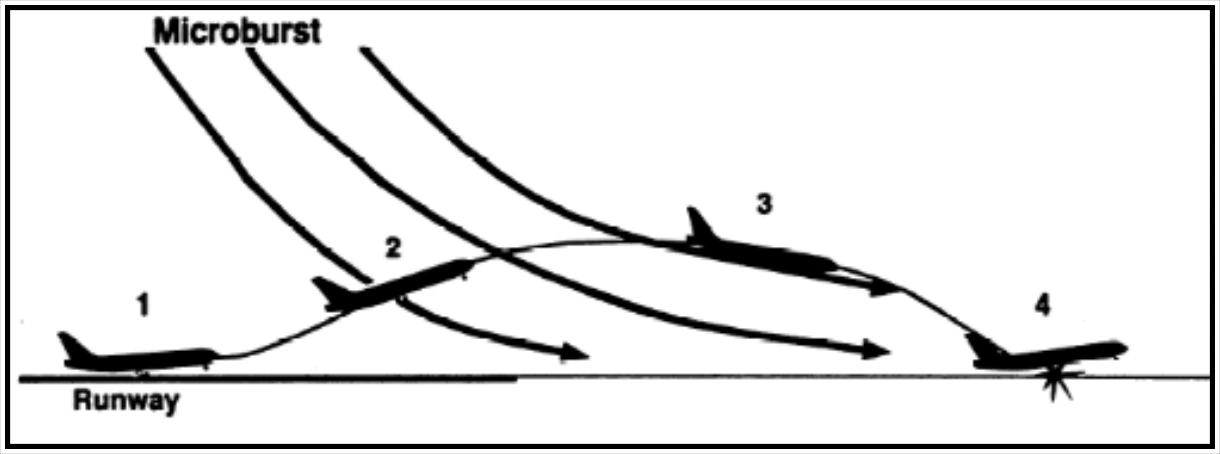
(1) Takeoff initially appears normal. (2) Aircraft encounters wind shear just after lift-off. (3) Airspeed decreases resulting in pitch attitude reduction. (4) Aircraft crashes off departure end of runway 20 seconds after lift-off.
In many events involving after-lift-off wind shear encounters, early trends in airspeed, pitch attitude, vertical speed, and altitude appeared normal. In this example, the airplane encountered wind shear before stabilized climb was established, which caused difficulty in detecting onset of shear. As the airspeed decreased, pitch attitude was reduced to regain trim airspeed (see Figure 22-15). By reducing pitch attitude, available performance capability was not used and the airplane lost altitude. As terrain became a factor, recovery to initial pitch attitude was initiated. This required unusually high stick force (up to 30 lb of pull may be needed on some airplanes). Corrective action, however, was too late to prevent ground contact since the downward flightpath was well established.
Reducing pitch attitude to regain lost airspeed or allowing attitude to decrease in response to lost airspeed, is the result of past training emphasis on airspeed control. Successful recovery from an inadvertent wind shear encounter necessitates maintaining or increasing pitch attitude and accepting lower-than-usual airspeed. Unusual and unexpected stick forces may be needed to counter natural airplane pitching tendencies due to airspeed and lift loss.
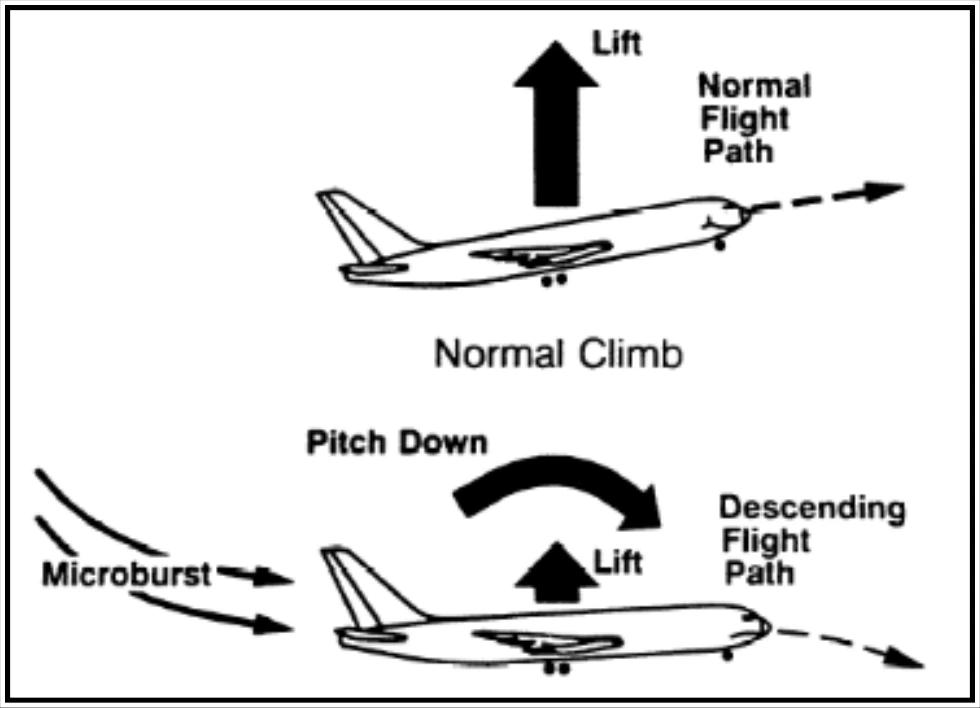
Microburst reduces airspeed and lift at normal attitude, which results in pitch-down tendency to regain airspeed.
To counter the loss of airspeed and lift resulting from wind shear, pitch attitude must not be allowed to fall below the normal range. Only by properly controlling pitch attitude and accepting reduced airspeed can flightpath degradation be prevented (see Figure 22-16). Once the airplane begins to deviate from the intended flightpath and high descent rates develop, it takes additional time and altitude to change flightpath direction.
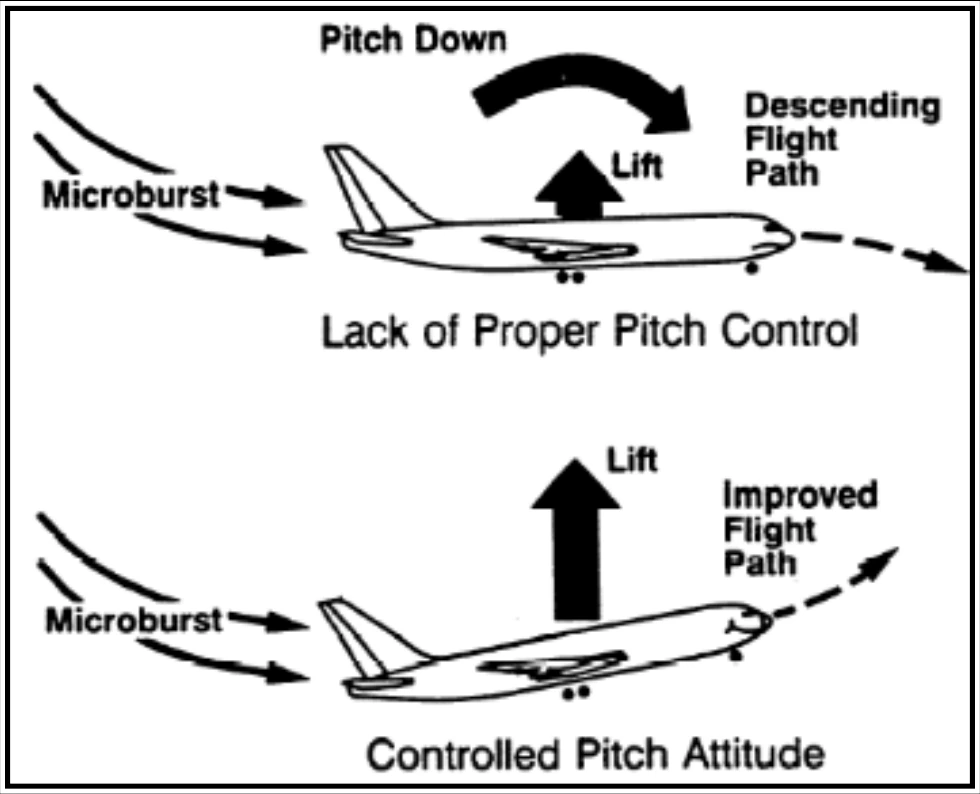
Control of pitch attitude and acceptance of reduced airspeed results in improved flightpath.
Only 5 to 15 seconds may be available to recognize and respond to a wind shear encounter (see Figure 22-17). Therefore, it is of great importance that a wind shear encounter be recognized as soon as possible.
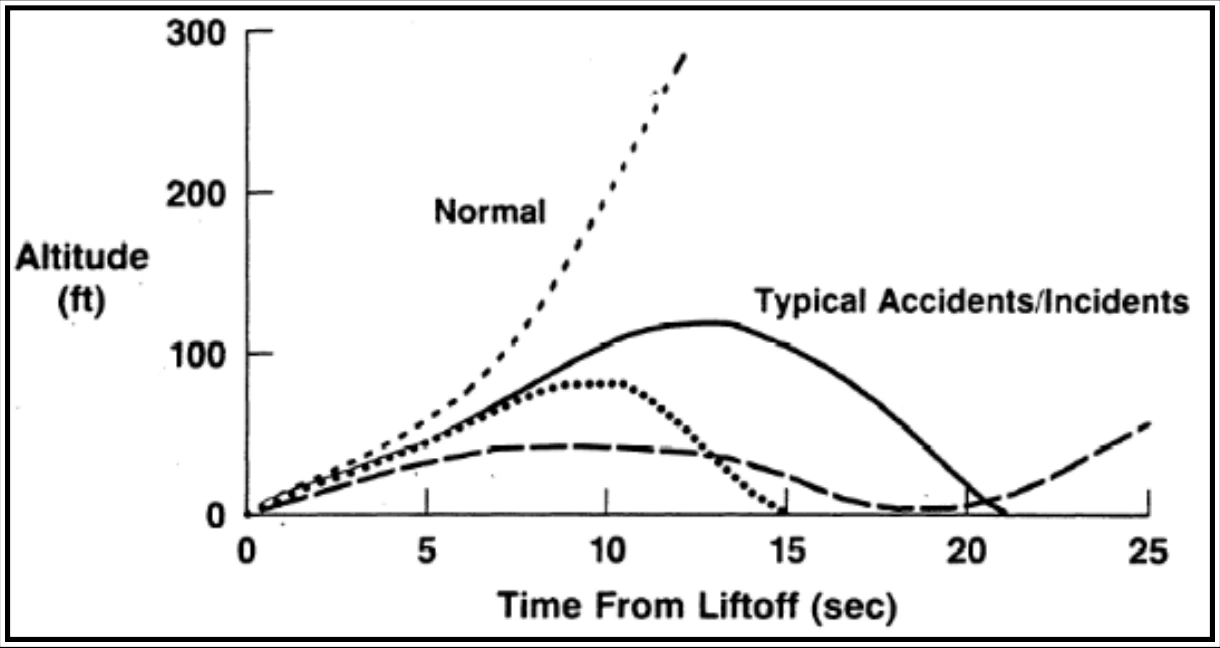
Takeoff initially appeared normal. Additional time is needed to arrest descent. Result: Only 5 to 15 seconds may be available for recognition and recovery.
22.7.3.2 Encounter During Takeoff—On Runway
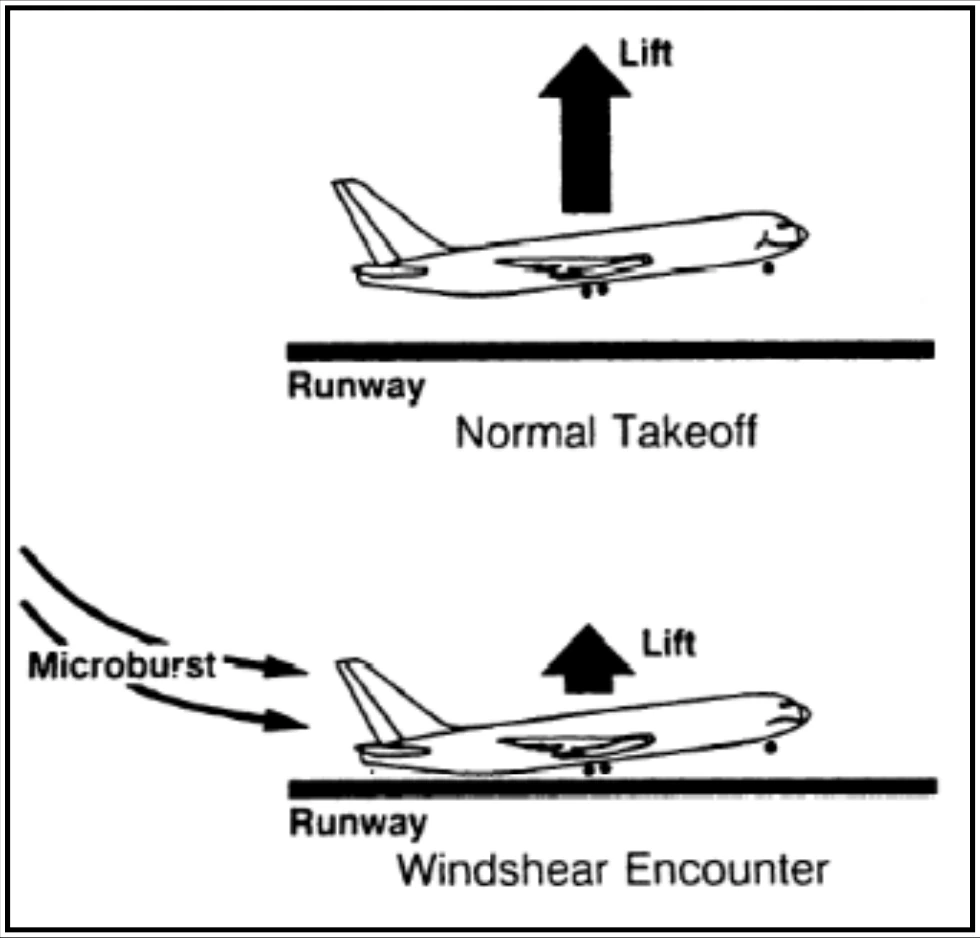
Analysis of a typical accident where an increasing tailwind shear was encountered during takeoff ground roll showed that initial indications appeared normal (see Figure 22-18). Due to the increasing tailwind shear, however, the airplane did not reach rotation speed (V ) until nearing the end of the runway. As the airplane lifted off, the tailwind continued increasing, preventing any further airspeed increase. The airplane contacted an obstacle off the departure end of the runway.
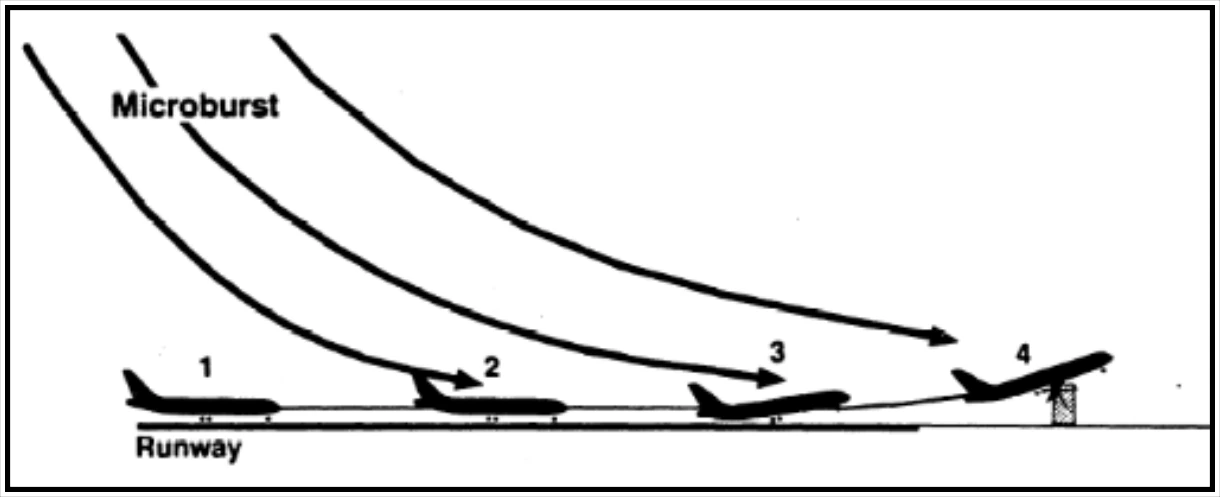
(1) Takeoff initially appeared normal. (2) Airspeed buildup slowed due to wind shear. (3) Airplane reached V near end of runway, lifted off but failed to climb. (4) Airplane contacted obstacle off departure end of runway.
Less-than-normal airspeed, due to wind shear encounter, resulted in reduced available lift at normal takeoff attitude (see Figure 22-19). In turn, the inability to lift off soon enough to clear obstacles resulted.