
Chapter 22
Thunderstorms
In contrast to shears that increase airspeed, an increasing tailwind (or decreasing headwind) shear will decrease indicated airspeed and performance capability. Due to airspeed loss, the airplane may tend to pitch down to regain trim speed.
22.7.3.4.2 Vertical Wind Shear Response
Vertical winds exist in every microburst and increase in intensity with altitude. Such winds usually reach peak intensity at heights greater than 500 ft above the ground. Downdrafts with speeds greater than 3,000 fpm can exist in the center of a strong microburst. The severity of the downdraft the airplane encounters depends on both the altitude and lateral proximity to the center of the microburst.
Perhaps more critical than sustained downdrafts, short duration reversals in vertical winds can exist due to the horizontal vortices associated with microbursts. This is shown in Figure 22-23 below.
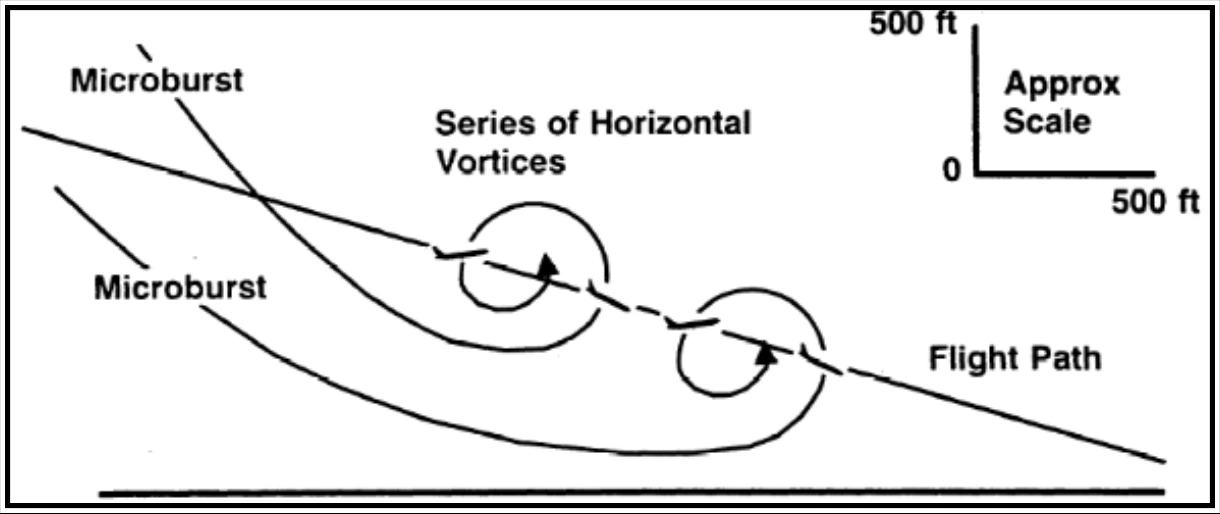
Rapid updraft/downdraft variations due to horizontal vortices can cause uncommanded pitch changes and may result in momentary stick shaker activation, well above normal stick shaker speeds.
An airplane flying through horizontal vortices as shown in Figure 22-23 experiences alternating updrafts and downdrafts causing pitch changes without pilot input. These vertical winds result in airplane angle-of-attack fluctuations that, if severe enough, may result in momentary stick shaker actuation or airframe shudder at speeds well above normal.
22.7.4 Convective Turbulence
See Section 19.2.1 for information on convective turbulence.
22.7.5 Convective Icing
See Section 20.3.9 for information on convective icing.
22.7.6 Hail
See Section 14.4.5 for information on hail.
22.7.7 Rapid Altimeter Changes
Pressure usually falls rapidly with the approach of a thunderstorm. Pressure then usually rises sharply with the onset of the first gust and arrival of the cold downdraft and heavy rain, falling back to normal as the thunderstorm passes. This cycle of pressure change may occur in 15 minutes. If the pilot does not receive a corrected altimeter setting, the altimeter may be more than 100 ft in error.
22.7.8 Static Electricity
Static electricity (a steady, high level of noise in radio receivers) is caused by intense corona discharges from sharp metallic points and edges of flying aircraft. It is encountered often in the vicinity of thunderstorms. When an aircraft flies through clouds, precipitation, or a concentration of solid particles (e.g., ice, sand, or dust), it accumulates a charge of static electricity. The electricity discharges onto a nearby surface or into the air, causing a noisy disturbance at lower frequencies.
The corona discharge is weakly luminous and may be seen at night. Although it has a rather eerie appearance, it is harmless. It was named “St. Elmo’s Fire” by Mediterranean sailors, who saw the brushy discharge at the top of ship masts.
22.7.9 Tornado
A tornado is a violently rotating column of air in contact with the ground, either pendant from a cumuliform cloud or underneath a cumuliform cloud, and often (but not always) visible as a funnel cloud. The most violent thunderstorms draw air into their cloud bases with great force. If the incoming air has any initial rotating motion, it often forms an extremely concentrated vortex from the surface well into the cloud. Meteorologists have estimated that wind in such a vortex can exceed 200 kt; pressure inside the vortex is quite low. The strong winds gather dust and debris, and the low pressure generates a funnel-shaped cloud extending downward from the cumulonimbus base. If the cloud does not reach the surface, it is a “funnel cloud”; if it touches a land surface, it is a “tornado”; and if it touches water, it is a “waterspout.” When tornadoes do occur without any visible funnel cloud, debris at the surface is usually the indication of the existence of an intense circulation in contact with the ground.