
Chapter 22
Thunderstorms
Microburst reduces airspeed and lift at normal attitude that results in inability to lift off.
An additional factor is the difficulty of recognizing deteriorating airplane performance. Timely recognition of a wind shear encounter on the runway may be difficult since the only indication may be a slower-than-normal airspeed increase. The presence of gusts may mask abnormal airspeed buildup. Time available to respond effectively to a wind shear may be as little as five seconds from the initial encounter.
If there is insufficient runway left to accelerate to normal takeoff speed, and inadequate runway to stop, lift-off and safe climb may require rotation at speeds less than V. In this case, additional pitch attitude may be needed to achieve sufficient lift (see Figure 22-20). In traditional training, crews are frequently cautioned not to rotate at speeds less than V to avoid high pitch attitudes that could result in aft body contact. In a wind shear encounter, rotation toward normal takeoff pitch attitude at lower-than-normal airspeed may be needed to lift off in the remaining runway. This may result in aft body contact. To deal with an inadvertent wind shear encounter, the pilot should be prepared to apply techniques that differ from those ordinarily used.
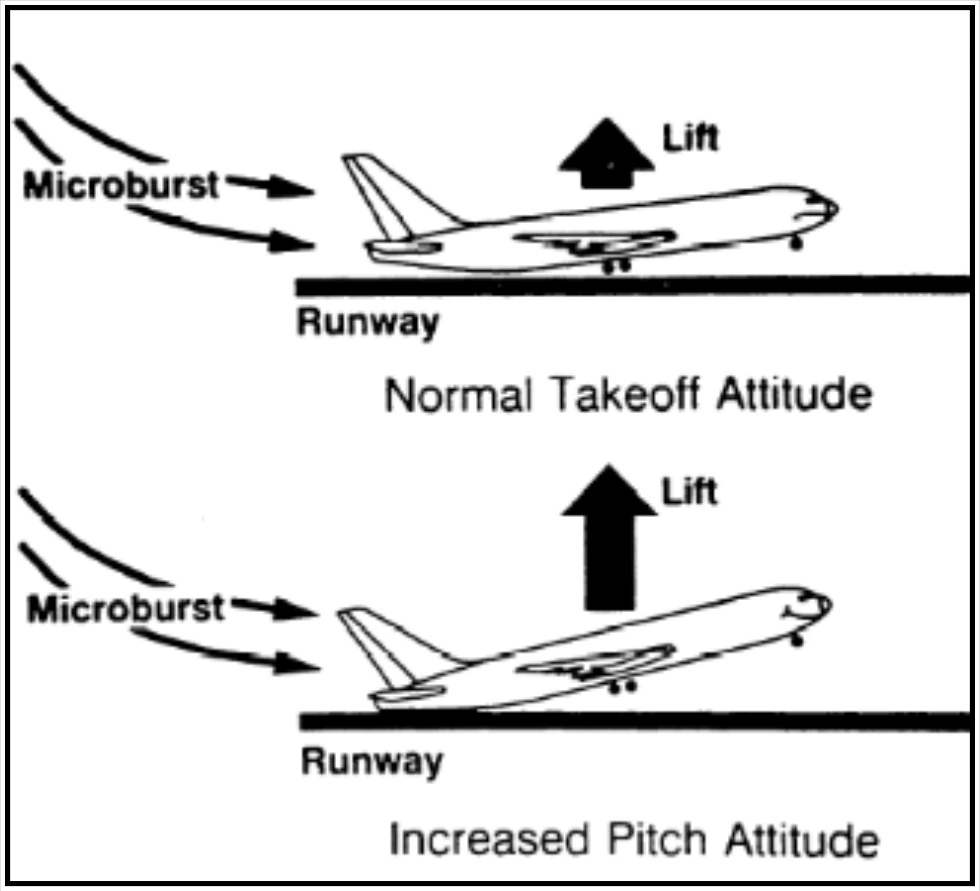
Increased pitch attitude generates lift needed for lift-off.
22.7.3.3 Encounter on Approach
Analysis of a typical wind shear encounter on approach provided evidence of an increasing downdraft and tailwind along the approach flightpath (see Figure 22-21). The airplane lost airspeed, dropped below the target glidepath, and contacted the ground short of the runway threshold.
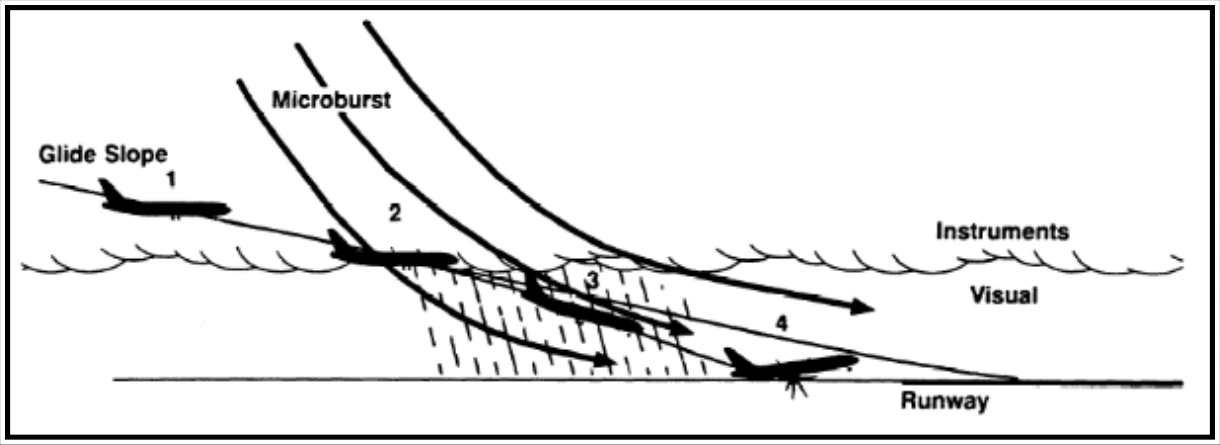
(1) Approach initially appears normal. (2) Airplane encounters increasing downdraft and tailwind at transition. (3) Airspeed decrease combined with reduced visual cues results in pitch attitude reduction. (4) Airplane crashes short of approach end of runway.
Reduced airspeed, as the airplane encountered the wind shear, resulted in decreased lift. This loss of lift increased the descent rate (see Figure 22-22). The natural nose-down pitch response of the airplane to low airspeed caused additional altitude loss. Pitch attitude increase and recovery initiation were not used soon enough to prevent ground contact.
Lack of timely and appropriate response—affected by weather conditions, inadequate crew coordination, and limited recognition time—was a significant factor in delaying recovery initiation. Gradual application of thrust during approach may have masked the initial decreasing airspeed trend. Poor weather conditions caused increased workload and complicated the approach. Transition from instruments to exterior visual references may have detracted from instrument scan. Inadequate crew coordination may have resulted in a failure to be aware of flightpath degradation. A stabilized approach with clearly defined callouts is essential to aid in the recognition of unacceptable flightpath trends and the need to initiate recovery.
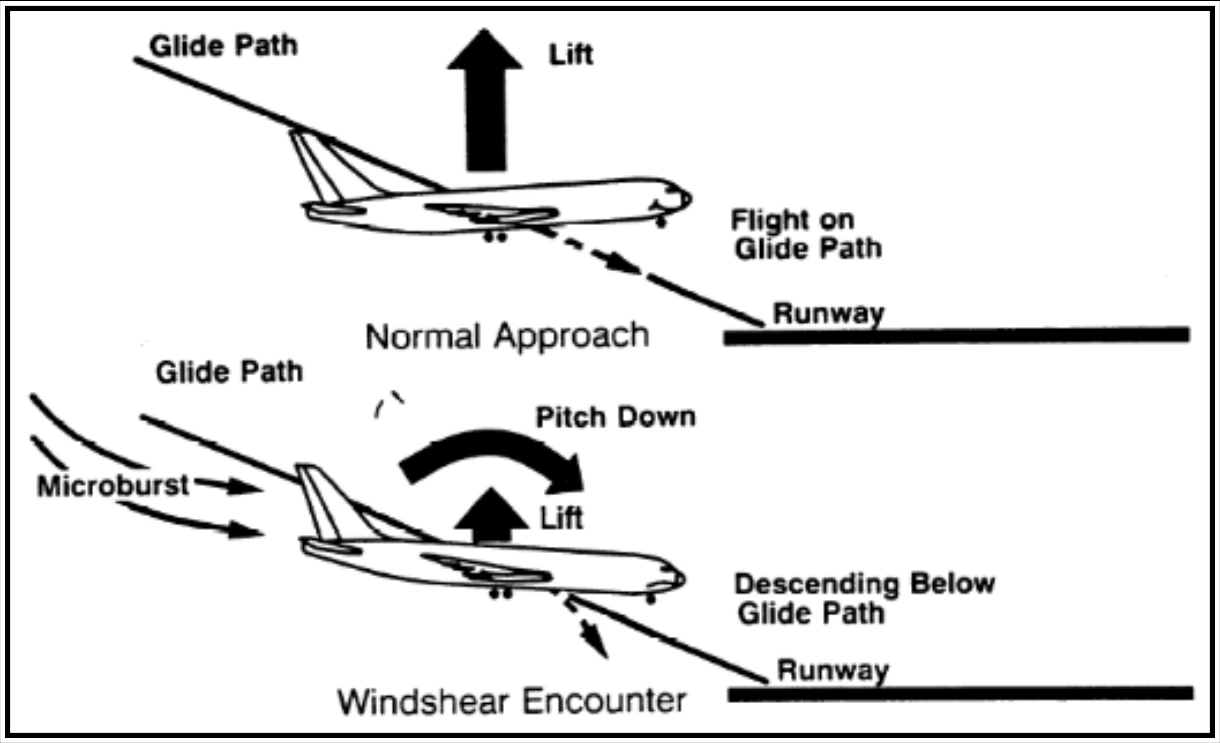
Microburst reduces airspeed and lift at normal attitude that results in pitch-down tendency to regain airspeed.
22.7.3.4 Wind Shear Effects on Airplanes and Systems
Several terms are used when discussing low-altitude wind variations with respect to aviation. These terms are defined as follows:
- Increasing Headwind Shear: Wind shear in which headwind increases, causing an airspeed increase.
- Decreasing Headwind Shear: Wind shear in which headwind decreases, causing an airspeed decrease.
- Decreasing Tailwind Shear: Wind shear in which tailwind decreases, causing an airspeed increase.
- Increasing Tailwind Shear: Wind shear in which tailwind increases, causing an airspeed decrease.
22.7.3.4.1 Headwind/Tailwind Shear Response
The various components of wind shear have unique effects on airplane performance. In addition, the magnitude of the shear depends on the flightpath through the microburst.
An increasing headwind (or decreasing tailwind) shear increases indicated airspeed and thus increases performance. The airplane will tend to pitch up to regain trim airspeed. An additional consideration is that this type of shear may reduce normal deceleration during flare, which could cause overrun.
Any rapid or large airspeed increase, particularly near convective weather conditions, should be viewed as a possible indication of a forthcoming airspeed decrease. Thus, a large airspeed increase may be reason for discontinuing the approach. However, since microbursts are often asymmetric and the headwind may not always be present, headwind shears are not to be relied upon to provide early indications of subsequent tailwind shears.