
Chapter 24
Observations
24.5.2.2.1 Routine AIREP Example
ARP XXX836 2443N 15516W 2229 F350 M43 315/128 TB LGT
ARP Routine report.
XXX836 Aircraft call sign.
2423N 15516W Location in latitude and longitude, 24° and 23 minutes north, 155° and 16 minutes west.
F350 Flight level or altitude, FL350.
M43 Temperature in Celsius, minus 43°C.
315/128 Wind direction (reference to true north) and speed, 315° and 128 kt.
TB LGT Light turbulence.
24.5.2.2.2 Special AIREP Example
ARS XXX836 2443N 15516W 2229 F350 M43 315/128 TB SEV
ARS Special AIREP.
Same as the routine example except:
TB SEV Severe turbulence.
24.5.3 Volcanic Activity Reports (VAR)
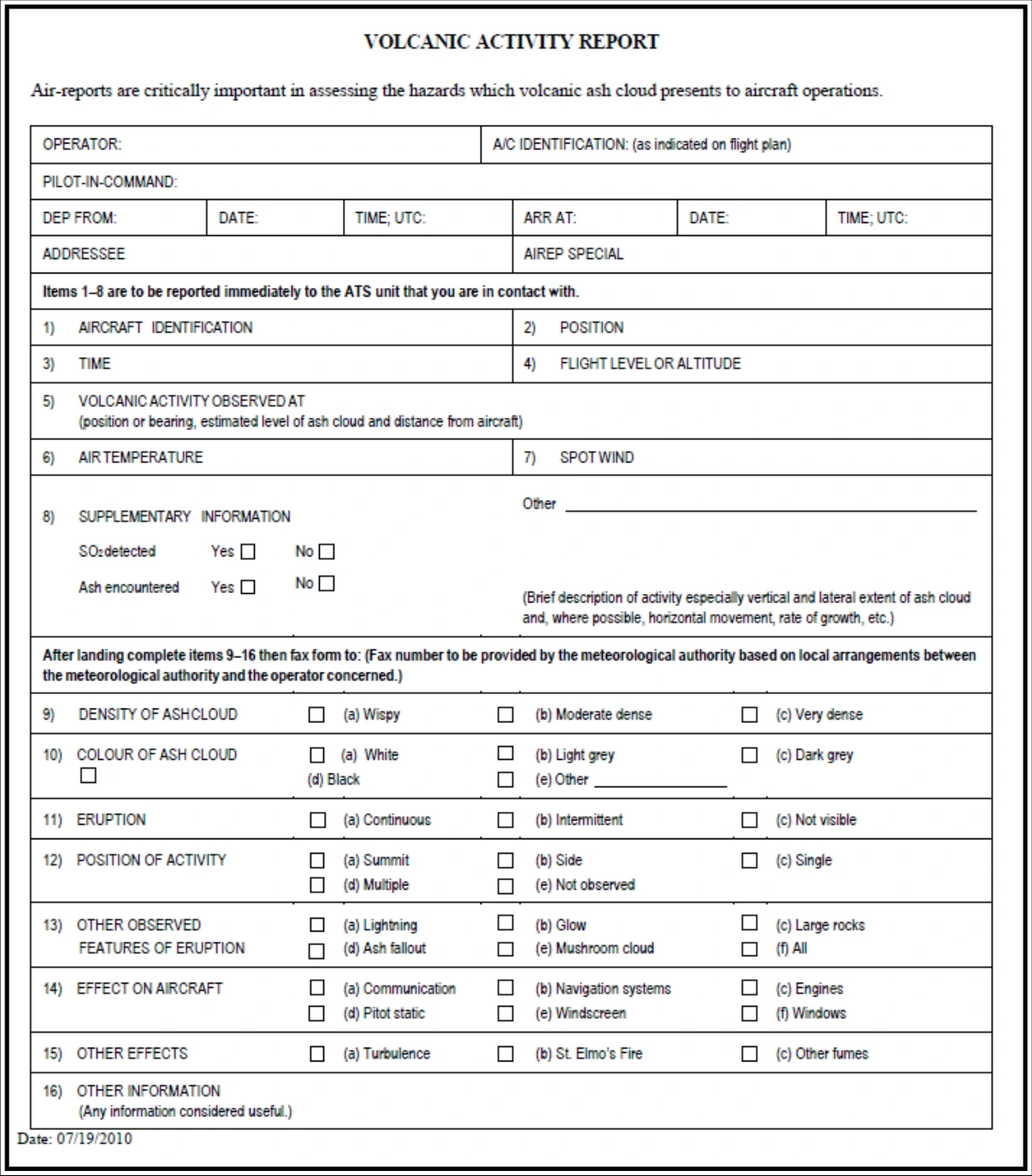
The VAR (see Figure 24-6) is a report for aircraft encounters with volcanic ash and/or SO clouds. The first part of the VAR is reported to ATC (as an Urgent PIREP or Special AIREP) as soon as practical. The second part of the VAR is submitted postflight. The VAR is used by volcano scientists and forecasters to better understand the characteristics of volcanic eruptions, including their volcanic ash and/or SO clouds.
Additional information can be found in FAA Order 8900.1, Volume 3, Chapter 26, Section 7, Safety Assurance System: Volcanic Ash Avoidance, Concepts, Policies, and Guidance.
24.5.4 Turbulence Observations
Since the 1990s, several innovations have improved the quality and availability of turbulence reports. Automated turbulence reporting systems are common on many commercial aircraft using the Aircraft Meteorological Data Relay (AMDAR) system.