Chapter 8
Atmospheric Pressure and Altimetry
8.1 Introduction
Atmospheric pressure is one of the most basic variables used to describe the state of the atmosphere and is commonly reported in weather observations. Unlike temperature and relative humidity, changes in atmospheric pressure are not as readily sensed by people. However, variations of pressure across the Earth are associated with pressure centers (either high-pressure centers or low-pressure centers) that cause the wind to blow and can bring important weather changes. Density, which is directly related to pressure, is a property of the atmosphere, which can be used by pilots to help determine how their aircraft will perform at various altitudes.
This chapter discusses atmospheric pressure, how it is measured, and how it varies across the Earth. This chapter also covers the altimeter, which is a pressure sensor used by pilots to determine altitude. Finally, density will be discussed, along with its relationship to density altitude.
8.2 Atmospheric Pressure
The atoms and molecules that make up the various layers in the atmosphere are always moving in random directions. Despite their tiny size, when they strike a surface, they exert pressure.
Each molecule is too small to feel and only exerts a tiny bit of pressure. However, when adding up all the pressures from the large number of molecules that strike a surface each moment, the total pressure is considerable. This is air pressure. As the density of the air increases, the number of strikes per unit of time and area also increases.
Since molecules move in all directions, they even exert air pressure upwards as they smash into objects from underneath. Air pressure is exerted in all directions.
Atmospheric pressure is the force per unit area exerted by the weight of the atmosphere. Since air is not solid, it cannot be weighed with conventional scales. Yet, three centuries ago, Evangelista Torricelli proved he could weigh the atmosphere by balancing it against a column of mercury. He actually measured pressure, converting it directly to weight.
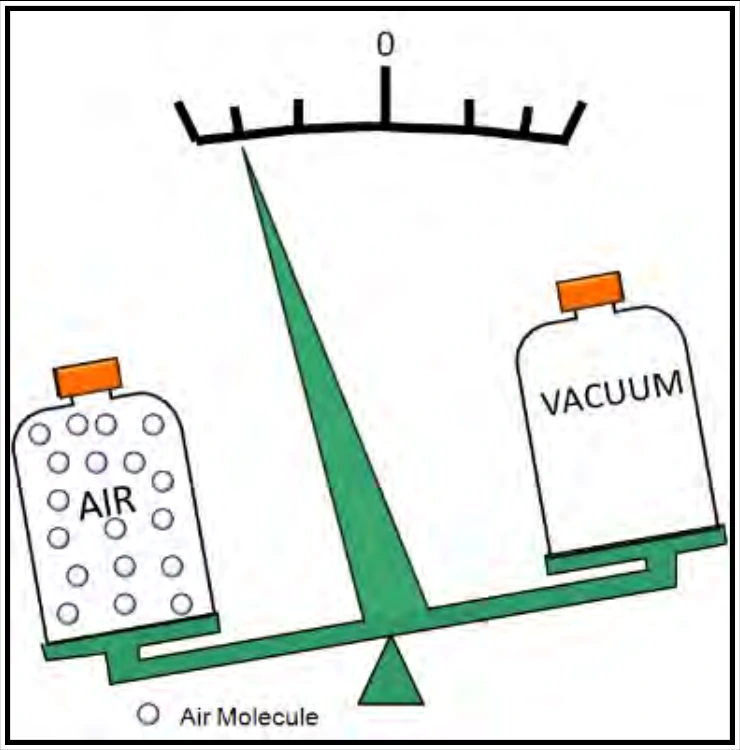
Air is composed of matter and thus, has weight due to the pull of Earth’s gravity.
8.2.1 Barometer
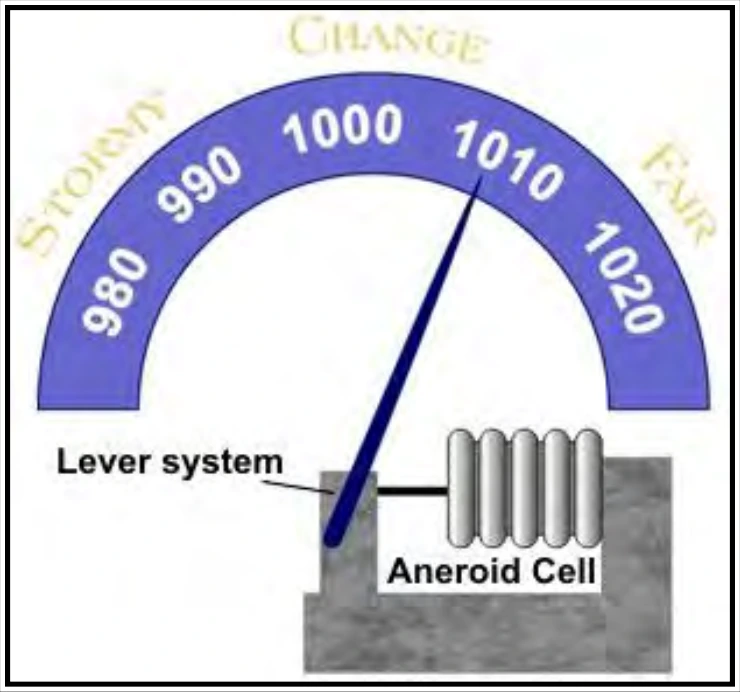
The instrument Torricelli designed to measure pressure was called a barometer. The aneroid barometer is the type most commonly used by meteorologists and the aviation community.
Essential features of an aneroid barometer (see Figure 8-2) are a flexible metal cell and the registering mechanism. Air is taken out of the cell to create a partial vacuum. The cell contracts or expands as pressure changes. One end of the cell is fixed, while the other end moves the registering mechanism. The coupling mechanism magnifies the movement of the cell driving an indicator hand along a scale graduated in pressure units.
8.2.2 Atmospheric Pressure Units
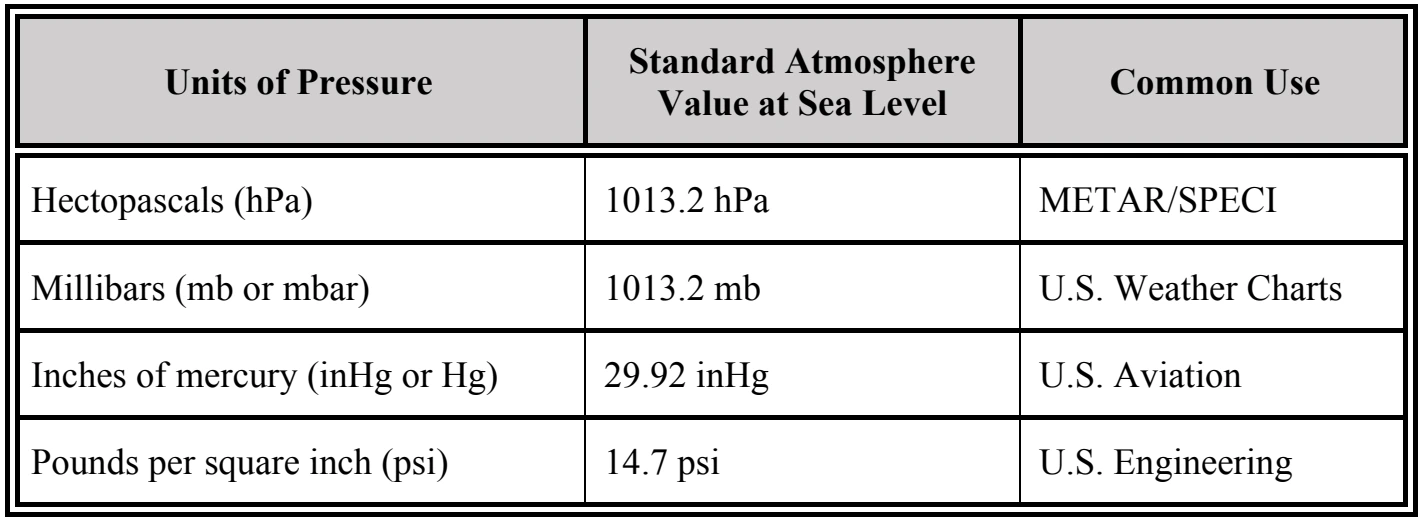
Atmospheric pressure is expressed in many ways throughout the world (see Table 8-1). Meteorologists worldwide have long measured atmospheric pressure in millibars (mb or mbar), which denote pressure as a force per square centimeter. However, after the introduction of the International System of Units (SI) in 1960, the hectopascal (hPa) was adopted by most countries and is used in the METAR/SPECI code first developed in 1968. Many meteorologists prefer to use the term they learned during their education and work experience. Therefore, some continue to use the term “millibars,” while others use “hectopascal” (which are equivalent). The unit inch of mercury (inHg or Hg) is still used in the United States for altimetry.
8.2.3 Station Pressure
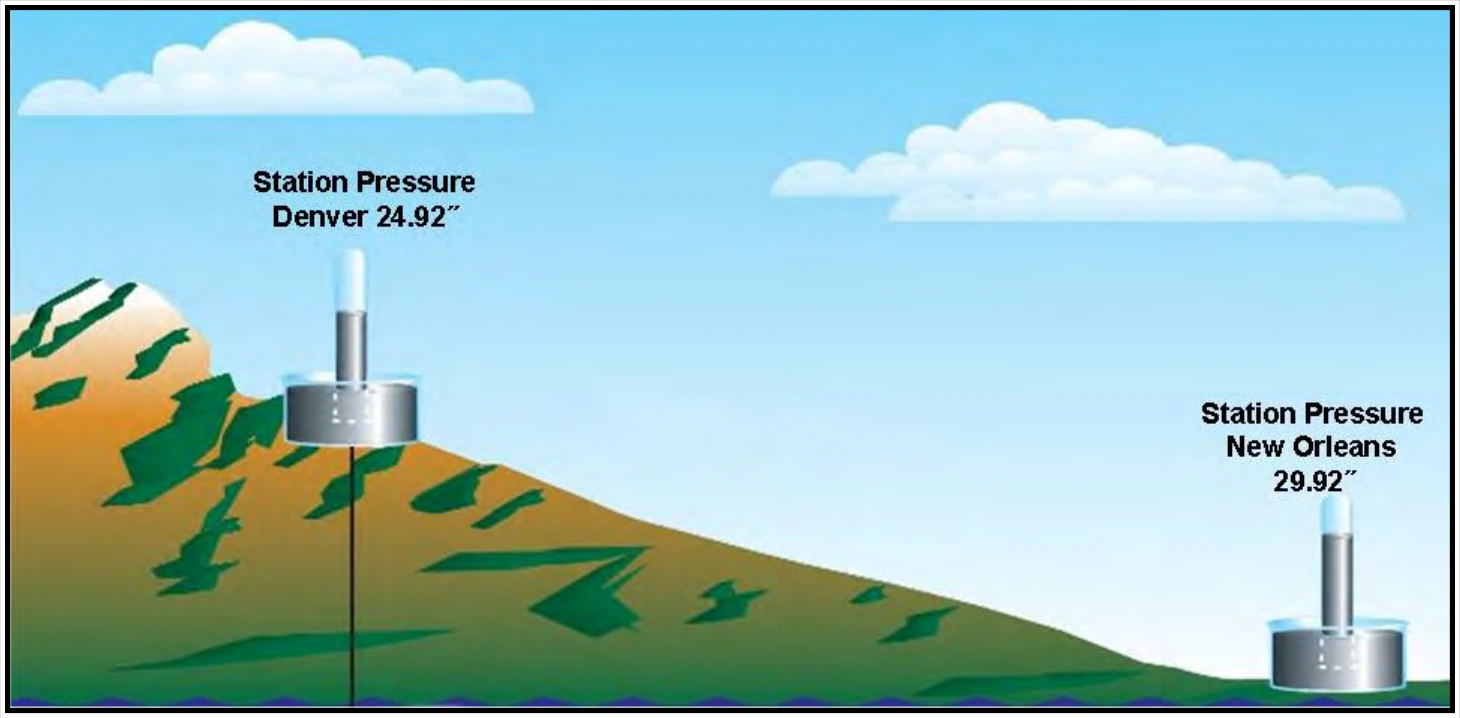
The pressure measured at an airport is called station pressure, or the actual pressure at field elevation. Pressure is lower at higher altitudes. Therefore, airports with higher field elevations usually have lower pressure than airports with lower field elevations. For instance, station pressure at Denver is less than at New Orleans (see Figure 8-3).