Chapter 2
Aerodynamics of Flight
Translational Lift
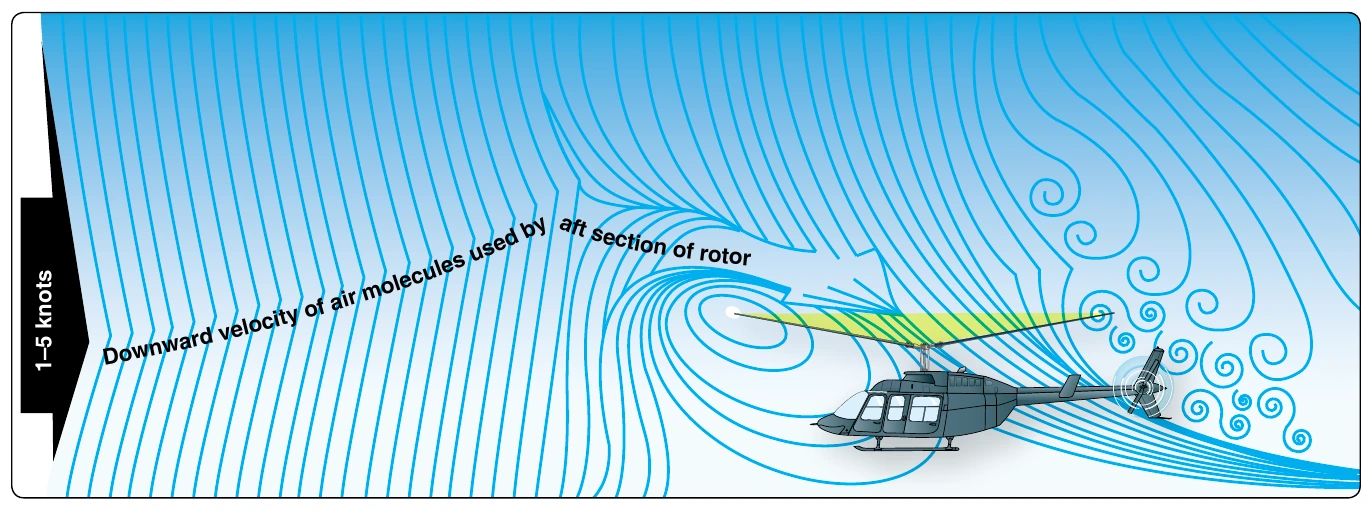
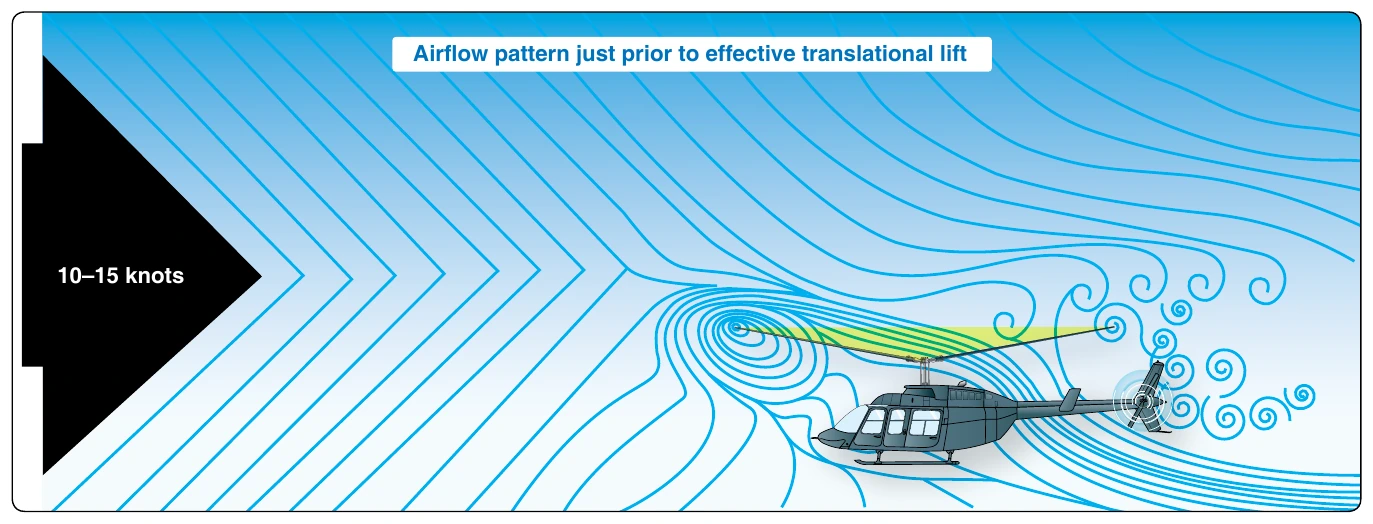
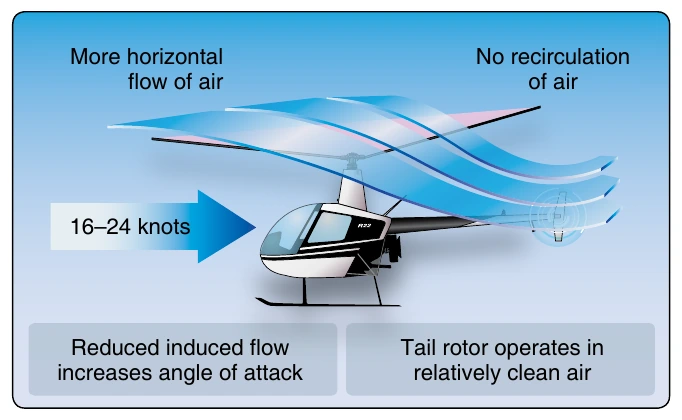
Improved rotor efficiency resulting from directional flight is called translational lift. The efficiency of the hovering rotor disk is greatly improved with each knot of incoming wind gained by horizontal movement of the aircraft or surface wind. As the incoming wind produced by aircraft movement or surface wind enters the rotor disk, turbulence and vortices are left behind and the flow of air becomes more horizontal. In addition, the tail rotor becomes more aerodynamically efficient during the transition from hover to forward flight. Figures 2-39 and 2-40 show the different airflow patterns at different speeds and how airflow affects the efficiency of the tail rotor.
Effective Translational Lift (ETL)
While transitioning to forward flight at about 16 to 24 knots, the helicopter goes through effective translational lift (ETL). As mentioned earlier in the discussion on translational lift, the rotor blades become more efficient as forward airspeed increases. Between 16 and 24 knots, the rotor disk completely outruns the recirculation of old vortices and begins to work in relatively undisturbed air. The flow of air through the rotor disk is more horizontal, which reduces induced flow and drag with a corresponding increase in angle of attach and lift. The additional lift available at this speed is referred to as the ETL, which makes the rotor disk operate more efficiently. This increased efficiency continues with increased airspeed until the best climb airspeed is reached, and total drag is at its lowest point.
As speed increases, translational lift becomes more effective, nose rises or pitches up, and aircraft rolls to the right. The combined effects of dissymmetry of lift, gyroscopic precession, and transverse flow effect cause this tendency. It is important to understand these effects and anticipate correcting for them. Once the helicopter is transitioning through ETL, the pilot needs to apply forward and left lateral cyclic input to maintain a constant rotor-disk attitude. [Figure 2-41]
Translational Thrust
Translational thrust occurs when the tail rotor becomes more aerodynamically efficient during the transition from hover to forward flight. As the tail rotor works in progressively less turbulent air, this improved efficiency produces more antitorque thrust, causing the nose of the aircraft to yaw left (with a main rotor turning counterclockwise) and forces the pilot to apply right pedal (decreasing the AOA in the tail rotor blades) in response. In addition, during this period, the airflow affects the horizontal components of the stabilizer found on most helicopters which tends to bring the nose of the helicopter to a more level attitude.
Induced Flow
As the rotor blades rotate, they generate what is called rotational relative wind. This airflow is characterized as flowing parallel and opposite the rotor’s plane of rotation and striking perpendicular to the rotor blade’s leading edge. This rotational relative wind is used to generate lift. As rotor blades produce lift, air is accelerated over the foil and projected downward. Anytime a helicopter is producing lift, it moves large masses of air vertically and down through the rotor disk. This downwash or induced flow can significantly change the efficiency of the rotor disk. Rotational relative wind combines with induced flow to form the resultant relative wind. As induced flow increases, resultant relative wind becomes less horizontal. Since AOA is determined by measuring the difference between the chord line and the resultant relative wind, as the resultant relative wind becomes less horizontal, AOA decreases. [See Figure 2-21]
Transverse Flow Effect
As the helicopter accelerates in forward flight, induced flow drops to near zero at the forward disk area and increases at the aft disk area. These differences in lift between the fore and aft portions of the rotor disk are called transverse flow effect. [Figure 2-41] This increases the AOA at the front disk area causing the rotor blade to flap up and reduces AOA at the aft disk area causing the rotor blade to flap down. Because the rotor acts like a gyro, maximum displacement occurs 90° in the direction of rotation. The result is a tendency for the helicopter to roll slightly to the right as it accelerates through approximately 20 knots or if the headwind is approximately 20 knots.
Transverse flow effect is recognized by increased vibrations of the helicopter at airspeeds around 12 to 15 knots and can be produced by forward flight or from the wind while in a hover. This vibration happens at an airspeed just below ETL on takeoff and after passing through ETL during landing. The vibration happens close to the same airspeed as ETL because that is when the greatest lift differential exists between the front and rear portions of the rotor system. As such, some pilots confuse the vibration felt by transverse flow effect with passing through ETL. To counteract transverse flow effect, a cyclic input to the left may be needed.
Sideward Flight
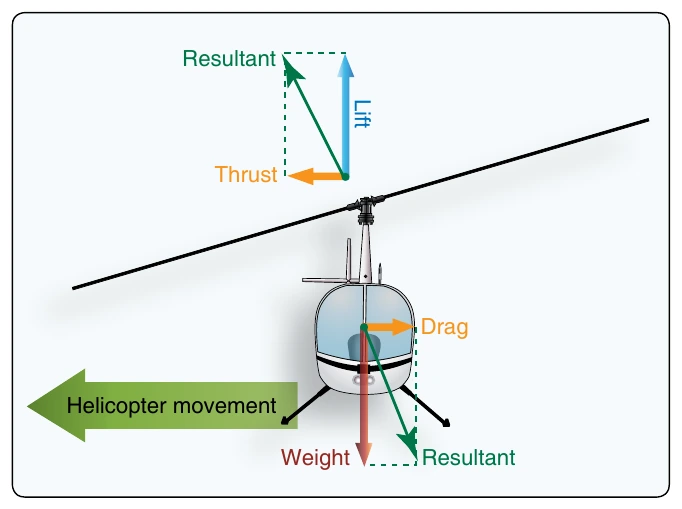
In sideward flight, the tip-path plane is tilted in the direction that flight is desired. This tilts the total lift-thrust vector sideward. In this case, the vertical or lift component is still straight up and weight straight down, but the horizontal or thrust component now acts sideward with drag acting to the opposite side. [Figure 2-42]
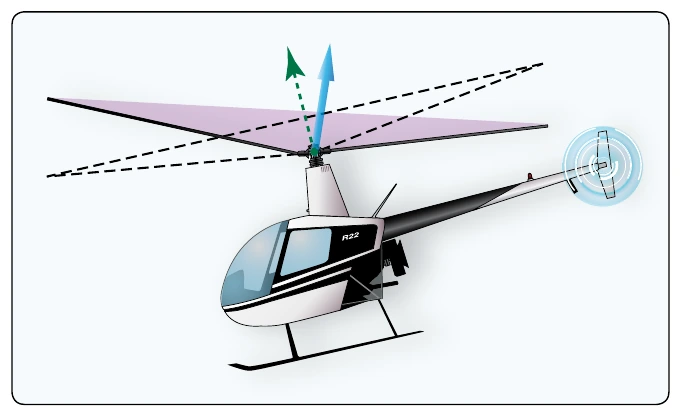
Sideward flight can be a very unstable condition due to the parasitic drag of the fuselage combined with the lack of horizontal stabilizer for that direction of flight. Increased altitudes help with control and the pilot must always scan in the direction of flight. Movement of the cyclic in the intended direction of flight causes the helicopter to move, controls the rate of speed, and ground track, but the collective and pedals are key to successful sideward flight. Just as in forward flight, the collective keeps the helicopter from contacting the ground and the pedals help maintain the correct heading; even in sideward flight, the tail of the helicopter should remain behind you. Inputs to the cyclic should be smooth and controlled, and the pilot should always be aware of the tip-path plane in relation to the ground. [Figure 2-43] Contacting the ground with the skids during sideward flight will most likely result in a dynamic rollover event before the pilot has a chance to react. Extreme caution should be used when maneuvering the helicopter sideways to avoid such hazards from happening. Refer to Chapter 11, Helicopter Hazards and Emergencies.