
Chapter 2
Aerodynamics of Flight
Coriolis Effect (Law of Conservation of Angular Momentum)
The Coriolis Effect is also referred to as the law of conservation of angular momentum. It states that the value of angular momentum of a rotating body does not change unless an external force is applied. In other words, a rotating body continues to rotate with the same rotational velocity until some external force is applied to change the speed of rotation. Angular momentum is the moment of inertia (mass times distance from the center of rotation squared) multiplied by the speed of rotation.
Changes in angular velocity, known as angular acceleration and deceleration, take place as the mass of a rotating body is moved closer to or farther away from the axis of rotation. The speed of the rotating mass varies proportionately with the square of the radius.
An excellent example of this principle in action is a figure skater performing a spin on ice skates. The skater begins rotation on one foot, with the other leg and both arms extended. The rotation of the skater’s body is relatively slow. When a skater draws both arms and one leg inward, the moment of inertia (mass times radius squared) becomes much smaller and the body is rotating almost faster than the eye can follow. Because the angular momentum must, by law of nature, remain the same (no external force applied), the angular velocity must increase.
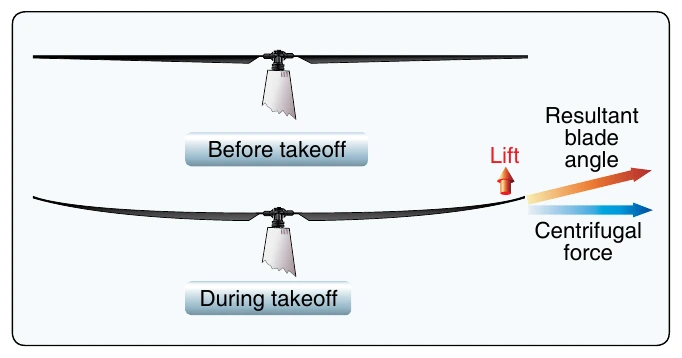
The rotor blade rotating about the rotor hub possesses angular momentum. As the rotor begins to cone due to G-loading maneuvers, the diameter of the rotor disk shrinks. Due to conservation of angular momentum, the blades increase speed even though the blade tips have a shorter distance to travel due to reduced disk diameter. The action results in an increase in rotor rpm which causes a slight increase in lift. Most pilots arrest this increase of rpm with an increase in collective pitch. This increase in blade rpm lift is somewhat negated by the slightly smaller disk area as the blades cone upward.
Gyroscopic Precession
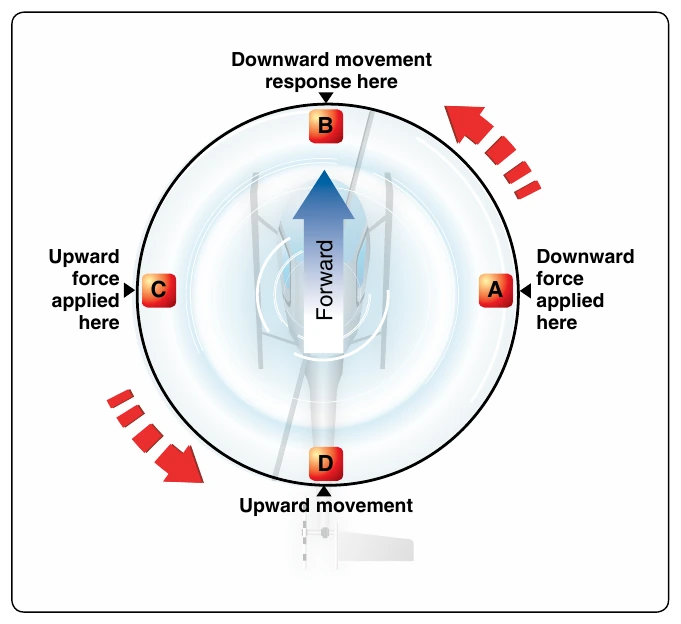
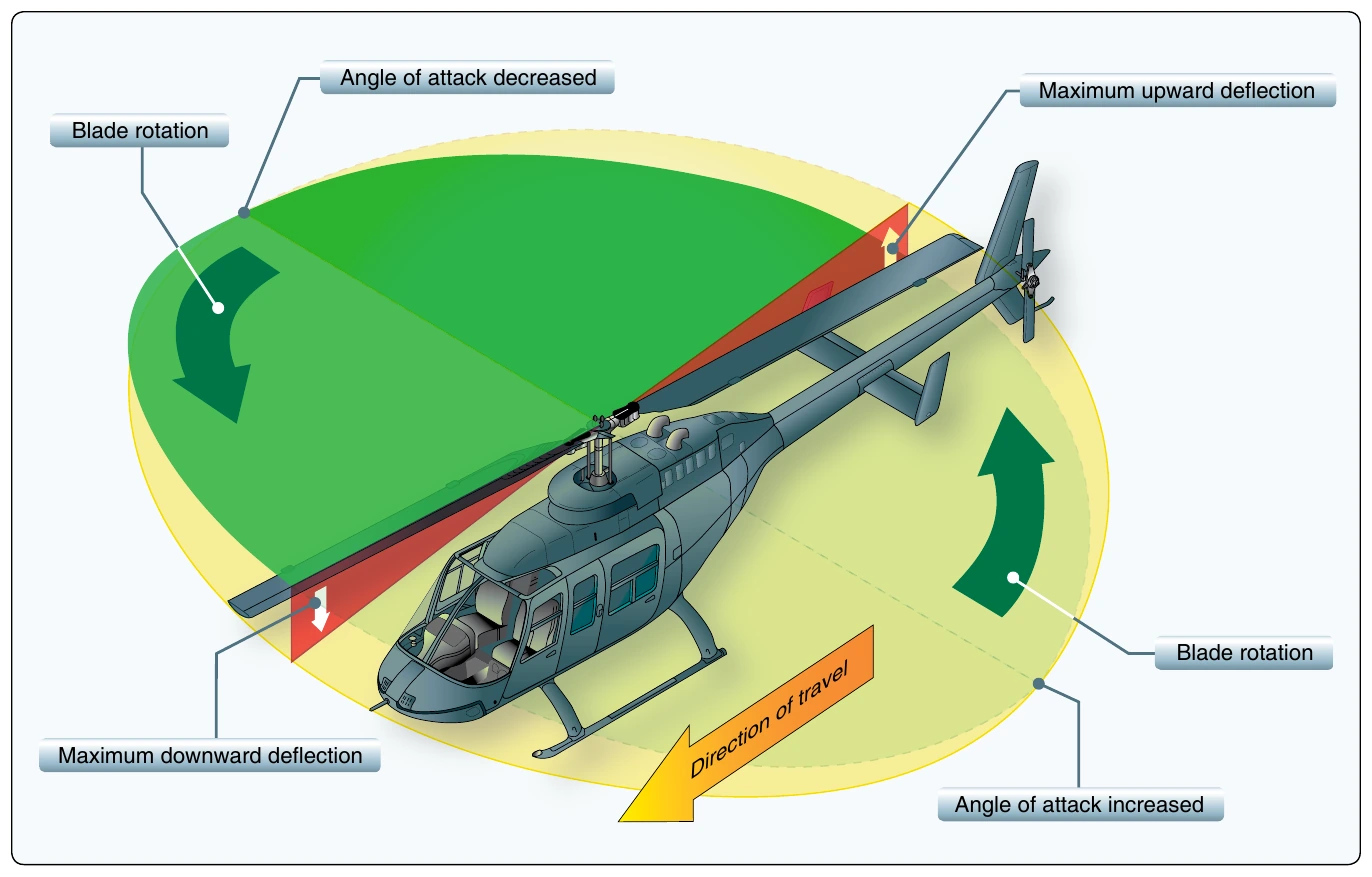
The spinning main rotor of a helicopter acts like a gyroscope. As such, it has the properties of gyroscopic action, one of which is precession. Gyroscopic precession is the resultant action or deflection of a spinning object when a force is applied to this object. This action occurs approximately 90° in the direction of rotation from the point where the force is applied (or 90° later in the rotation cycle). [Figure 2-30]
Examine a two-bladed rotor disk to see how gyroscopic precession affects the movement of the tip-path plane. Moving the cyclic pitch control increases the angle of incidence of one rotor blade with the result of a greater lifting force being applied at that point in the plane of rotation. This same control movement simultaneously decreases the angle of incidence of the other blade the same amount, thus decreasing the lifting force applied at that point in the plane of rotation. The blade with the increased angle of incidence tends to flap up; the blade with the decreased angle of incidence tends to flap down. Because the rotor disk acts like a gyro, the blades reach maximum deflection at a point approximately 90° later in the plane of rotation. Figure 2-31 illustrates the result of a forward cyclic input. The retreating blade angle of incidence is increased, and the advancing blade angle of incidence is decreased resulting in a tipping forward of the tip-path plane, since maximum deflection takes place 90° later when the blades are at the rear and front, respectively. In a rotor disk using three or more blades, the movement of the cyclic pitch control changes the angle of incidence of each blade an appropriate amount so that the end result is the same.
Vertical Flight
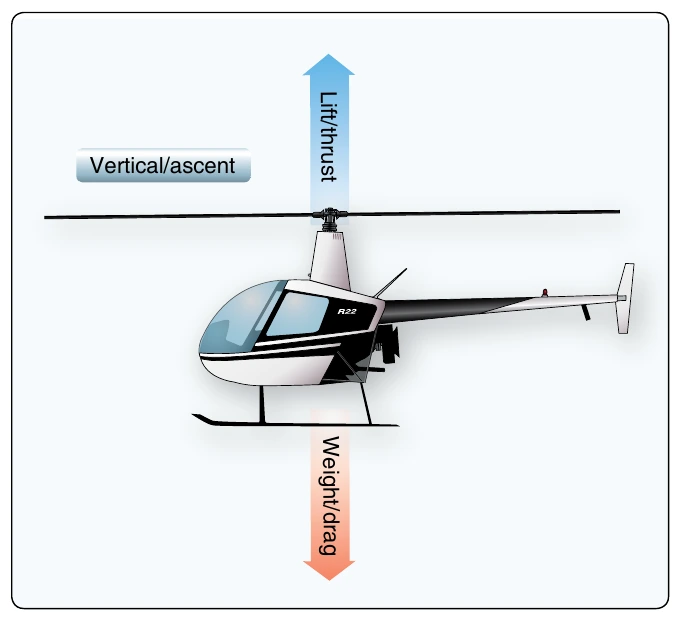
Hovering is actually an element of vertical flight. Increasing the angle of incidence of the rotor blades (pitch) while keeping their rotation speed constant generates additional lift and the helicopter ascends. Decreasing the pitch causes the helicopter to descend. In a no-wind condition in which lift and thrust are less than weight and drag, the helicopter descends vertically. If lift and thrust are greater than weight and drag, the helicopter ascends vertically. [Figure 2-32]
Forward Flight
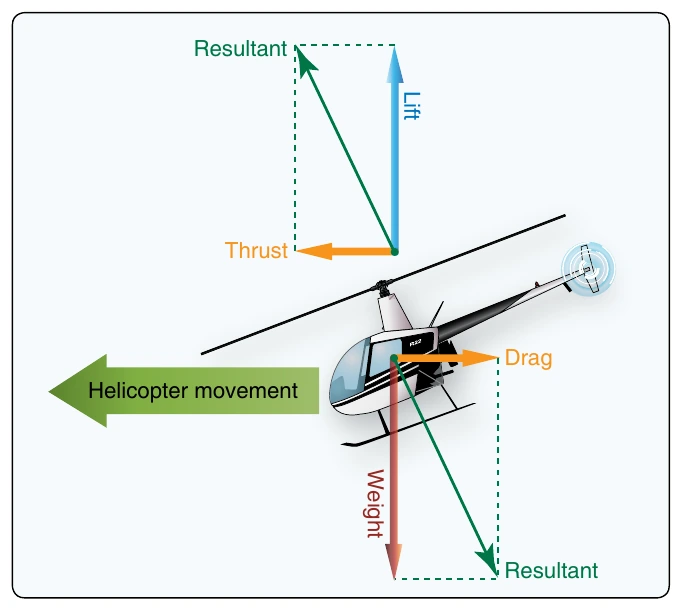
In steady forward flight, with no change in airspeed or vertical speed, the four forces of lift, thrust, drag, and weight must be in balance. Once the tip-path plane is tilted forward, the total lift-thrust force is also tilted forward. This resultant lift-thrust force can be resolved into two components—lift acting vertically upward and thrust acting horizontally in the direction of flight. In addition to lift and thrust, there is weight (the downward acting force) and drag (the force opposing the motion of an airfoil through the air). [Figure 2-33]
In straight-and-level, unaccelerated forward flight (straight-and-level flight is flight with a constant heading and at a constant altitude), lift equals weight and thrust equals drag. If lift exceeds weight, the helicopter accelerates vertically until the forces are in balance; if thrust is less than drag, the helicopter slows down until the forces are in balance. As a helicopter initiates a move forward, it begins to lose altitude because lift is lost as thrust is diverted forward. However, as the helicopter begins to accelerate from a hover, the rotor disk becomes more efficient due to translational lift (see translational lift on page 2-19). The result is excess power over that which is required to hover. Continued acceleration causes an even larger increase in airflow through the rotor disk (up to a maximum determined by drag and the engine’s limit of power), and more efficient flight. In order to maintain unaccelerated flight, the pilot must understand that with any changes in power or in cyclic movement, the helicopter begins either to climb or to descend. Once straight-and-level flight is obtained, the pilot should make note of the power (torque setting) required and not make major adjustments to the flight controls. [Figure 2-34]
Airflow in Forward Flight
Airflow across the rotor disk in forward flight varies from airflow at a hover. In forward flight, air flows opposite the aircraft’s flightpath. The velocity of this air flow equals the helicopter’s forward speed. Because the rotor blades turn in a circular pattern, the velocity of airflow across a blade depends on the position of the blade in the plane of rotation at a given instant, its rotational velocity, and airspeed of the helicopter. Therefore, the airflow meeting each blade varies continuously as the blade rotates. The highest velocity of airflow occurs over the right side (3 o’clock position) of the helicopter (advancing blade in a rotor disk that turns counterclockwise) and decreases to rotational velocity over the nose. It continues to decrease until the lowest velocity of airflow occurs over the left side (9 o’clock position) of the helicopter (retreating blade). As the blade continues to rotate, velocity of the airflow then increases to rotational velocity over the tail. It continues to increase until the blade is back at the 3 o’clock position.