
Chapter 2
Aerodynamics of Flight
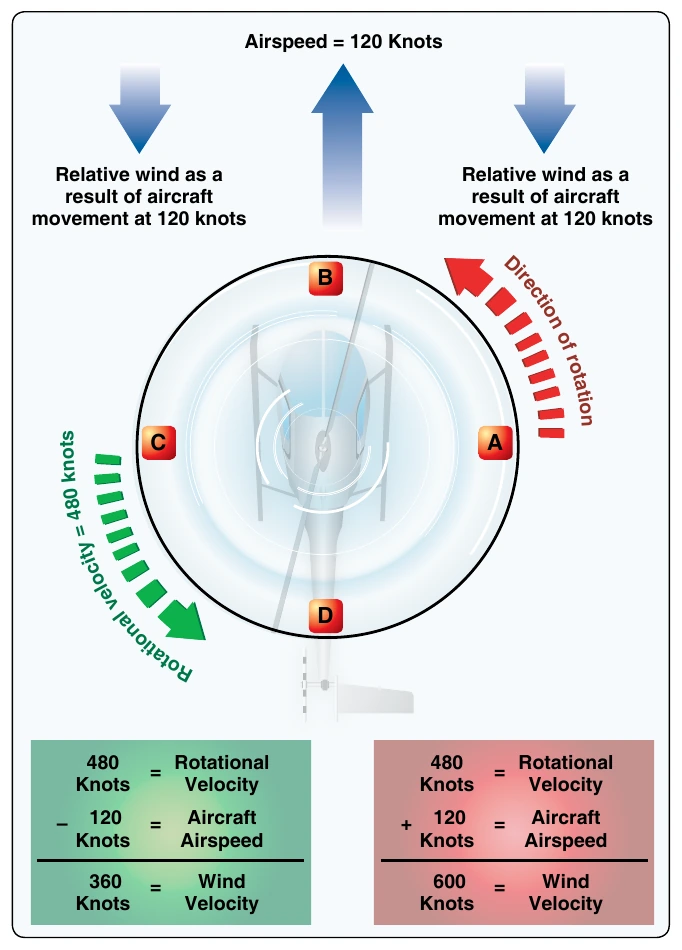
The advancing blade in Figure 2-35, position A, moves in the same direction as the helicopter. The velocity of the air meeting this blade equals rotational velocity of the blade plus wind velocity resulting from forward airspeed. The retreating blade (position C) moves in a flow of air moving in the opposite direction of the helicopter. The velocity of airflow meeting this blade equals rotational velocity of the blade minus wind velocity resulting from forward airspeed. The blades (positions B and D) over the nose and tail move essentially at right angles to the airflow created by forward airspeed; the velocity of airflow meeting these blades equals the rotational velocity. This results in a change to velocity of airflow all across the rotor disk and a change to the lift pattern of the rotor disk.
Advancing Blade
As the relative wind speed of the advancing blade increases, the blade gains lift and begins to flap up. It reaches its maximum upflap velocity at the 3 o’clock position, where the wind velocity is the greatest. This upflap creates a downward flow of air and has the same effect as increasing the induced flow velocity by imposing a downward vertical velocity vector to the relative wind which decreases the AOA.
Retreating Blade
As relative wind speed of the retreating blade decreases, the blade loses lift and begins to flap down. It reaches its maximum downflap velocity at the 9 o’clock position, where wind velocity is the least. This downflap creates an upward flow of air and has the same effect as decreasing the induced flow velocity by imposing an upward velocity vertical vector to the relative wind which increases the AOA.
Dissymmetry of Lift
Dissymmetry of lift is the differential (unequal) lift between advancing and retreating halves of the rotor disk caused by the different wind flow velocity across each half. This difference in lift would cause the helicopter to be uncontrollable in any situation other than hovering in a calm wind. There must be a means of compensating, correcting, or eliminating this unequal lift to attain symmetry of lift.
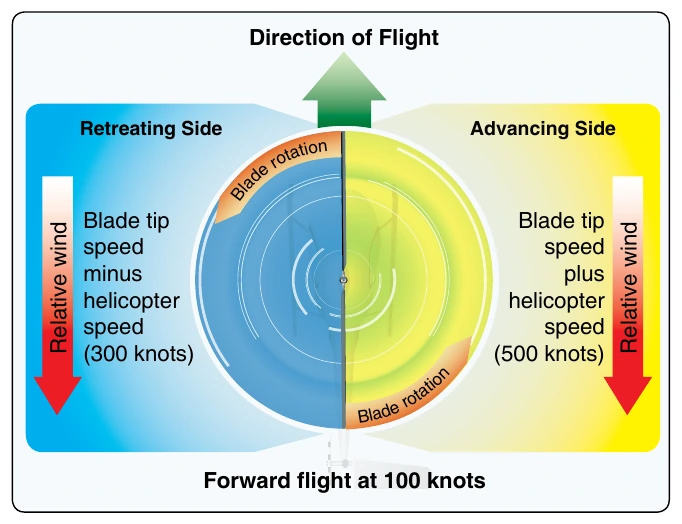
When the helicopter moves through the air, the relative airflow through the main rotor disk is different on the advancing side from the retreating side. The relative wind encountered by the advancing blade is increased by the forward speed of the helicopter, while the relative wind speed acting on the retreating blade is reduced by the helicopter’s forward airspeed. Therefore, as a result of the relative wind speed, the advancing blade side of the rotor disk can produce more lift than the retreating blade side. [Figure 2-36]
If this condition were allowed to exist, a helicopter with a counterclockwise main rotor blade rotation would roll to the left because of the difference in lift. In reality, the main rotor blades flap and feather automatically to equalize lift across the rotor disk. Articulated rotor disks, usually with three or more blades, incorporate a horizontal hinge (flapping hinge) to allow the individual rotor blades to move, or flap up and down as they rotate. A semi-rigid rotor disk (two blades) utilizes a teetering hinge, which allows the blades to flap as a unit. When one blade flaps up, the other blade flaps down.
As shown in Figure 2-37, as the rotor blade reaches the advancing side of the rotor disk (A), it reaches its maximum up flap velocity. When the blade flaps upward, the angle between the chord line and the resultant relative wind decreases. This decreases the AOA, which reduces the amount of lift produced by the blade. At position (C), the rotor blade is now at its maximum down flapping velocity. Due to down flapping, the angle between the chord line and the resultant relative wind increases. This increases the AOA and thus the amount of lift produced by the blade.
The combination of blade flapping and slow relative wind acting on the retreating blade normally limits the maximum forward speed of a helicopter. At a high forward speed, the retreating blade stalls because of a high AOA and slow relative wind speed. This situation is called retreating blade stall and is evidenced by a nose pitch up, vibration, and a rolling tendency—usually to the left in helicopters with counterclockwise blade rotation.
Pilots can avoid retreating blade stall by not exceeding the never-exceed speed. This speed is designated VNE and is indicated on a placard and marked on the airspeed indicator by a red line.
Blade flapping compensates for dissymmetry of lift in the following way. At a hover, equal lift is produced around the rotor disk with equal pitch (AOI) on all the blades and at all points in the rotor disk (disregarding compensation for translating tendency). The rotor disk is parallel to the horizon. To develop a thrust force, the rotor disk must be tilted in the desired direction of movement. Cyclic feathering changes the angle of incidence differentially around the rotor disk. For a counterclockwise rotation, forward cyclic movement decreases the angle of incidence on the right of the rotor disk and increases it on the left.
When transitioning to forward flight either from a hover or taking off from the ground, pilots must be aware that as the helicopter speed increases, translational lift becomes more effective and causes the nose to rise or pitch up (sometimes referred to as blowback). This tendency is caused by the combined effects of dissymmetry of lift and transverse flow. Pilots must correct for this tendency by maintaining a constant rotor disk attitude that will move the helicopter through the speed range in which blowback occurs. If the nose is permitted to pitch up while passing through this speed range, the aircraft may also tend to roll to the right. To correct for this tendency, the pilot must continuously move the cyclic forward as velocity of the helicopter increases until the takeoff is complete, and the helicopter has transitioned into forward flight.
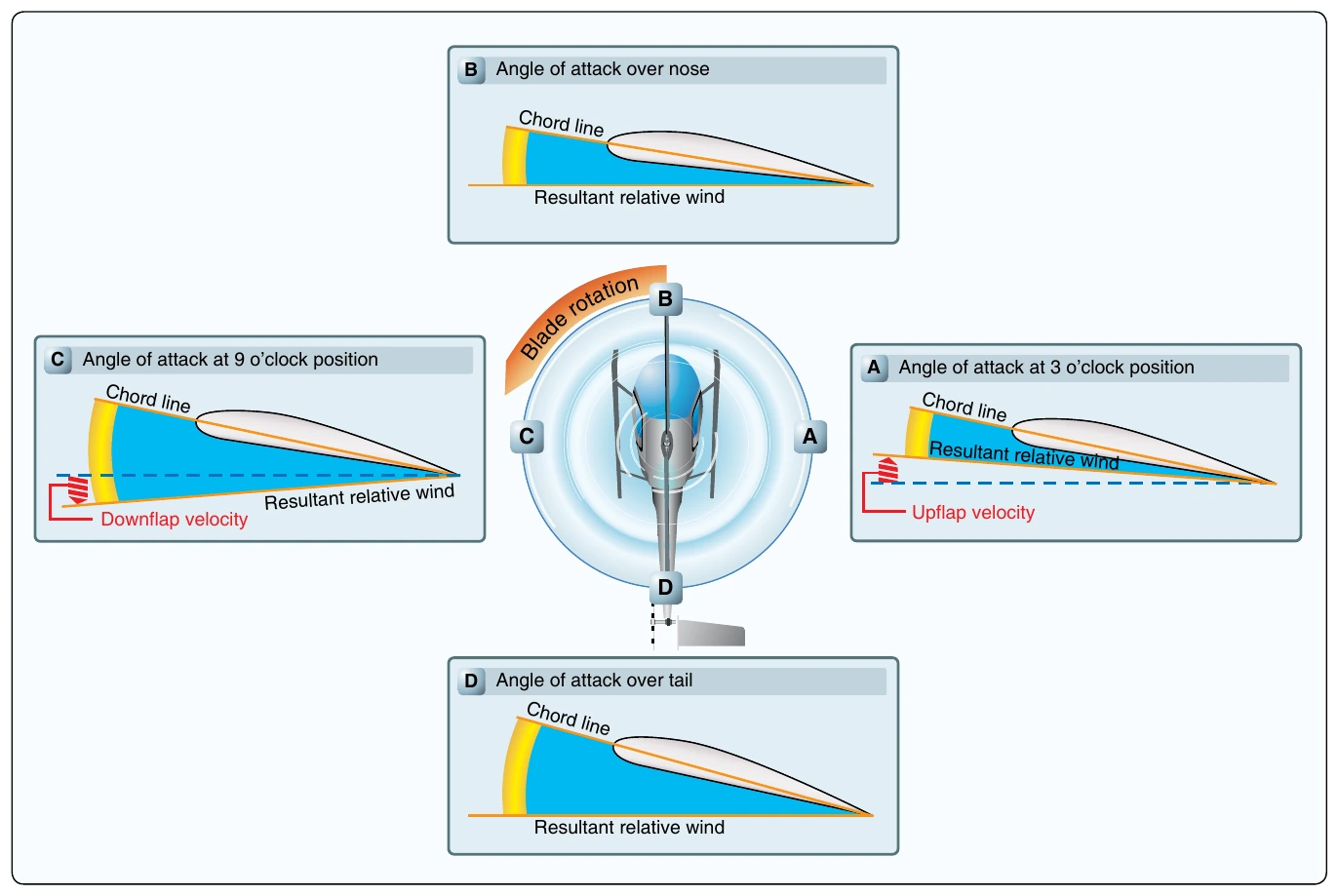
Figure 2-38 illustrates the tilting forward of the rotor disk, which is the result of a change in pitch angle with forward cyclic. At a hover, the cyclic is centered and the pitch angle on the advancing and retreating blades is the same. At low forward speeds, moving the cyclic forward reduces pitch angle on the advancing blade and increases pitch angle on the retreating blade. This causes a slight rotor disk tilt. At higher forward speeds, the pilot must continue to move the cyclic forward. This further reduces pitch angle on the advancing blade and further increases pitch angle on the retreating blade. As a result, there is even more tilt to the rotor disk than at lower speeds.
A horizontal lift component (thrust) generates higher helicopter airspeed. The higher airspeed induces blade flapping to maintain symmetry of lift. The combination of flapping and cyclic feathering maintains symmetry of lift and desired attitude on the rotor disk and helicopter.