
Chapter 5
Flight Instruments
Step 1: Determine the Magnetic Course True Course (180°) ± Variation (+10°) = Magnetic Course (190°)
The Magnetic Course (190°) is steered if there is no deviation error to be applied. The compass card must now be considered for the compass course of 190°.
Step 2: Determine the Compass Course Magnetic Course (190°, from step 1) ± Deviation (–2°, from correction card) = Compass Course (188°)
To find true course when the compass course is known, remove the variation and deviation corrections previously applied:
Compass Course ± Deviation = Magnetic Course ± Variation = True Course
Northerly Turning Errors
The center of gravity of the float assembly is located lower than the pivotal point. As the airplane turns, the force that results from the magnetic dip causes the float assembly to swing in the same direction that the float turns. The result is a false northerly turn indication. Because of this lead of the compass card, or float assembly, a northerly turn should be stopped prior to arrival at the desired heading. This compass error is amplified with the proximity to either pole. One rule of thumb to correct for this leading error is to stop the turn 15° plus half of the latitude (i.e., if the airplane is being operated in a position around the 40° of latitude, the turn should be stopped 15° + 20° = 35° prior to the desired heading).
Southerly Turning Errors
When turning in a southerly direction, the forces are such that the compass float assembly lags rather than leads. The result is a false southerly turn indication. The compass card, or float assembly, should be allowed to pass the desired heading prior to stopping the turn. As with the northerly error, this error is amplified with the proximity to either pole. To correct this lagging error, the aircraft should be allowed to pass the desired heading prior to stopping the turn. The same rule of 15° plus half of the latitude applies here (i.e., if the airplane is being operated in a position around the 30° of latitude, the turn should be stopped 15° + 15° + 30° after passing the desired heading).
Acceleration Error
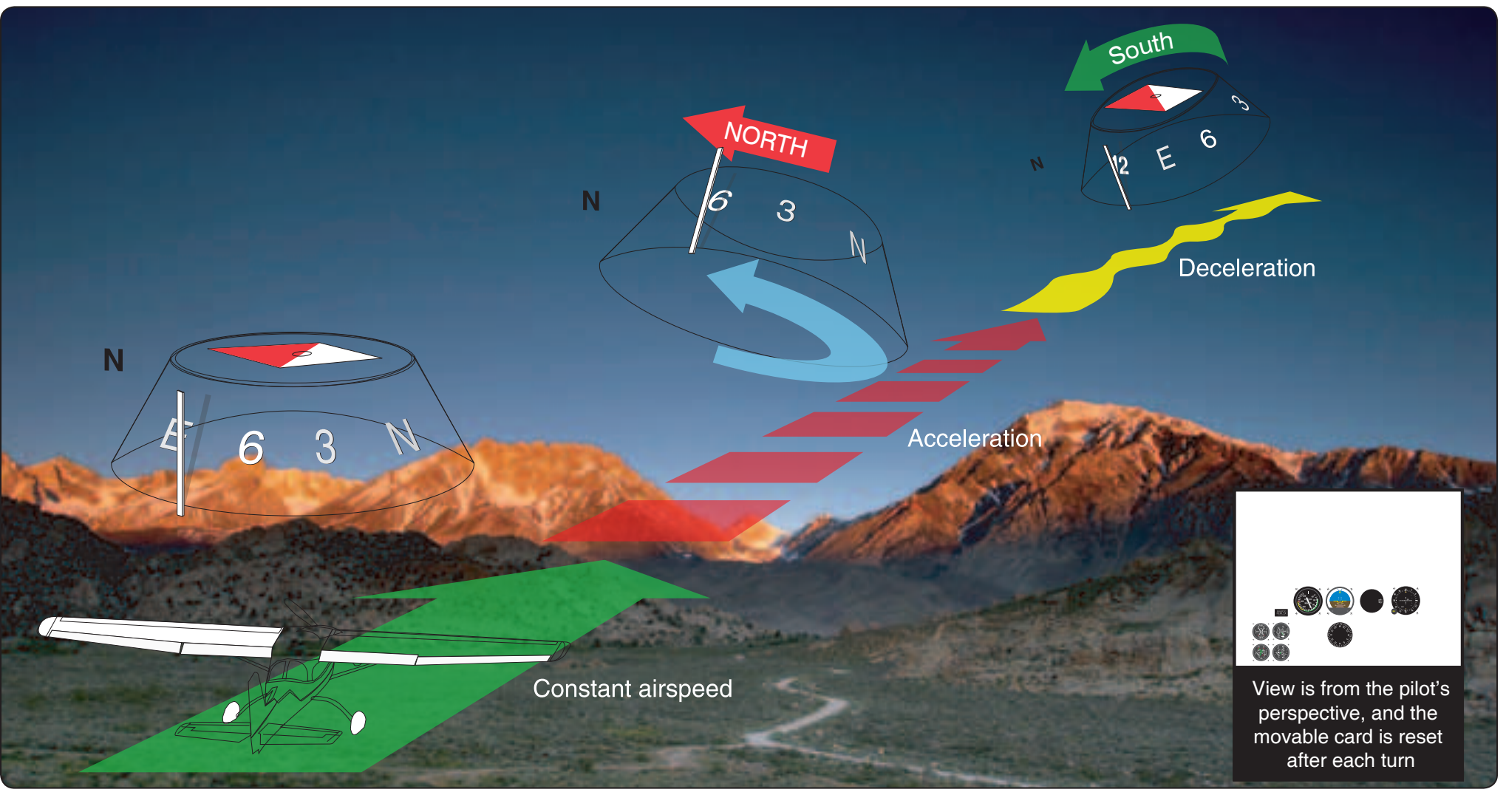
The magnetic dip and the forces of inertia cause magnetic compass errors when accelerating and decelerating on Easterly and westerly headings. Because of the pendulous-type mounting, the aft end of the compass card is tilted upward when accelerating, and downward when decelerating during changes of airspeed. When accelerating on either an easterly or westerly heading, the error appears as a turn indication toward north. When decelerating on either of these headings, the compass indicates a turn toward south. The word "ANDS" (Acceleration-North/Deceleration-South) may help you to remember the acceleration error. [Figure 5-21]
Oscillation Error
Oscillation is a combination of all of the other errors, and it results in the compass card swinging back and forth around the heading being flown. When setting the gyroscopic heading indicator to agree with the magnetic compass, use the average indication between the swings.
The Vertical Card Magnetic Compass
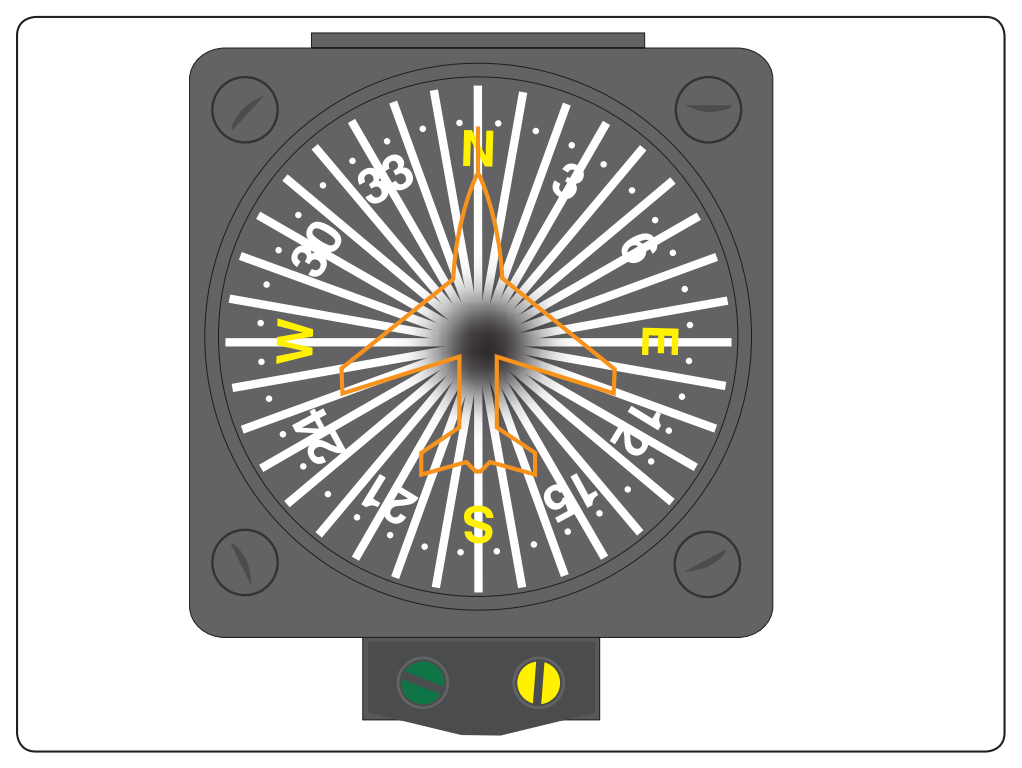
The floating magnet type of compass not only has all the errors just described, but also lends itself to confused reading. It is easy to begin a turn in the wrong direction because its card appears backward. East is on what the pilot would expect to be the west side. The vertical card magnetic compass eliminates some of the errors and confusion. The dial of this compass is graduated with letters representing the cardinal directions, numbers every 30°, and marks every 5°. The dial is rotated by a set of gears from the shaft-mounted magnet, and the nose of the symbolic airplane on the instrument glass represents the lubber line for reading the heading of the aircraft from the dial. Eddy currents induced into an aluminum-damping cup damp oscillation of the magnet. [Figure 5-22]
The Flux Gate Compass System
As mentioned earlier, the lines of flux in the Earth’s magnetic field have two basic characteristics: a magnet aligns with these lines, and an electrical current is induced, or generated, in any wire crossed by them.