Chapter 6
Airplane Attitude Instrument Flying
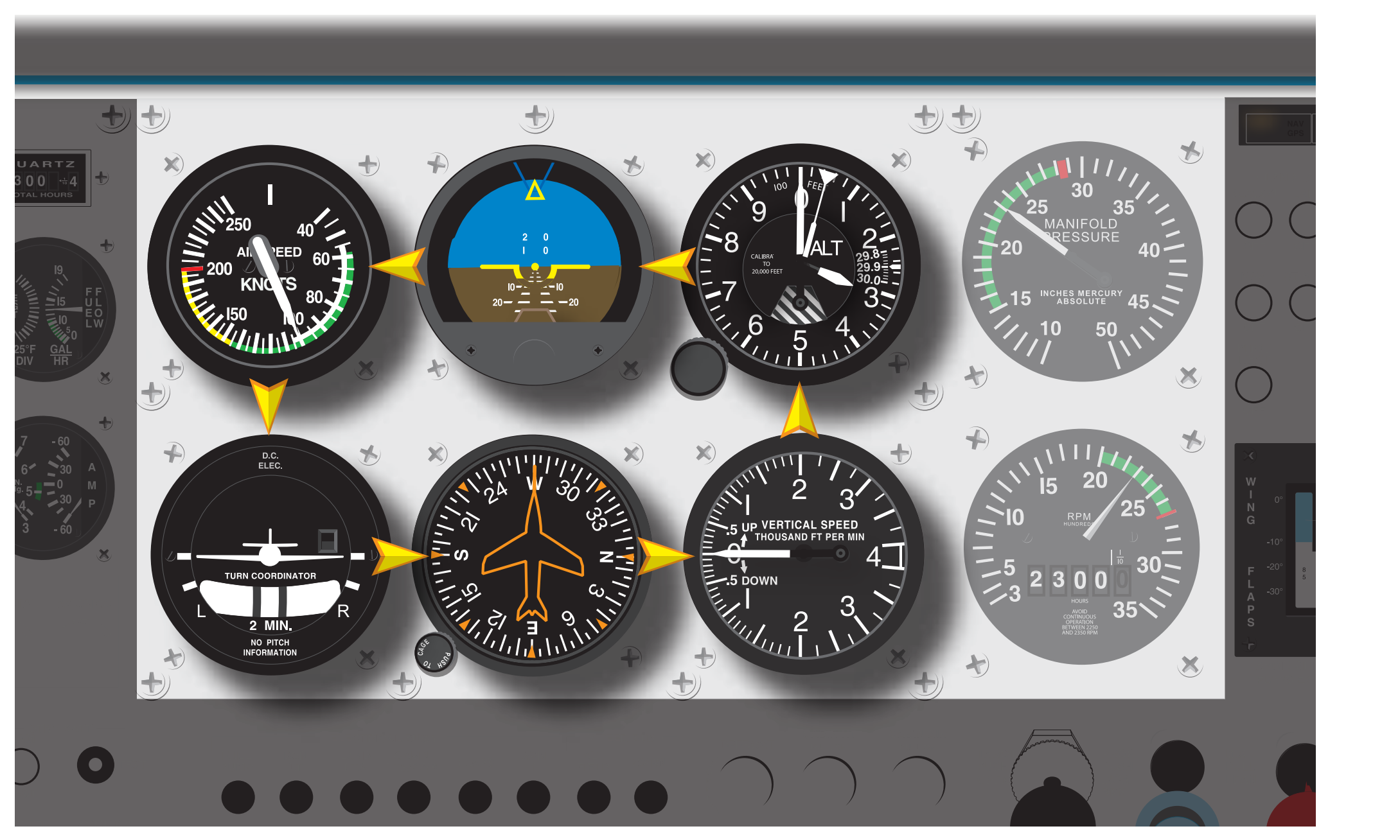
Omission of an instrument from a cross-check is another likely fault. It may be caused by failure to anticipate significant instrument indications following attitude changes. For example, in a roll-out from a 180° steep turn, straight-and-level flight is established with reference only to the attitude indicator, and the pilot neglects to check the heading indicator for constant heading information. Because of precession error, the attitude indicator temporarily shows a slight error, correctable by quick reference to the other flight instruments.
Emphasis on a single instrument, instead of on the combination of instruments necessary for attitude information, is an understandable fault during the initial stages of training. It is a natural tendency to rely on the instrument that is most readily understood, even when it provides erroneous or inadequate information. Reliance on a single instrument is poor technique. For example, a pilot can maintain reasonably close altitude control with the attitude indicator, but cannot hold altitude with precision without including the altimeter in the cross-check.
Instrument Interpretation
The second fundamental skill, instrument interpretation, requires more thorough study and analysis. It begins by understanding each instrument’s construction and operating principles. Then, this knowledge must be applied to the performance of the aircraft being flown, the particular maneuvers to be executed, the cross-check and control techniques applicable to that aircraft, and the flight conditions.
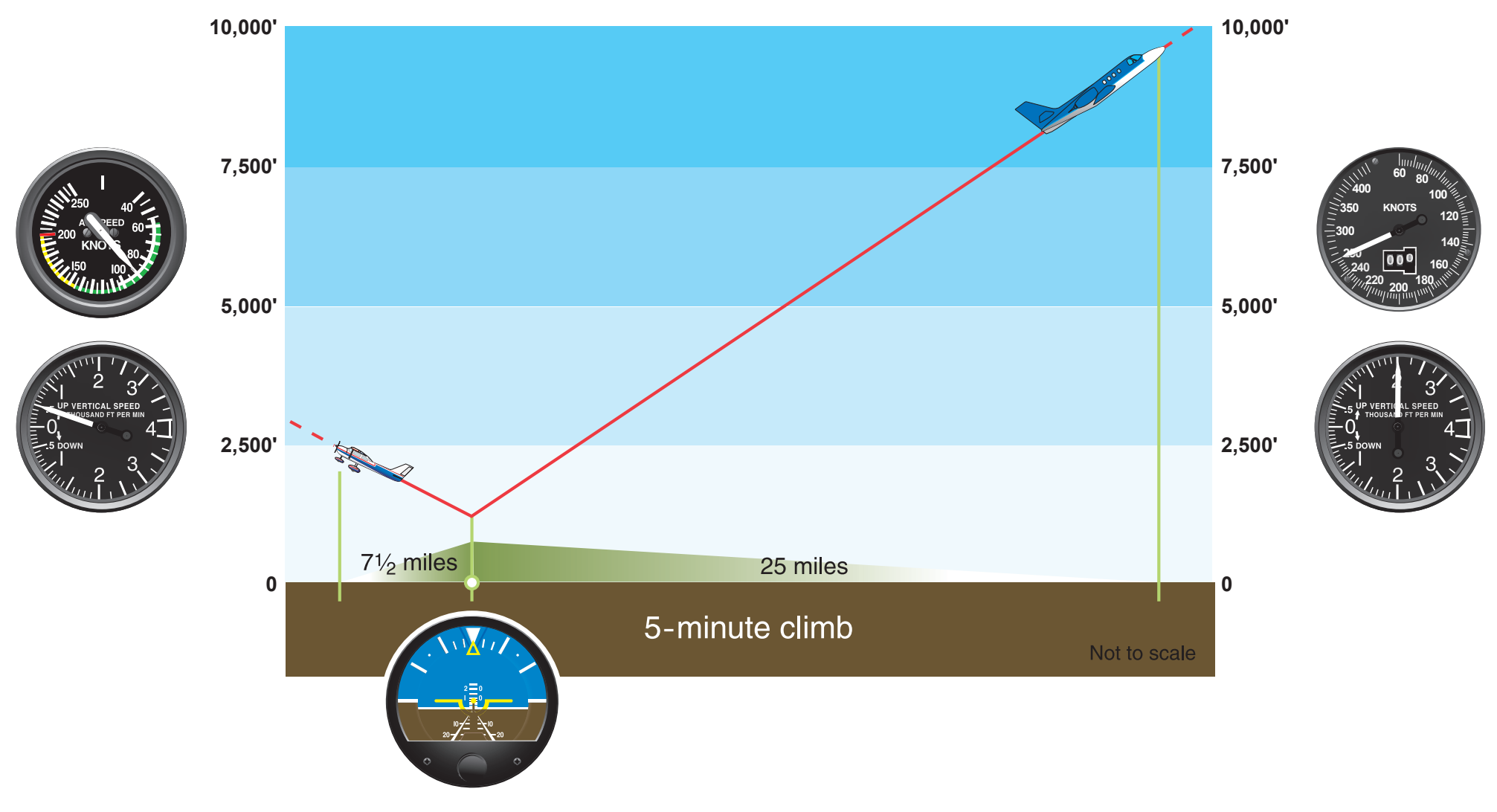
For example, a pilot uses full power in a small airplane for a 5-minute climb from near sea level, and the attitude indicator shows the miniature aircraft two bar widths (twice the thickness of the miniature aircraft wings) above the artificial horizon. [Figure 6-20] The airplane is climbing at 500 fpm as shown on the VSI, and at airspeed of 90 knots, as shown on the airspeed indicator. With the power available in this particular airplane and the attitude selected by the pilot, the performance is shown on the instruments. Now, set up the identical picture on the attitude indicator in a jet airplane. With the same airplane attitude as shown in the first example, the VSI in the jet reads 2,000 fpm and the airspeed indicator reads 250 knots.
As the performance capabilities of the aircraft are learned, a pilot interprets the instrument indications appropriately in terms of the attitude of the aircraft. If the pitch attitude is to be determined, the airspeed indicator, altimeter, VSI, and attitude indicator provide the necessary information. If the bank attitude is to be determined, the heading indicator, turn coordinator, and attitude indicator must be interpreted. For each maneuver, learn what performance to expect and the combination of instruments to be interpreted in order to control aircraft attitude during the maneuver. It is the two fundamental flight skills, instrument cross-check and instrument interpretation, that provide the smooth and seamless control necessary for basic instrument flight as discussed at the beginning of the chapter.
Section II — Electronic Flight Display
Introduction
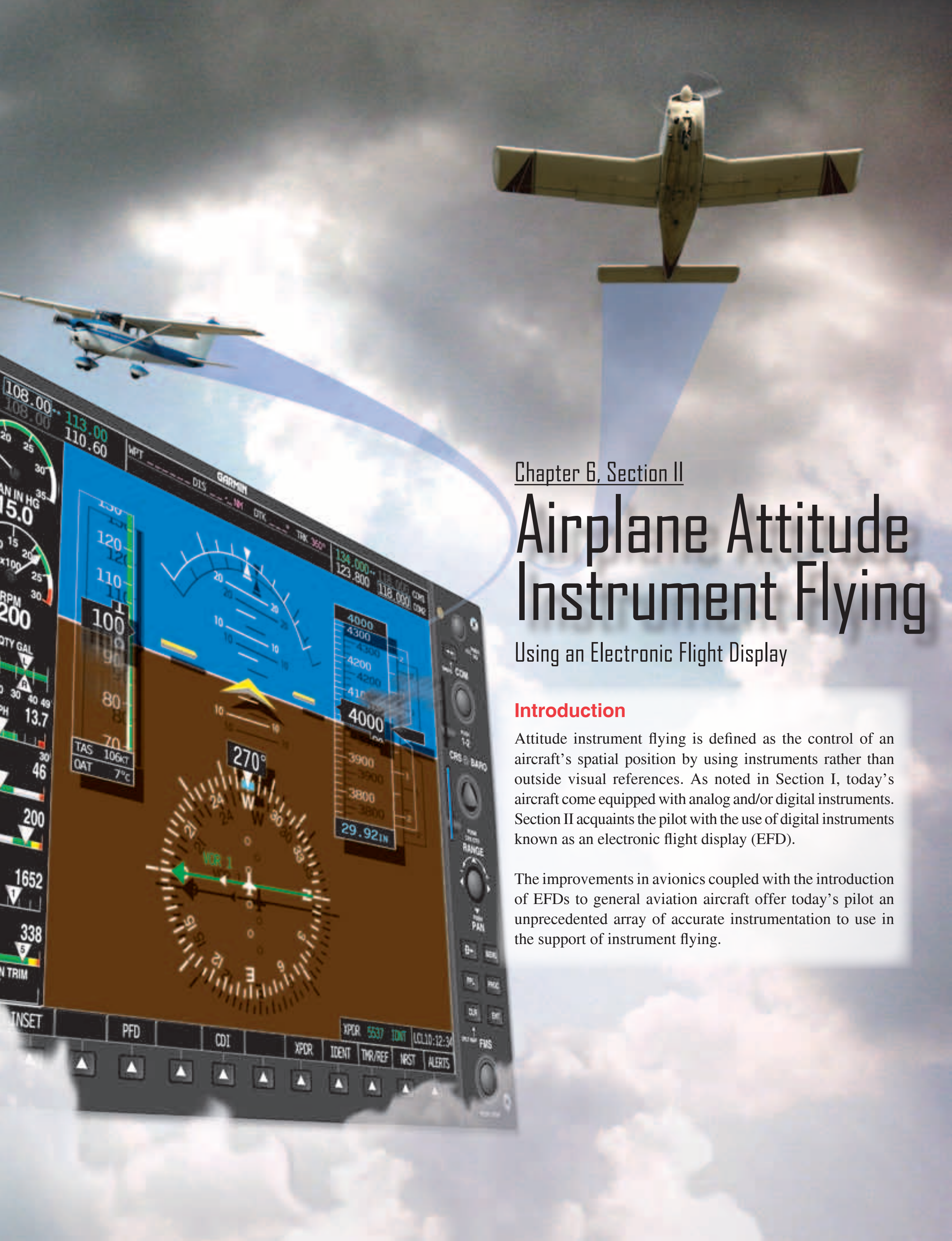
Attitude instrument flying is defined as the control of an aircraft’s spatial position by using instruments rather than outside visual references. As noted in Section I, today’s aircraft come equipped with analog and/or digital instruments. Section II acquaints the pilot with the use of digital instruments known as an electronic flight display (EFD).
The improvements in avionics coupled with the introduction of EFDs to general aviation aircraft offer today’s pilot an unprecedented array of accurate instrumentation to use in the support of instrument flying.
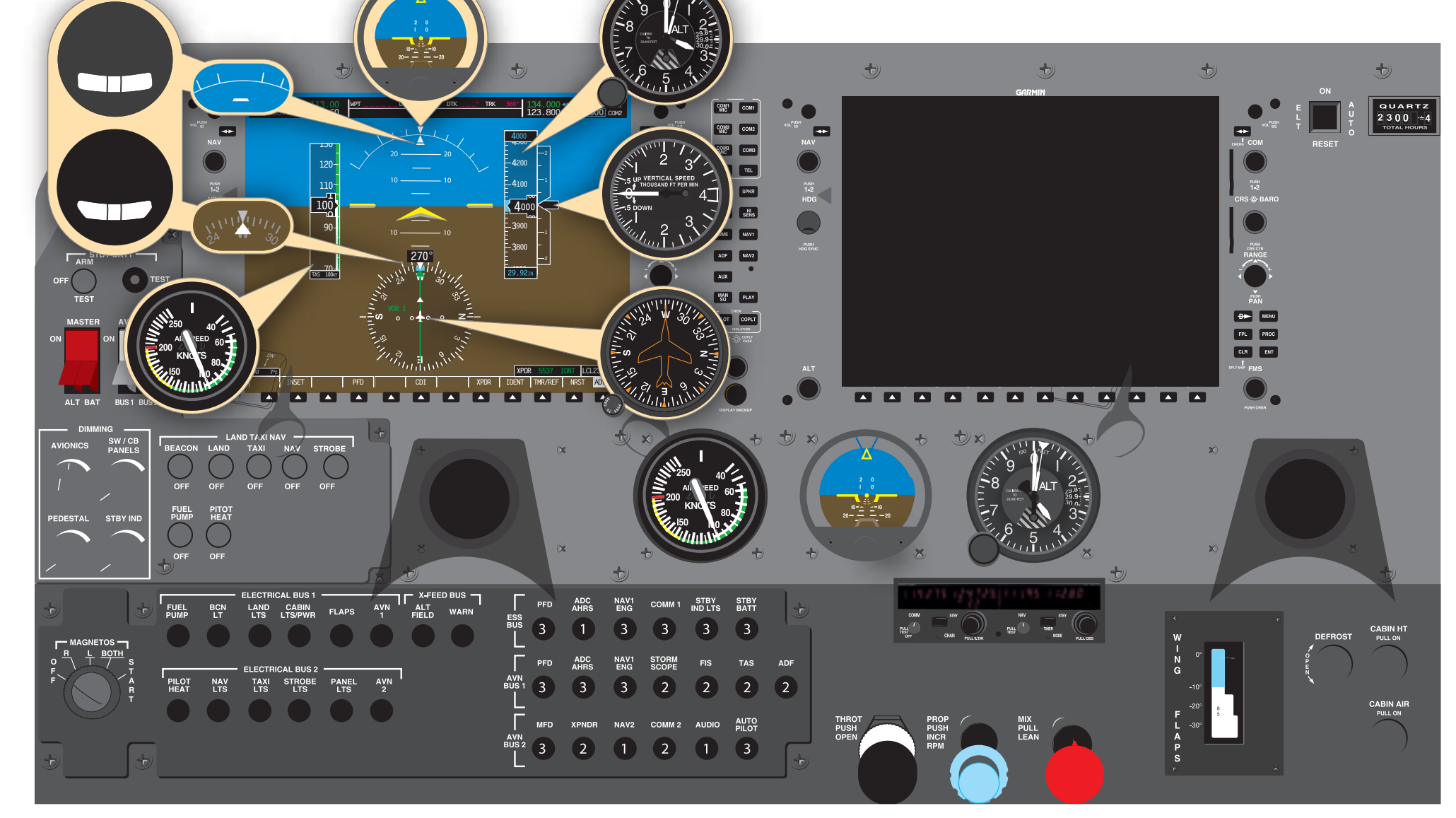
Until recently, most general aviation aircraft were equipped with individual instruments utilized collectively to safely maneuver the aircraft by instrument reference alone. With the release of the EFD system, the conventional instruments have been replaced by multiple liquid crystal display (LCD) screens. The first screen is installed in front of the left seat pilot position and is referred to as the primary flight display (PFD). [Figure 6-21] The second screen is positioned in approximately the center of the instrument panel and is referred to as the multifunction display (MFD). [Figure 6-22] The pilot can use the MFD to display navigation information (moving maps), aircraft systems information (engine monitoring), or should the need arise, a PFD. [Figure 6-23] With just these two screens, aircraft designers have been able to declutter instrument panels while increasing safety. This has been accomplished through the utilization of solid-state instruments that have a failure rate far lower than those of conventional analog instrumentation.
However, in the event of electrical failure, the pilot still has emergency instruments as a backup. These instruments either do not require electrical power, or as in the case of many attitude indicators, they are battery equipped. [Figure 6-24]
Pilots flying under visual flight rules (VFR) maneuver their aircraft by reference to the natural horizon, utilizing specific reference points on the aircraft. In order to operate the aircraft in other than VFR weather, with no visual reference to the natural horizon, pilots need to develop additional skills. These skills come from the ability to maneuver the aircraft by reference to flight instruments alone. These flight instruments replicate all the same key elements that a VFR pilot utilizes during a normal flight. The natural horizon is replicated on the attitude indicator by the artificial horizon.
Understanding how each flight instrument operates and what role it plays in controlling the attitude of the aircraft is fundamental in learning attitude instrument flying. When the pilot understands how all the instruments are used in establishing and maintaining a desired aircraft attitude, the pilot is better prepared to control the aircraft should one or more key instruments fail or if the pilot should enter instrument flight conditions.
Learning Methods
There are two basic methods utilized for learning attitude instrument flying. They are “control and performance” and “primary and supporting.” These methods rely on the same flight instruments and require the pilot to make the same adjustments to the flight and power controls to control aircraft attitude. The main difference between the two methods is the importance that is placed on the attitude indicator and the interpretation of the other flight instruments.