
Chapter 6
Airplane Attitude Instrument Flying
Trim
Another important step in attitude instrument flying is trimming the aircraft. Trim is utilized to eliminate the need to apply force to the control yoke in order to maintain the desired attitude. When the aircraft is trimmed appropriately, the pilot is able to relax pressure on the control yoke and momentarily divert attention to another task at hand without deviating from the desired attitude. Trimming the aircraft is very important, and poor trim is one of the most common errors instructors note in instrument students.
Cross-Check
Once the initial attitude changes have been made, the pilot should verify the performance of the aircraft. Cross-checking the control and performance instruments requires the pilot to visually scan the instruments, as well as interpret the indications. All the instruments must be utilized collectively in order to develop a full understanding of the aircraft attitude. During the cross-check, the pilot needs to determine the magnitude of any deviations and determine how much of a change is required. All changes are then made based on the control instrument indications.
Adjust
The final step in the process is adjusting for any deviations that have been noted during the cross-check. Adjustments should be made in small increments. The attitude indicator and the power instruments are graduated in small increments to allow for precise changes to be made. The pitch should be made in reference to bar widths on the miniature airplane. The bank angle can be changed in reference to the roll scale and the power can be adjusted in reference to the tachometer, manifold pressure gauge, etc.
By utilizing these four steps, pilots can better manage the attitude of their aircraft. One common error associated with this process is making a larger than necessary change when a deviation is noted. Pilots need to become familiar with the aircraft and learn how great a change in attitude is needed to produce the desired performance.
Applying the Four-Step Process
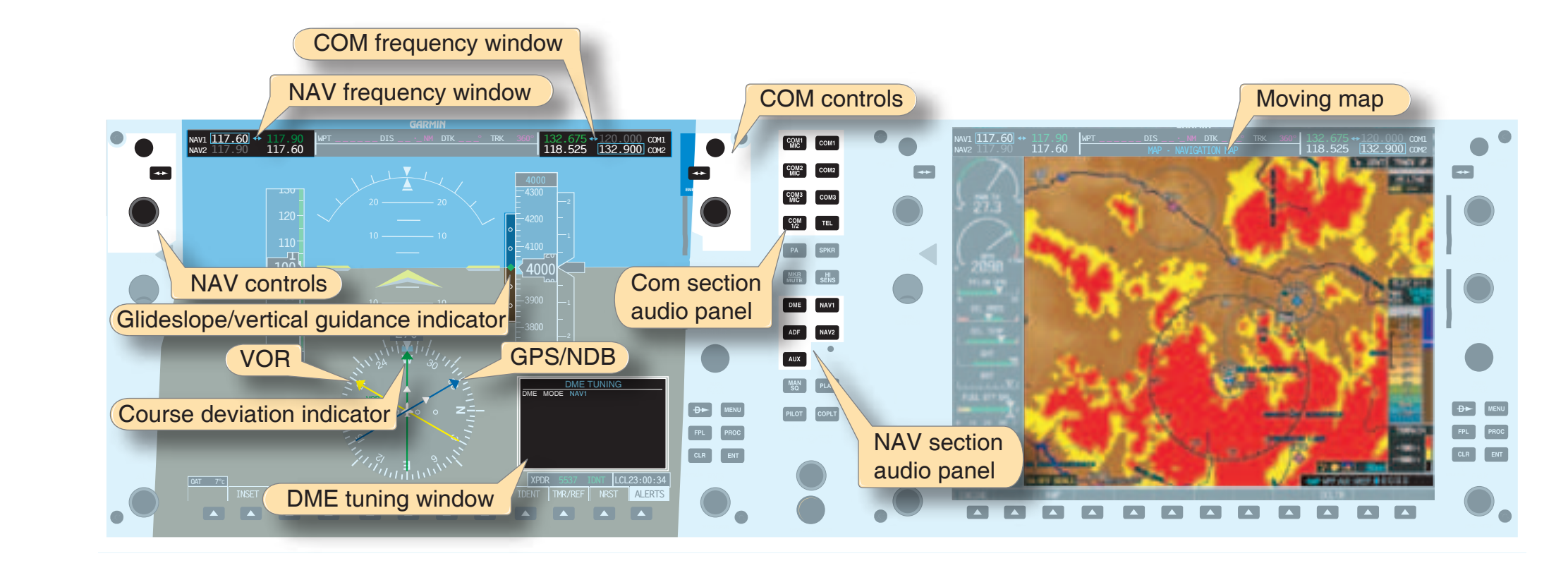
In attitude instrument flight, the four-step process is used to control pitch attitude, bank attitude, and power application of the aircraft. The EFD displays indications precisely enough that a pilot can apply control more accurately.
Pitch Control
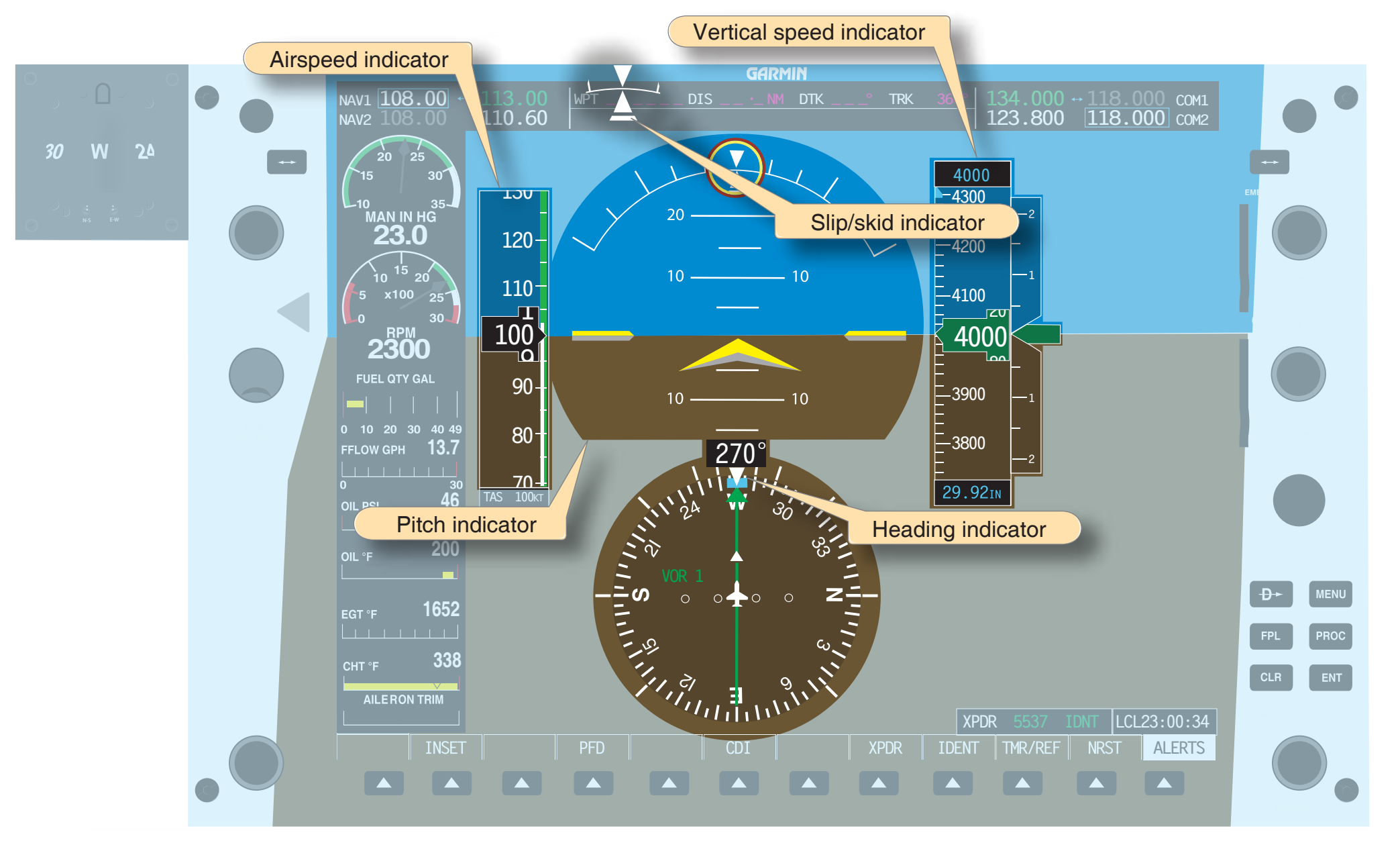
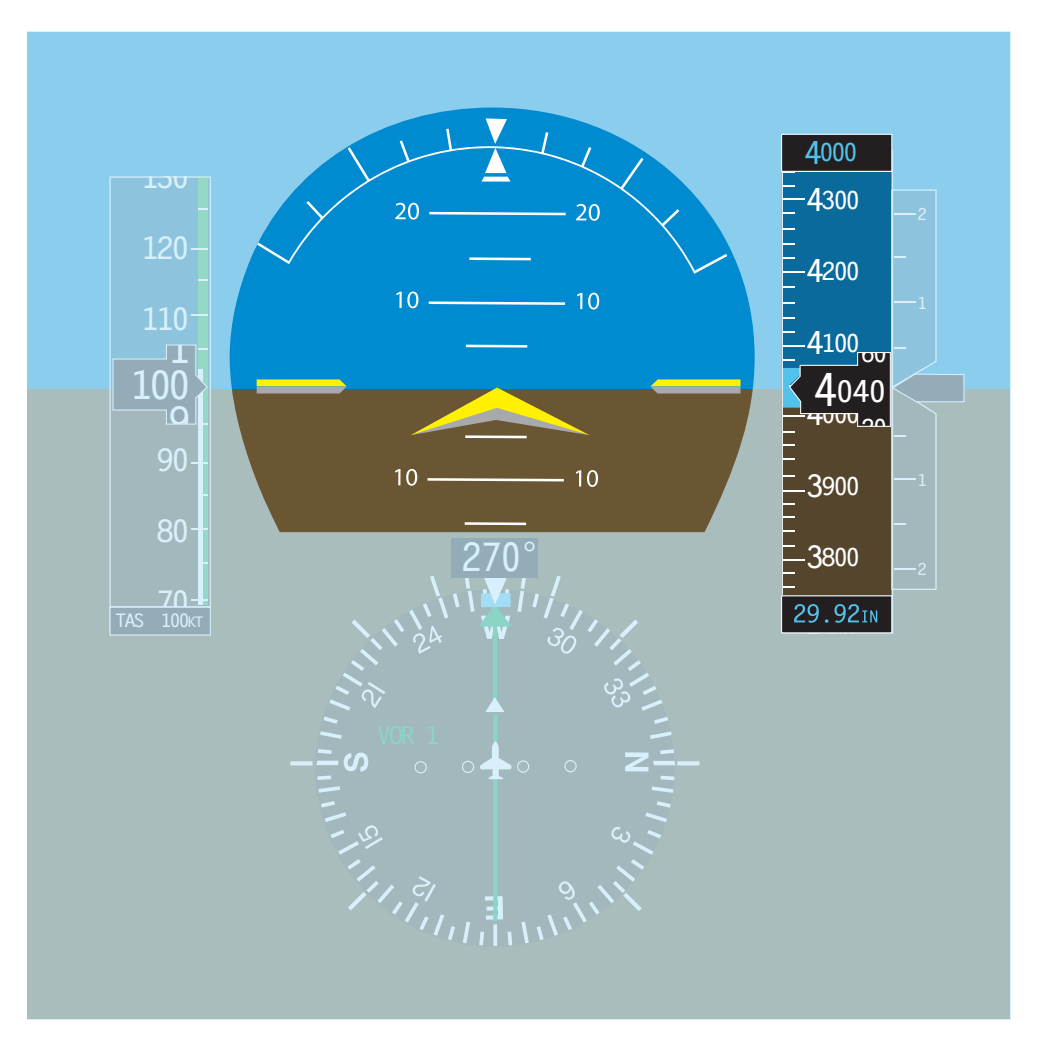
The pitch control is indicated on the attitude indicator,which spans the full width of the PFD. Due to the increased size of the display, minute changes in pitch can be made and corrected. The pitch scale on the attitude indicator is graduated in 5-degree increments that allow the pilot to make corrections with precision to approximately ⁄ degree. The miniature airplane utilized to represent the aircraft in conventional attitude indicators is replaced in glass panel displays by a yellow chevron. [Figure 6-28] Representing the nose of the aircraft, the point of the chevron affords the pilot a much more precise indication of the degree of pitch and allows the pilot to make small, precise changes should the desired aircraft performance change. When the desired performance is not being achieved, precise pitch changes should be made by referencing the point of the yellow chevron.
Bank Control
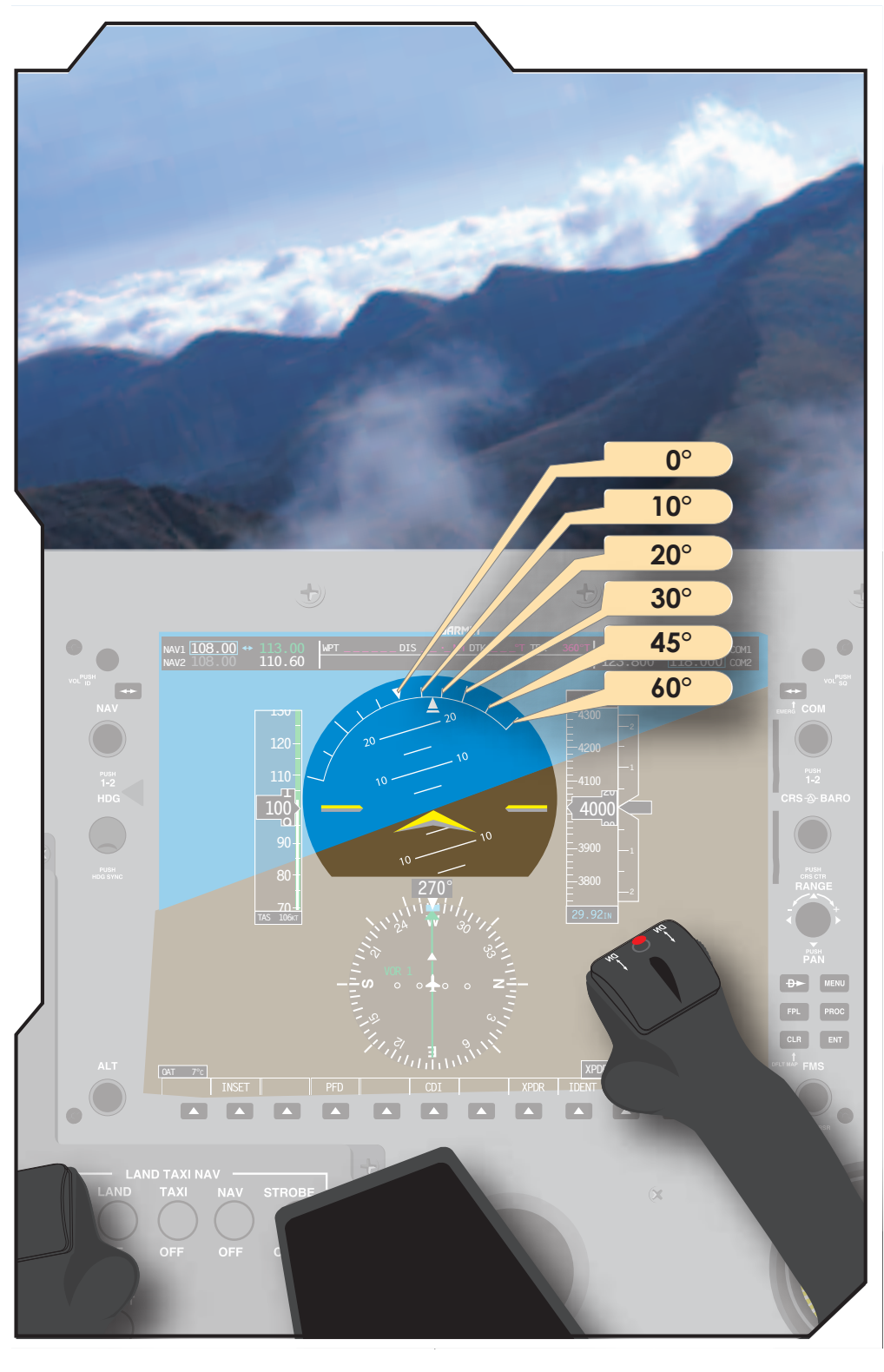
Precise bank control can be developed utilizing the roll pointer in conjunction with the roll index displayed on the attitude indicator. The roll index is sectioned by hash marks at 0°, 10°, 20°, 30°, 45°, 60° and the horizon line, which depicts 90° of bank. [Figure 6-29] The addition of the 45° hash mark is an improvement over conventional attitude indicators.
In addition to the roll index, the instrument pilot utilizes the turn rate indicator to maintain the aircraft in a standard rate turn (3° per second). Most instrument maneuvers can be done comfortably, safely, and efficiently by utilizing a standard rate turn.
Power Control
The power instruments indicate how much power is being generated by the engine. They are not affected by turbulence, improper trim, or control pressures. All changes in power should be made with reference to power instruments and cross-checked on performance instruments.